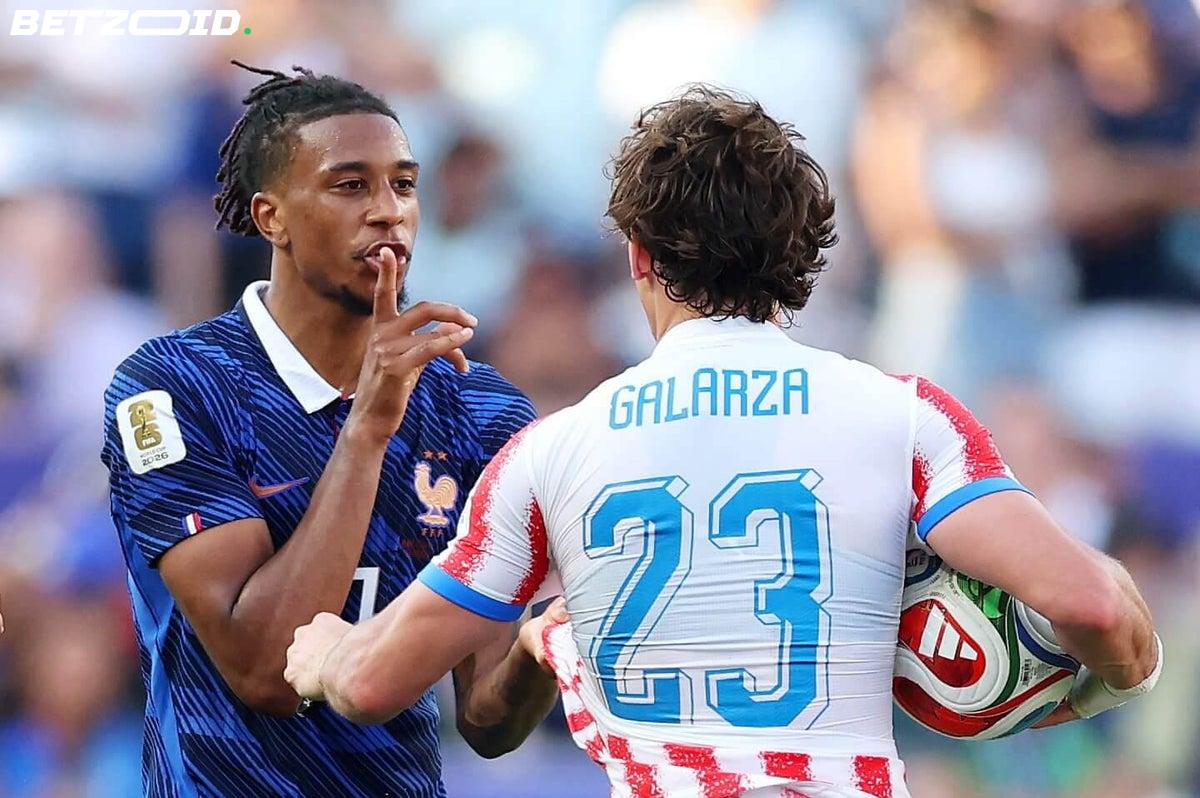
France have formally appealed to FIFA to overturn Michael Olise's yellow card from Saturday's last-16 win over Paraguay — and given the context, they have a case.
Olise was booked after an altercation with Matias Galarza, who went to ground clutching his face. Replays showed the Bayern Munich forward had grabbed his shirt. That's it. A simulation that worked in the moment, caught cold by the cameras, and now France are the ones left scrambling to fix it.
What's actually at stake
The booking isn't just a footnote. Olise is one card away from a suspension — meaning a yellow in Thursday's quarter-final against Morocco in Foxborough would rule him out of a potential semi-final against Spain or Portugal. That's not a minor inconvenience. He's been one of the most dangerous players in the tournament.
The French Football Federation has been clear that their appeal stands on its own merits and isn't a direct reaction to the Folarin Balogun situation — though it's impossible to read it in isolation. FIFA recently suspended Balogun's one-match ban for a year under Article 27 of their disciplinary code after pressure involving U.S. President Donald Trump, government officials, and a legal team. The American striker, sent off against Bosnia and Herzegovina, is now free to face Belgium on Monday.
UEFA did not hold back. Their statement called the Balogun decision "unprecedented, incomprehensible and unjustifiable" and said it "crossed a red line" with the integrity of the game at stake. The Royal Belgian Football Association has also appealed it.
FIFA's credibility problem
The governing body is now in a corner of its own making. If they reverse Balogun's ban under political pressure and then refuse France's appeal — one grounded in a clear case of simulation — the inconsistency will be impossible to defend. Anyone pricing up quarter-final or semi-final markets should factor in genuine uncertainty about who actually takes the pitch.
FIFA has been approached for comment. So far, nothing.