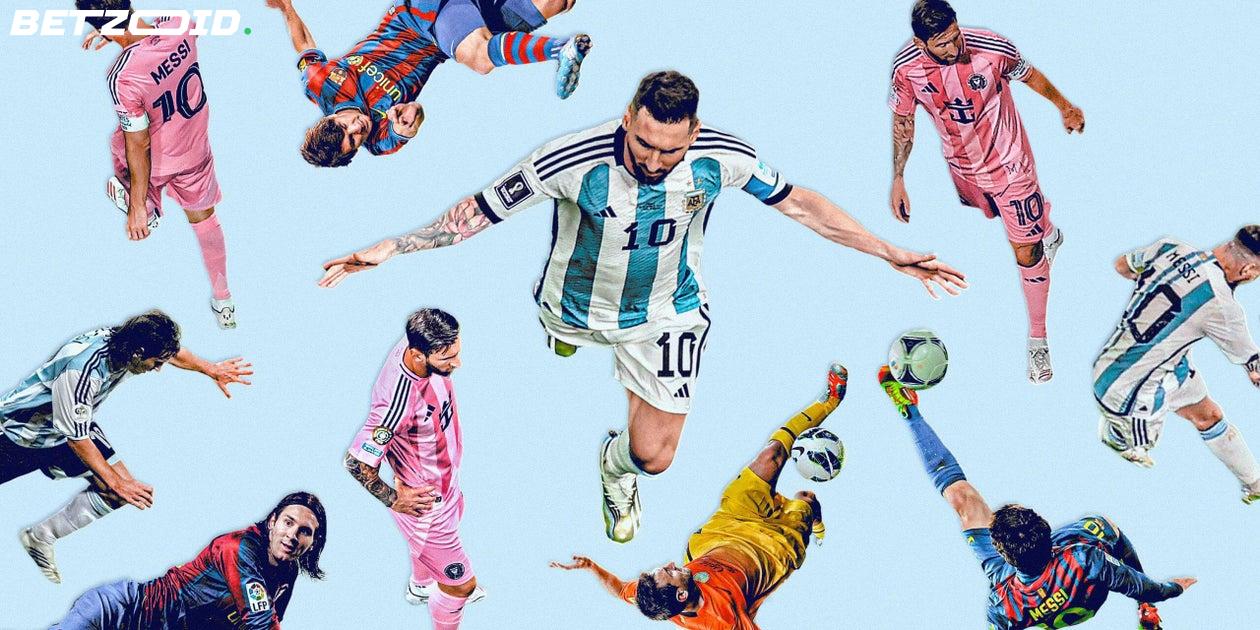
"I would love to see each one of you defending against Messi." Jerome Boateng typed that during a Covid lockdown Twitter Q&A, after the internet had spent years replaying the moment Messi turned him into furniture. He wasn't wrong to be defensive about it. Nobody had an answer either.
The Athletic spent months collecting testimonies from players who shared a pitch with Messi across two decades. Goalkeepers, centre-backs, defensive midfielders, full-backs. Different eras, different tactics, same conclusion: nothing worked. Not tactical solutions, not physical ones, not fouling him. Not even fouling him.
The Walking Man Who Destroyed Defences
Raphael Varane played against Messi 21 times. His description of what made it uniquely maddening has nothing to do with pace or dribbling — it's about where Messi stood when he didn't have the ball.
"Messi's speciality was walking in areas where you don't know who should defend him," Varane explains. "Is it the midfielder? Is it the full-back? Is it the central defender? You get the impression that he's walking, so you defend less. But it's the opposite."
William Gallas saw the same trap from a different angle. Facing an 18-year-old Messi before a Champions League tie with Barcelona in 2006, France called him asking how he planned to stop him. "I don't know," Gallas told them. He spent the day before watching clips. It didn't help. Years later, reflecting on a 2009 international friendly when Messi was even better, Gallas described him like this: "It was like he was in the Matrix. He saw things before everyone else."
That's not hyperbole dressed up as analysis. Professor David Sumpter, a mathematician who worked with Barcelona during Messi's time there, found that Messi and his teammates were locating pockets of space that didn't yet exist — spaces that wouldn't open for another two or three seconds. "With Messi, it seemed almost like he could see 10 minutes into the future," Sumpter said. "Early in the match, he would map out where those spaces were likely to occur, then make sure he found them as the game went on."
Pablo Hernandez, who faced him in La Liga, put it more simply: "He thinks two seconds before anyone else."
What the Goalkeeper Saw
Gorka Iraizoz faced Messi 27 times as Athletic Club's goalkeeper. He conceded 18 goals. His breakdown of why Messi was so hard to stop in front of goal is clinical — and slightly painful to read.
"You had the feeling that you had covered the space, that you knew what was going to happen — and suddenly he did something else," Iraizoz says. "His physique helped him hide the ball until the last moment, without much leg swing, without giving any clue about where he was going to shoot. He could wait, then open his body with a subtle touch to the far post or add power to the near post."
The minimal backlift is the key detail. Most shooters telegraph their intentions through leg swing and body shape. Messi's shots arrive before defenders or goalkeepers have processed the visual information that normally triggers a dive. By the time you react, the ball is already in.
In a Copa del Rey final against Athletic, Valverde assigned left-back Mikel Balenziaga to man-mark Messi — one of the few approaches that has occasionally, briefly, worked against him. It lasted 20 minutes before Messi beat Balenziaga twice, then three more Athletic players, during a single dribble. Xabier Etxeita, trying to block the shot, positioned himself for the far post. Messi went near post at the last second. "It left us all with that feeling that we had done everything a football team could do," Etxeita said. "Even still, we were unable to."
Carlos Sanchez, the Colombia midfielder, is one of the few who can claim to have successfully shackled Messi — in a 2011 Copa America match that finished goalless. His description of the job sounds exhausting. "He requires constant, relentless attention. In half a second, he can make something happen, and everything I've done would mean nothing." Shackling the best player in the world and keeping a clean sheet. Described like babysitting at the edge of a pool.
The Messi of 2022 Was a Different Problem
At the 2022 World Cup, Messi was 35, walking more than he was running, and still the most dangerous player in Qatar. Rene Meulensteen was Australia's assistant coach when they faced Argentina in the last 16, and his tactical breakdown of how they approached a walking Messi is fascinating.
"We knew because of him we could play out from the back," he says. "We had Aaron Mooy always coming into the back of Messi. We knew he wouldn't defend. We had build-up strategies to find whoever was in behind him." It worked — until it didn't. One moment of hesitation from the goalkeeper, a second ball lost, and Argentina punished them. The recipe was right. The execution cracked.
Messi's semi-final against Croatia illustrated what remained of the old version. At 35, against Josko Gvardiol — 15 years younger, six inches taller — Messi stop-started him, faked one way, went the other, and manufactured space where none existed to set up Julian Alvarez. Anatomically, as sprint coach Jonas Dodoo noted, "he is built to change direction. He has a long body and short legs — designed for agility."
Tristan Muyumba, who has faced Messi multiple times since he joined MLS with Inter Miami, adds a detail that gets overlooked in the tactical breakdowns. "He'll flash you a little smile or slap your hand. He doesn't seem to have a lofty opinion of himself. There seems to be a kindness to him."
Ivan Ergic, who faced Messi on three occasions — first when an 18-year-old came off the bench at the 2006 World Cup and scored within minutes — later became a writer and playwright. He describes Messi as having "preserved the culture of the dribbler" at a time when coaches were coaching it out of the game. "Dribbling is a dying art," Ergic says. "I consider it almost Messi's greatest achievement that he stubbornly brought that skill back into football."
Andres Guardado had 20 photos of himself with Messi on the pitch. "I do not have the ball in any of them," the Mexican said. Ashley Cole, one of the best attacking left-backs of his generation, clings to one statistic from his time facing him: "I live on the fact that he never scored against a team I was playing in."
That's what it comes to. The ones who stopped him cite it like a survival story. The ones who didn't — the majority — mostly just describe being astonished, even from the other side of the argument. Jozo Simunovic, the Celtic centre-back, remembered looking around during a game against Barcelona and noticing Messi staring at him every time he turned. Not at the ball. At him. Mapping his position. Clocking where he could be hurt. "It was so weird," Simunovic said. Now he understands it. Didn't make it any less unsettling at the time.