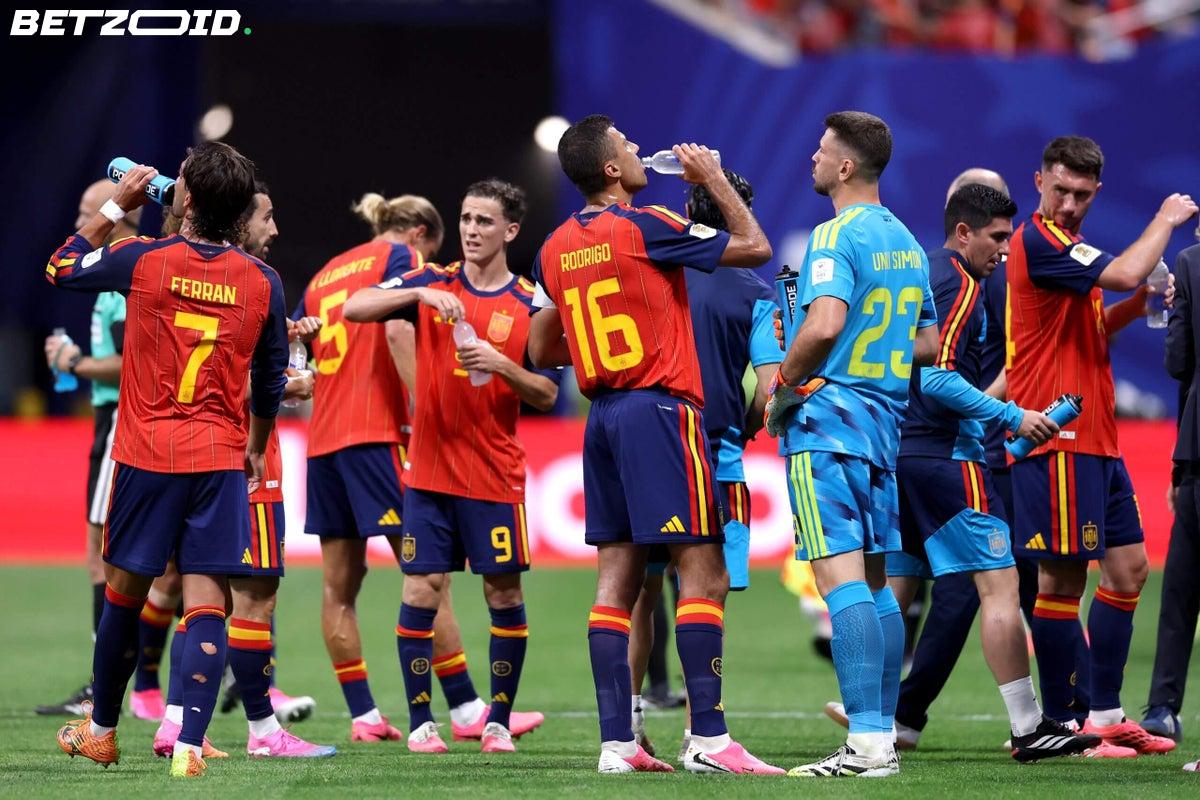
"It's not for the welfare of the players. It's about advertising and making money." Former West Ham captain Nigel Reo-Coker said it plainly on CBS Sports Golazo, and however blunt, it's hard to argue with him.
FIFA's mandatory three-minute hydration breaks — introduced at this summer's World Cup in every single match, regardless of temperature or conditions — have officially been sold as a player welfare initiative. The reality is considerably more commercial.
Fox Sports in the US cut to adverts from the opening game, with commentator Ian Darke informing viewers the break was "powered to you by Powerade" — an official FIFA sponsor. Australia's SBS has McDonald's branding their breaks as the "Maccas Match Break." Spain, Italy, France, Canada, Mexico, Ireland — broadcasters across the world have been monetising those three minutes. A 30-second slot during a US match costs advertisers around $750,000, according to the Wall Street Journal. For early-stage games not involving the USMNT, it's still roughly $200,000.
What players and coaches actually think
Virgil van Dijk didn't hide his frustration after the Netherlands' 2-2 draw with Japan. "Every time going to a commercial, it's a bit, not really that I like it," he said. "I think you have to look at it in every game separately." Mauricio Pochettino was more direct: "I don't like it. I only like it when the conditions are extreme."
The sporting impact isn't trivial either. When Curacao equalised against Germany just before a hydration break, the momentum reset — Germany came back out, found their rhythm, and won 7-1. Whether that's correlation or causation is debatable. What isn't: scheduled stoppages change how matches breathe.
Media analyst Paolo Pescatore put it well: "Two things can be true at once — it can support player welfare and create another revenue opportunity." That's a fair framing. But the tell is FIFA making these breaks standard in every game. If this were purely about welfare, breaks would be triggered by conditions, not by the broadcast schedule.
Are these breaks becoming permanent?
Almost certainly. Pescatore's view: "Once a measure can be justified on welfare grounds and also creates commercial value, it quickly becomes part of the playbook. I would be very surprised if they disappeared."
That's the commercial logic at work. FIFA benefits indirectly because the additional advertising inventory makes future TV rights packages more valuable. Broadcasters get two extra premium windows per match. Advertisers get a captive global audience that isn't going anywhere mid-game.
A handful of broadcasters have resisted — the BBC and ITV in the UK haven't shown ads, partly due to OFCOM advertising limits. Brazil's Globo has held the line. ITV used one break for Emma Hayes to deliver 70 seconds of tactical analysis during Spain vs Cape Verde — actually compelling television. But those are the exceptions.
Alexi Lalas, predictably given his employer, is a fan: "There will be a generation whose version of the beautiful game includes quarters." That might be the most revealing thing anyone has said about this whole situation. Not a defence of player welfare. A vision of what football becomes when broadcast revenue fully shapes the sport's structure.
Fans will tolerate heat breaks in 38-degree conditions. They'll be less forgiving when the thermometer reads 22 and the game just stopped so someone could sell them a beer.