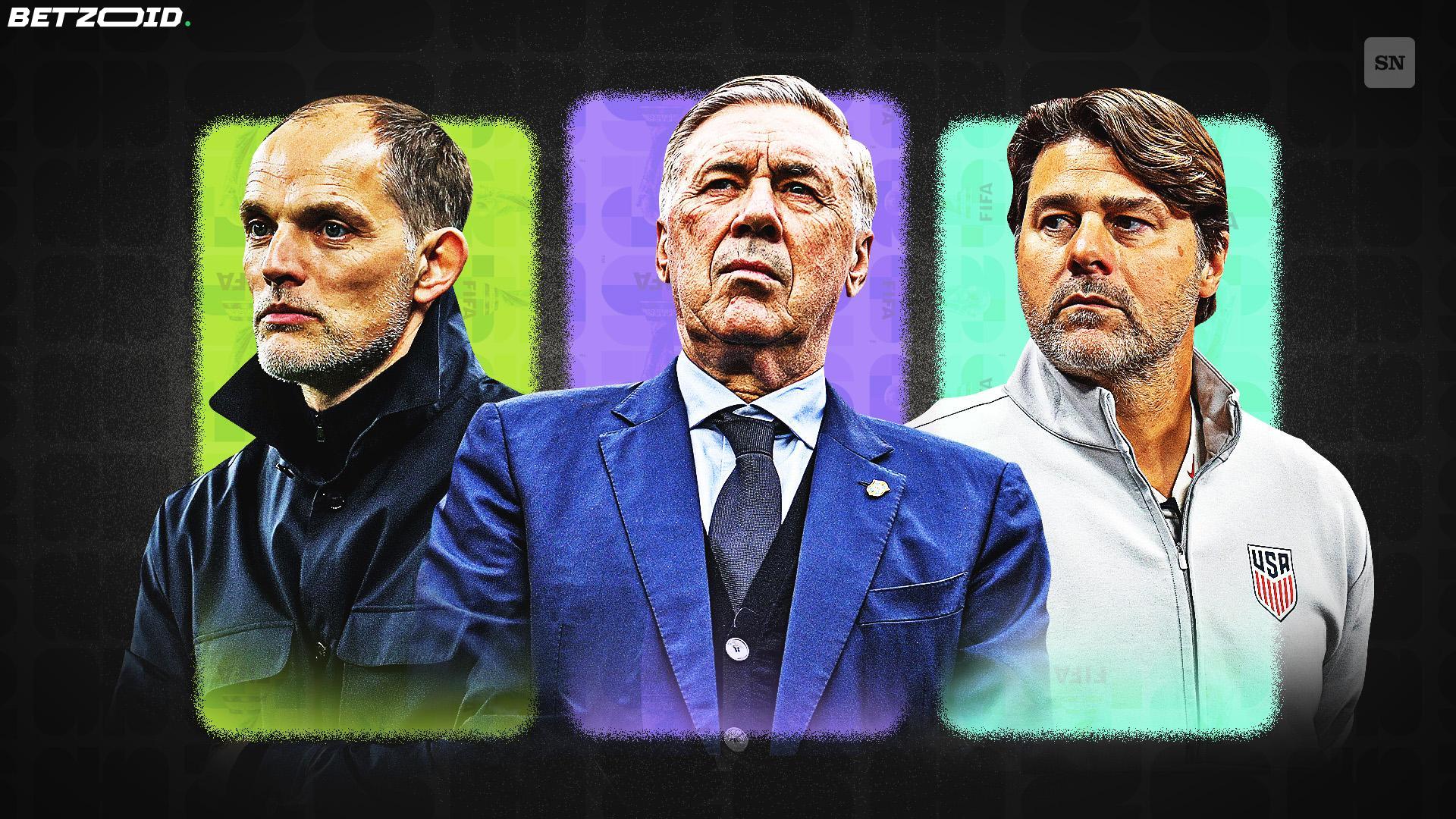
No foreign head coach has ever won the World Cup. Not one. In nearly 100 years of the tournament, every single winner has been managed by one of their own. And yet at the 2026 edition, 26 of 48 teams — including the United States, Brazil, England, and Canada — will be led by someone who wasn't born in the country they're coaching.
That's the backdrop. Make of it what you will.
The precedent problem for Brazil and England
Brazil under Carlo Ancelotti is the headline act. The Italian has won five Champions Leagues and six league titles across AC Milan, Chelsea, PSG, Real Madrid, and Bayern Munich. No argument there. But Brazil hiring a European to lead their national team for the first time — a country that won all five of its World Cups with Brazilian coaches — is not a minor footnote. It's a philosophical rupture.
"I do find it all incredibly damning that Brazil is incapable of producing top managers," said David Mosse, a Brazil-born researcher and Fox Sports writer. "There are people in Brazil firmly against it, and even the people who are OK with it — it's kind of sad that this is the best route to go if we're going to win a World Cup."
England's situation has a longer history. Sven-Goran Eriksson took them to two World Cups with consecutive quarterfinal exits. Fabio Capello replaced him and went out in the round of 16 in 2010 — finishing second in a group the U.S. topped. Then came Gareth Southgate, an Englishman, who took them to a World Cup semi-final, two consecutive European Championship finals, and a quarter-final. His reward was being replaced by German Thomas Tuchel after the 2024 Euros.
To Tuchel's credit, England have gone 10-2-1 since he took over in January 2025, including winning all eight qualifiers. Warren Barton, a former England international now with Fox Sports, is pragmatic: "I haven't got a problem with it. They could be from Timbuktu, if they can get it over the line." There's something to that argument — but England also went unbeaten under McClaren before the wheels fell off, and results in qualifying rarely reflect how a team handles genuine tournament pressure.
The betting market on England winning the World Cup will be partly a bet on Tuchel keeping his cool when an England squad notoriously does not.
The USMNT's foreign coach dependency
Mauricio Pochettino took over the USMNT after Copa America 2024 ended in embarrassment. The logic was familiar: American coaches lack the big-game credibility, so bring in a big name from abroad. Pochettino's PSG and Tottenham pedigree checked those boxes.
His approach has been markedly different from predecessor Gregg Berhalter — more rotation, more formation experimentation, less emphasis on a fixed identity. A 5-1 win over Uruguay with a three-man backline last autumn looked promising. A switch back to two centre-backs in March did not. Pochettino arrives at his first World Cup having not yet settled on a clear system.
The broader question for U.S. soccer isn't really Pochettino versus an American coach. It's what success or failure here signals about the pipeline.
"There will always be a group of American soccer fans who don't think Americans can do soccer but still want our national team to be excellent," said Jason Davis of SiriusXM. "That's a problem. There's a large group of people with an inferiority complex... I think that's, frankly, nonsense."
He's right that the inferiority complex is real. Whether it's justified is what the next few weeks will go a long way toward answering — or not answering at all, depending on how much you trust tournament football to settle philosophical debates.
The historical numbers aren't encouraging for the foreign contingent: of the last 20 semi-finalists across five World Cups, only two were managed by foreign coaches. Zero have won the whole thing. If Ancelotti, Tuchel, or Pochettino lifts the trophy in July, they'll be the first. History says that's unlikely. But someone has to be first eventually — the question is whether 2026 is actually that moment or just another data point for the other side of the argument.