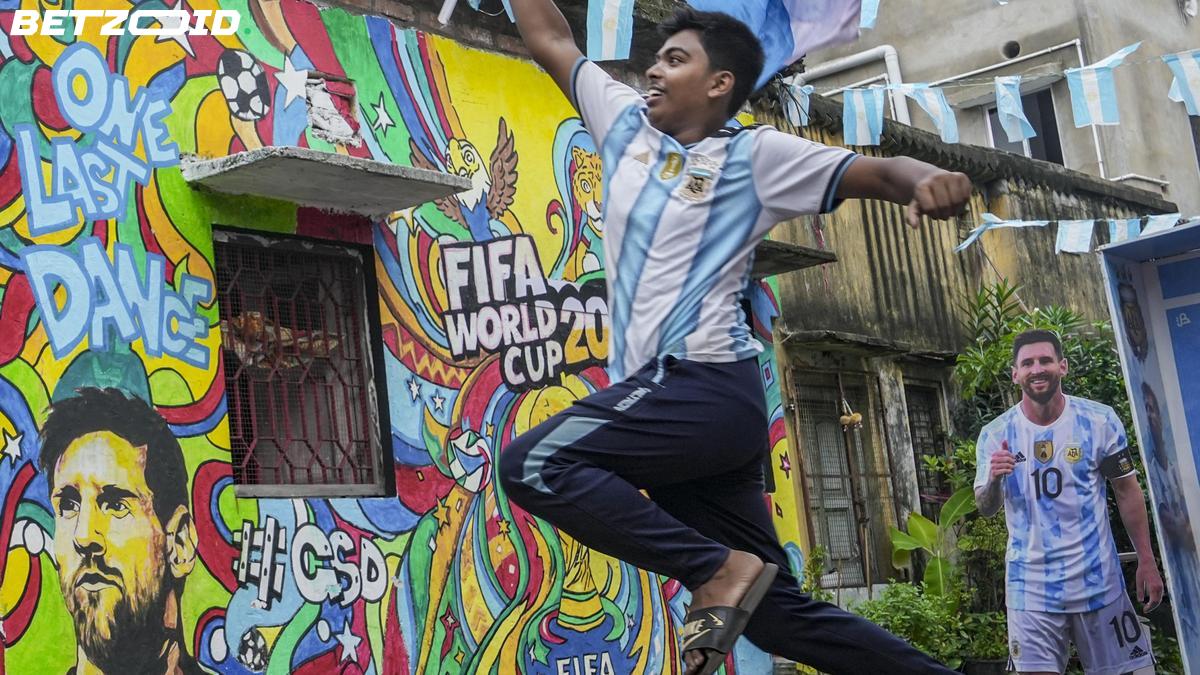
"They are surprised," Lionel Scaloni said of his players. "Thrilled that a country on the other end of the world supports us, loves us and feels proud wearing our blue-and-white stripes." If you were inside the Mercedes-Benz Stadium on Wednesday night, you understood exactly what he meant.
As Argentina overturned England to reach the 2026 World Cup final, the songs bouncing around Atlanta's stadium didn't just belong to fans who'd flown in from Buenos Aires. They came from Kolkata, Dhaka, Kochi, Varanasi. Voices shaped by Bengali and Hindi and Malayalam, all singing for Messi.
Four decades in the making
This isn't a 2022 Qatar phenomenon that lingered. It goes back to Mexico 1986, when Diego Maradona dribbled through England and made half the world forget their own nationality. Television was still a novelty across much of India. Millions watched a No. 10 in a sky-blue shirt dismantle the most powerful football nations on earth, and something stuck.
Vipul, a Varanasi export businessman who was a young man during that tournament, hunted down a faded replica of Maradona's jersey in Delhi's Sarojini Market. He still has it. He was in Atlanta on Wednesday with his son Anmol, who grew up with a different Argentina — Messi's Argentina, with all the Copa America hurt and the Qatar redemption baked in. Father and son, same love, different heroes. They're now heading to New Jersey hoping to watch Messi lift the trophy again.
That kind of story replicates across South Asia at a scale that genuinely defies geography. Buenos Aires and Dhaka are separated by nearly 16,000 kilometres. No shared language, no colonial overlap, no obvious cultural bridge. And yet every four years, streets across India and Bangladesh fill with blue-and-white flags. Homes become watch parties. Children paint their faces.
The neutral support question — and the controversy
Argentina has drawn criticism throughout this tournament too. Opponents have called out refereeing decisions, social media has been loud about perceived favourable treatment, and the Falklands banner brandished by Lo Celso after the England semifinal ignited fresh arguments. None of it has meaningfully shifted the crowd's affection. Inside stadiums across the United States, neutral support tilts toward Argentina almost reflexively. Every Messi touch still pulls a collective gasp from people who have no Argentine passport and no stake in the result beyond pure football feeling.
Rupak Saha, wearing the blue and gold of East Bengal, was in Atlanta shouting for Messi. "We want Messi to give us another World Cup," he said. "We are all here for him." There's your betting tell, if you need one — a team that generates this level of emotional investment across continents carries weight in the markets that cold statistics can't fully capture.
Maradona gave people permission to believe that genius could beat power. Messi showed that perseverance could outlast heartbreak. For supporters in India and Bangladesh, those aren't abstract football philosophies. They're personal.
As Atlanta cleared out into the Georgia night, Argentine songs echoed through the streets. Some of those voices were heading home to Buenos Aires. Others would catch flights back to Dhaka, Kolkata, Chennai, Delhi. The final is in New Jersey. The blue-and-white will travel with all of them.