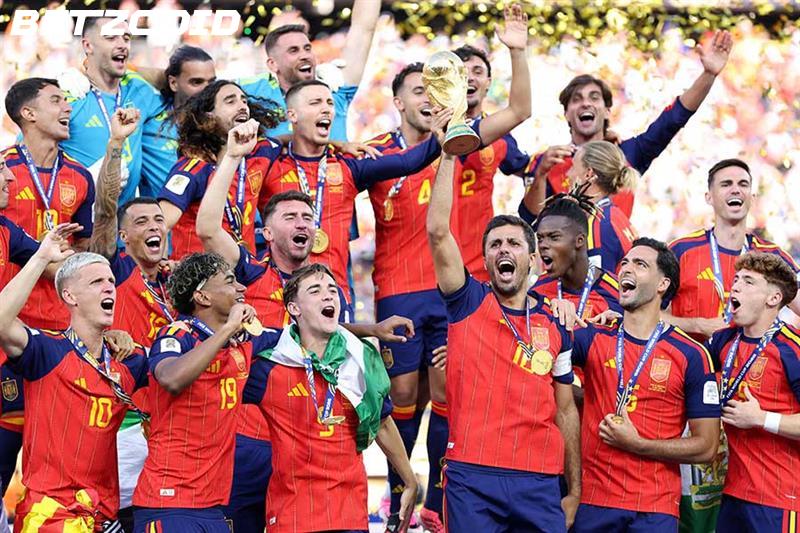
Spain are world champions. A 1-0 win over Argentina in extra time on Sunday handed them the 2026 World Cup — and ended defending champions Argentina's reign in the most tight-fisted of finishes. Somewhere, Gianni Infantino is already drafting his "best ever" speech. He's given it twice before, after Russia 2018 and Qatar 2022, and right on cue, he delivered it again in the US.
Donald Trump went further. The tournament was "five times greater" than any previously held, apparently. Nobody knows where that figure came from. Nobody asked.
But strip away the superlatives and ask an honest question: was this actually good?
The case for the defence
The numbers are genuinely hard to dismiss. Nearly seven million spectators attended — more than the combined totals of 2018 and 2022. Six billion viewers globally. Projected FIFA revenue of $15 billion, almost double Qatar's $7.6 billion. And with 308 goals at an average of 2.96 per game, the tournament posted its highest scoring rate since Mexico 1970.
America's stadiums, for all the pre-tournament nerves about filling them, were essentially full for almost every match. Fans weren't just present — they were having the time of their lives, waving at giant video boards like it was the greatest afternoon of their existence.
The Golden Boot race gave it genuine star power. Messi, Mbappe, Haaland, Kane, Bellingham — all of them showing up, all of them competing. Mbappe won it with 10 goals, breaking his own career World Cup scoring record with 22 total, surpassing Messi. That subplot alone carried the tournament's middle weeks.
And then there was Cape Verde. A tiny African nation, first World Cup appearance, 40-year-old goalkeeper Vozinha becoming an overnight internet sensation by keeping a clean sheet against Spain. They avoided defeat in 90 minutes against both finalists. Debut stories like that are precisely what a World Cup is supposed to produce.
On the betting side, an estimated $50 billion to $150 billion was wagered globally — making it the largest gambling event in history, somewhere around $500 million per match. Odds compilers had 104 games and 39 days to work with. The market had never seen anything like it.
Where it fell short
The group stage was largely consequence-free for the major nations. Twelve groups, with eight third-placed teams advancing to the knockouts, meant getting eliminated early required a sustained level of ineptitude that most established footballing nations simply don't possess. Seventy-two matches to whittle the field down for a knockout competition. That's more games than an entire previous World Cup used to contain — and for much of it, very little was actually at stake.
Many games were absorbing. Many were tedious. There's no sugar-coating that.
At the other end, the knockout schedule was crammed. Argentina played their quarter-final, semi-final, and final in nine days — in a tournament that ran for almost six weeks. FIFA had the space to breathe. They chose not to use it.
VAR generated controversy at a scale that felt relentless. The lowest point: Egypt's 3-2 loss to Argentina in the Round of 16, where a goal was ruled out for a foul deep in the attacking buildup, triggering outrage well beyond Egyptian football circles. It wasn't an isolated case.
The hydration breaks — mandatory three-minute stoppages mid-half, even in indoor stadiums — were introduced to manage heat in cities reaching 38°C. In principle, sensible. In practice, they killed rhythm, handed coaches mid-game tactical resets that altered results, and gave broadcasters guaranteed commercial breaks. By the latter stages, the boos when the break was called were audible and growing.
- Ticket prices, flights, food, and accommodation financially squeezed fans who attended
- Three to four matches daily — up to six on final group days — made following the tournament exhausting even for the most dedicated
- Refereeing standards drew widespread complaints from coaches throughout
The politics it couldn't escape
The combustible mix of sport and geopolitics was there from the start. Travel bans and visa restrictions under the Trump administration affected fans from more than a quarter of the participating nations — Iran, Haiti, and several African and Middle Eastern countries among them.
Iran's team, whose country is technically at war with host nation the United States, was permitted into the US only 24 hours before each group game and required to return to their Mexican base immediately after. In Seattle, Iran and Egypt met on Pride Day. Argentina players posed with a Falkland Islands sovereignty banner after beating England in the semi-final, prompting the British government to demand a FIFA investigation.
Then there was Folarin Balogun. Red-carded against Bosnia and Herzegovina, he should have missed the Belgium game. Trump phoned Infantino. The card was reviewed. Balogun played. No further explanation was offered.
Egypt coach Hossam Hassan, unprompted, waved a Palestinian flag in Dallas after his side reached the Round of 16. In two press conferences, the 59-year-old called those who don't empathise with the Palestinian cause "not human beings." It was a defiant move in that setting — and one that felt, compared to the tournament's other political episodes, at least honest about what it was.
Infantino is already floating a 64-team expansion for the next edition. He'll call it the best ever. He always does.