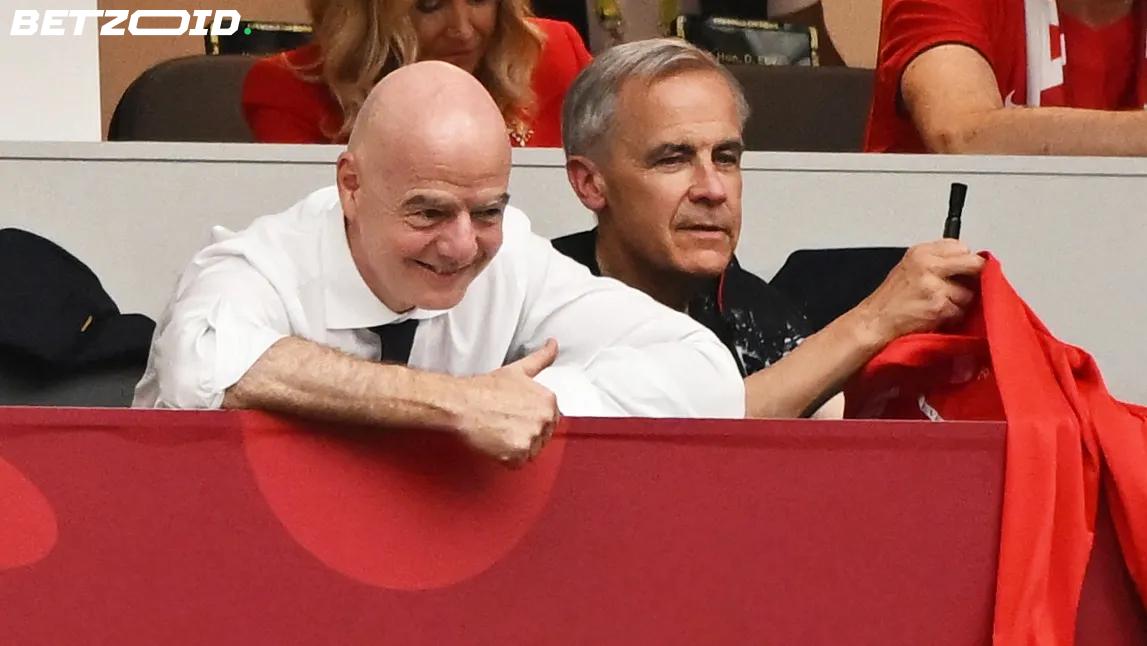
"This ban has achieved nothing; it has only created more frustration and hatred." Those are FIFA president Gianni Infantino's own words — and now he's acting on them. FIFA has announced that all 211 of its member associations, Russia included, will be invited to participate in its new U-15 World Cup & Festival, scheduled for October 22-31, 2026 in Azerbaijan.
Russia has been banned from FIFA and UEFA competitions since its invasion of Ukraine in 2022. That ban covers everything from U-17 level upwards. The Court of Arbitration for Sport refused to overturn it when Russia appealed. That suspension hasn't moved — but FIFA has found a way around it by creating a brand-new competition at the youngest age category, one that bypasses the standard regional qualification structure entirely. No qualification process. Just an open invitation.
Why U-15 specifically?
The argument Russia has consistently pushed is that teenagers shouldn't carry the consequences of decisions made by governments. Infantino has publicly sympathised with that position, telling Sky Sports earlier this year that allowing young Russian players to compete "could help" reduce what he called frustration and hatred. UEFA actually tried something similar back in 2023, floating the idea of Russia returning to U-17 competition — then pulled back after more than a dozen member associations said they'd refuse to take the pitch against them.
At U-15 level, with a festival format rather than a formal qualification competition, FIFA appears to be betting that resistance will be softer. Whether that bet pays off depends entirely on how many European associations feel the same way now as they did in 2023. Probably quite a few still do.
Russia's Minister of Sport, Mikhail Degtyarev, made no effort to frame this as anything other than the start of a longer campaign. "We hope that FIFA's decision will be the first step towards the full return of Russian national teams and clubs to world and European football competitions," he wrote on Telegram. That's not a subtle read of the situation — that's the stated goal.
The bigger picture
This sits alongside a broader softening in international sport. The International Olympic Committee amended the Olympic Charter this week in ways that could similarly open the door for Russian athletes to return to the Games. The modification stresses that the IOC should remain free from "governmental, cultural, societal or economic pressure" — language that can cut both ways depending on who's applying pressure.
Meanwhile, Russia's senior side has spent its suspension playing friendlies against whichever nations were willing. After a 3-0 win over Trinidad and Tobago in June, a choir of children sang a Soviet-era song inside a Kaliningrad stadium while screens showed clips from Russia's past World Cup campaigns. The message being sent there wasn't subtle either.
The U-15 festival is a boys tournament in 2026, girls in 2027, with separate competitions for both from 2028 onward. Russia is in for 2026 — assuming enough nations don't make the same call UEFA's members made two years ago and refuse to play them.