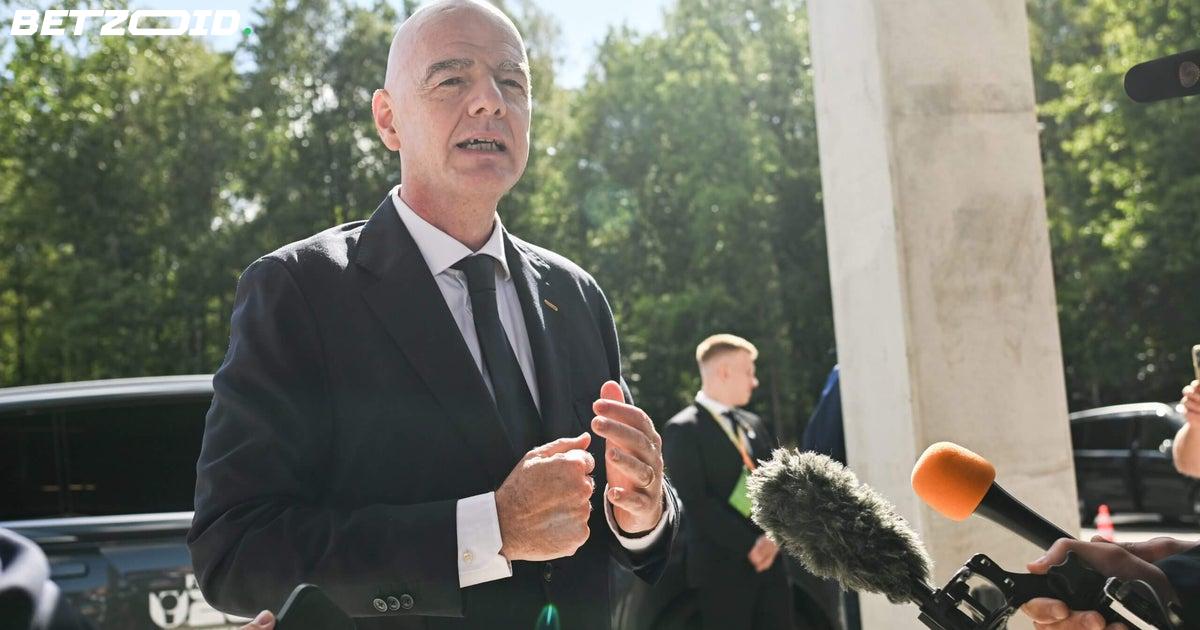
FIFA is seeking to amend its disciplinary code to prevent a repeat of the controversy that surrounded United States forward Folarin Balogun's suspended ban during the World Cup. The FIFA Council, the governing body's decision-making arm that includes president Gianni Infantino, eight vice-presidents and 28 other members, meets in Zurich on Thursday for the first time since the tournament and will be presented with an amendment aimed at preventing similar scenarios in future.
A document outlining the proposal, seen and reviewed by The Athletic, states it is necessary "to ensure stability and predictability regarding player eligibility and, therefore, protect the integrity of competitions." The amendment would add limits to Article 27 of FIFA's disciplinary code, the provision invoked to allow Balogun to play after his red card, and would forbid suspensions of automatic one-match bans in future tournaments.
Balogun received a red card in the round-of-32 match against Bosnia and Herzegovina, which appeared to trigger an automatic one-match ban under FIFA's World Cup rules. That ban was suspended, and Balogun played in the round-of-16 match against Belgium, which the U.S. lost 4-1, going out of the tournament. According to the report, Balogun's ban was suspended after U.S. President Donald Trump called Infantino to request a review of the decision. FIFA has said the decision was made by its independent disciplinary panel, and Infantino has always insisted he had no role in it. FIFA does not normally allow appeals during the World Cup, but U.S. Soccer made submissions arguing that the VAR presentation to the on-field referee relied excessively on freeze-frames and slow-motion images.
UEFA, whose leadership has long been at odds with Infantino, described the decision as "incomprehensible" and said it "crossed a red line."
Sources close to FIFA Council members, speaking on condition of anonymity because they were not authorised to speak publicly, said the wording of the amendment was only shared with members on Tuesday night, fewer than 48 hours before Thursday's meeting. They argued the move represented an attempt by Infantino to force through a policy at short notice to help "clean up" the stain of Balogun's reprieve, and said the existing rules were not unclear to most people, only requiring finessing because of what they called a highly unusual and inappropriate decision to let Balogun play.
English Football Association chair and FIFA vice-president Debbie Hewitt wrote to Infantino last month requesting the release of any documents related to the Balogun case.
The Balogun episode is one of several controversies that have put Infantino's position under scrutiny, alongside his failed attempt to sell off FIFA's commercial business to private U.S. investors and concerns over the FIFA Peace Prize awarded to President Trump. Those issues led UEFA and Concacaf to call for changes in FIFA's leadership, though no rival candidate has yet stepped forward to challenge Infantino in the upcoming presidential election. Former Tottenham and Switzerland defender Ramon Vega has said he intends to run against Infantino, according to earlier reporting, though he has not confirmed backing from the required national associations, and UEFA has separately set out criteria it wants in any challenger to Infantino.
Despite the pressure, Infantino heads into Thursday's meeting appearing more secure than he did a couple of months ago. Concacaf president and FIFA vice-president Victor Montagliani has decided against challenging Infantino, instead seeking his own fourth term, while Paris Saint-Germain president Nasser Al-Khelaifi has also resisted overtures to run. Infantino received the full backing of the Confederation of African Football last week and has unanimous support in South America, while Oceania and large parts of Asia also back him. Asian Football Confederation president Sheikh Salman bin Ebrahim Al Khalifa, who had questioned Infantino's future during the summer, recently wrote to him suggesting a working group to propose reforms.