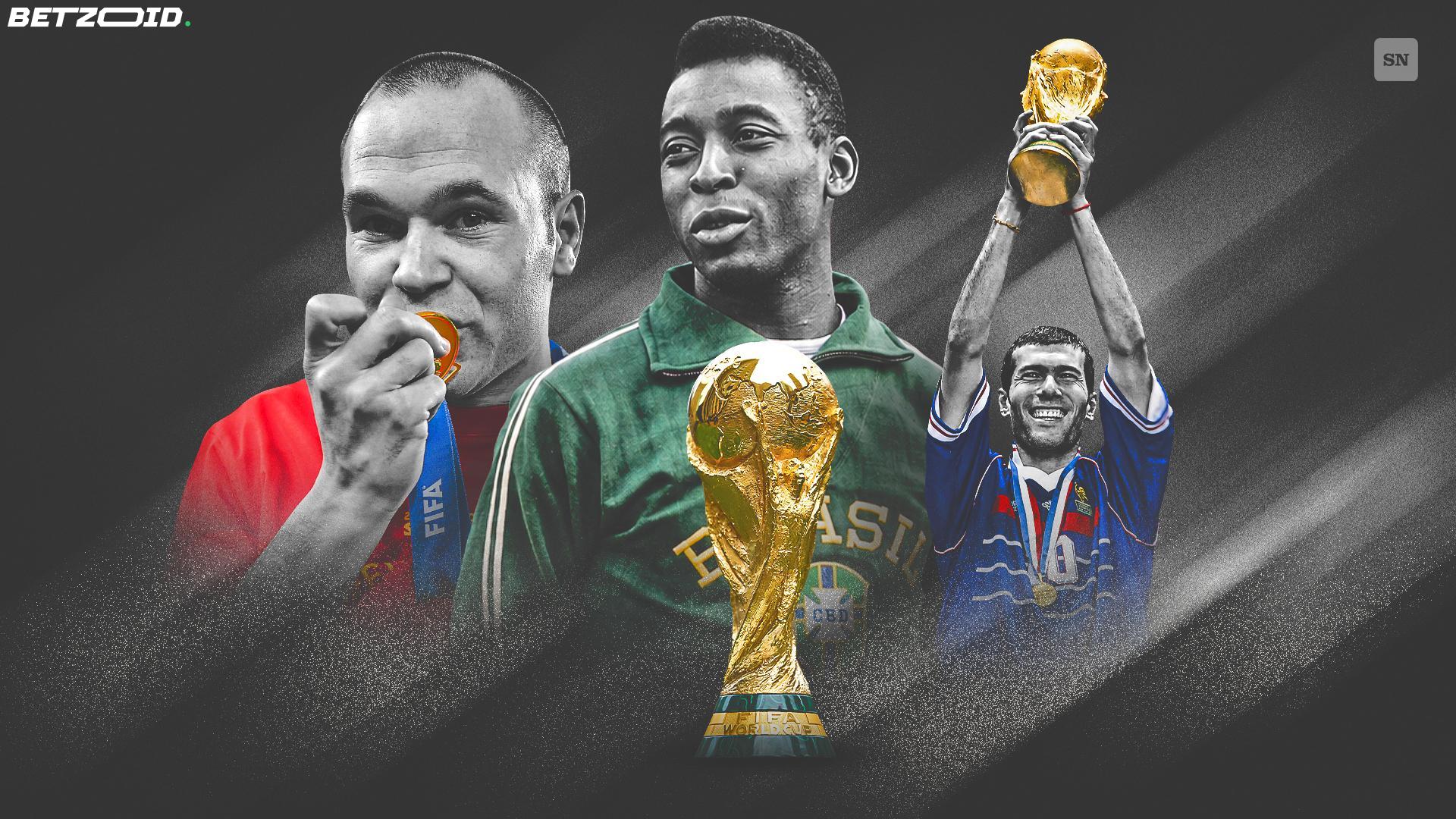
Twenty-two squads have lifted the World Cup. Eight nations account for all of them. And yet, the gap between the greatest and the merely good is vast enough to drive a bus through.
Ranking them requires more than trophy counts — it demands weighing star power, the quality of opposition faced, the manner of victory, and whether these teams left a permanent mark on the sport. Here's how all 22 World Cup winners stack up, from the forgettable to the genuinely legendary.
The Bottom Half: Winners Who Left Few Footprints
Italy's 1982 side sits last on this list, and the physicality that defined their tournament run is a big reason why. Paolo Rossi's six goals — including a hat-trick to eliminate Brazil — were genuinely brilliant, but the team behind him was thin on globally recognized talent. Claudio Gentile's treatment of Maradona remains notorious. They won. They were also not fun to watch.
West Germany's 1954 team deserves credit for one of the sport's all-time upsets, beating a Hungary side that was supposed to be unbeatable. Helmut Rahn's 84th-minute winner in Bern is part of football folklore. But beyond that single tournament, few players from that squad built lasting legacies — knee injuries cut short the most prominent careers before they could cement anything further.
Uruguay's 1950 win over Brazil in the Maracanazo is one of the most famous results in football history. A 2-1 comeback victory in the de facto final, inside the Maracanã, with 200,000 watching. That moment alone earns Uruguay's place ahead of several technically superior sides. The 1930 Uruguay team — the original winners — edges slightly ahead on historical weight. They won back-to-back Olympic titles and then the inaugural World Cup, beating Argentina 4-2 in the final after coming from behind. That lineage matters.
Italy's 1934 and 1938 teams were genuinely strong in Europe, even if South American withdrawals thinned the competition. Giuseppe Meazza's brilliance underpins both campaigns — his name is literally on the stadium shared by Inter and Milan. Silvio Piola's brace in the 1938 final sealed back-to-back titles, and he remains Serie A's all-time top scorer. Good teams. Context limits their ceiling.
Brazil's 1994 side gets unfairly dismissed. Romario was exceptional, Dunga led a defensively disciplined unit, and they beat Italy on penalties in a final. Not flashy. Effective. They had a 17-year-old Ronaldo Nazario who never played a minute, which tells you something about just how stacked the future would become.
The Middle Tier: Iconic Moments, Genuine Quality
Argentina's 1978 team gave the world Mario Kempes — a player who arrived at the tournament scoreless in the group stage and then ripped two goals each past Poland and Peru before sealing a 3-1 extra-time win over the Netherlands in the final. Captain Daniel Passarella led the defending. The 6-0 win over Peru still raises eyebrows. Kempes' goals don't.
Brazil's 1962 team won the World Cup without Pele. Let that land. Garrincha and Vava stepped up with four goals each, carrying the Seleção through a physically brutal tournament. Winning a World Cup when your best player is injured from the group stage is an achievement that gets consistently undervalued.
West Germany's 1990 side ground their way to the title in Italy. Lothar Matthaus led with four goals, Buchwald handled Maradona effectively, and a Brehme penalty in the 85th minute settled it. Not a beautiful team. A ruthlessly efficient one. Andreas Brehme's penalty odds of being the decisive blow probably looked decent before it landed in the net.
France's 2018 winners were more than the sum of their parts, and their parts were elite. A teenage Mbappe leading a team featuring Griezmann, Pogba, and Kante to a 4-2 final victory over Croatia — after somewhat cautious displays through the earlier rounds — remains a defining modern World Cup triumph. Deschamps played it pragmatically and won. The critics went quiet.
Italy's 2006 team was a masterclass in controlling football matches without requiring constant attacking fireworks. Buffon was impenetrable. Pirlo and De Rossi owned midfields. Cannavaro won the Ballon d'Or. Only two goals conceded all tournament. They beat France on penalties after Zidane's infamous headbutt on Materazzi, and Marcello Lippi's tactical boldness in bringing on four forwards against Germany in the semifinal showed exactly the kind of managerial confidence that wins tournaments.
Germany's 2014 team destroyed Brazil 7-1 in a semifinal on Brazilian soil. That result alone earns them a place in history. Neuer, Lahm, Hummels, Kroos, Muller, Klose — a complete squad that conceded four goals total across the tournament and beat Messi's Argentina in the final with a Gotze extra-time winner.
The Elite: The Teams That Defined the Tournament
Spain's 2010 side invented a new definition of suffocation. Zero goals conceded in the knockout stage. Four consecutive 1-0 wins to win the title. David Villa's five goals carried 63% of their total scoring burden. Casillas, Pique, Puyol, Ramos, Xavi, Busquets, Alonso — the spine of that team remains among the best ever assembled. They had already won Euro 2008 and would go on to win Euro 2012. The 2010 World Cup was the centrepiece of the most dominant four-year run in international football history.
France's 1998 squad on home soil was loaded — Zidane, Henry, Vieira, Desailly, Blanc, Pires, Trezeguet. Nine group-stage goals, a famous Thuram brace to beat Croatia in the semis, and then a 3-0 dismantling of Ronaldo's Brazil in the final — albeit with an air of mystery around Ronaldo's pre-match condition. Still: three goals against the favourites in a World Cup final on home turf is not a lucky result. The talent on that team was real.
West Germany's 1974 team defeated the greatest expression of Total Football ever produced — the Netherlands — by coming from behind in the final. Gerd Muller upfront, Beckenbauer marshalling the defence. They lost to East Germany in a meaningless group game and won everything that mattered. The tactical intelligence of that side held off a Dutch revolution that will be remembered forever for not winning the title.
Brazil's 2002 team was the last to win every single match in regulation — all seven of them. Ronaldo scored eight goals. Rivaldo added five. Ronaldinho two more. Cafu, Roberto Carlos, Kaka all in the same squad. They beat Germany 2-0 in the final in Yokohama, and if France and Argentina hadn't been upset early, the path would have been even harder. The results don't lie.
And then there is the 1970 Brazil team. Pele. Jairzinho. Gerson. Rivellino. Tostao. They scored 11 goals in three knockout games, including a 4-1 win over Italy in the final. Carlos Alberto's goal remains one of the greatest in the sport's history. The England save by Gordon Banks that Pele himself called the greatest he ever saw was made in a group stage game they won 1-0 anyway. That is how good Brazil were in 1970 — their opponents produced legendary moments just trying to contain them.
Argentina's 2022 team earns the sixth spot — higher than some might expect — because Scaloni engineered something genuinely rare: a World Cup squad built entirely around maximising one player, and it worked. Messi won the Golden Ball. Emi Martinez saved Argentina in penalties twice. The final against France was the greatest in the tournament's history. Mac Allister, De Paul, Otamendi, Lautaro — supporting cast assembled with precision. They lost to Saudi Arabia in the group stage and still won the whole thing.
- 1. Brazil, 1970 — Pele, Jairzinho, the best international team ever assembled
- 2. Brazil, 2002 — The Three Rs, seven wins, all in regulation
- 3. West Germany, 1974 — Muller and Beckenbauer beat Total Football
- 4. France, 1998 — Zidane's 3-0 final destruction of Brazil
- 5. Spain, 2010 — The greatest suffocation act in tournament history
- 6. Argentina, 2022 — Built for Messi. Delivered for Messi.
- 7. Argentina, 1986 — Maradona's tournament from start to finish
- 8. Uruguay, 1930 — The original, the template
- 9. England, 1966 — Hurst's hat-trick, Moore's captaincy, one golden summer
- 10. Brazil, 1958 — Pele at 17, announcing everything that was coming
- 11. Germany, 2014 — Seven goals against the hosts. In their own semifinal.
- 12. Italy, 2006 — Two goals conceded, one Ballon d'Or, one iconic headbutt
- 13. France, 2018 — Mbappe's arrival. Deschamps' vindication.
- 14. West Germany, 1990 — Matthaus and penalties, Brehme and redemption
- 15. Brazil, 1962 — Won it without their best player on the pitch
- 16. Argentina, 1978 — Kempes turned the tournament on its head
- 17. Italy, 1938 — Piola's goals, Meazza's vision, back-to-back titles
- 18. Brazil, 1994 — Unglamorous, functional, and still champions
- 19. Italy, 1934 — Strong in Europe, but South America stayed home
- 20. Uruguay, 1950 — The Maracanazo. One result that lives forever.
- 20. West Germany, 1954 — The Miracle of Bern, built on one iconic night
- 22. Italy, 1982 — Rossi was brilliant. The rest was functional and physical.