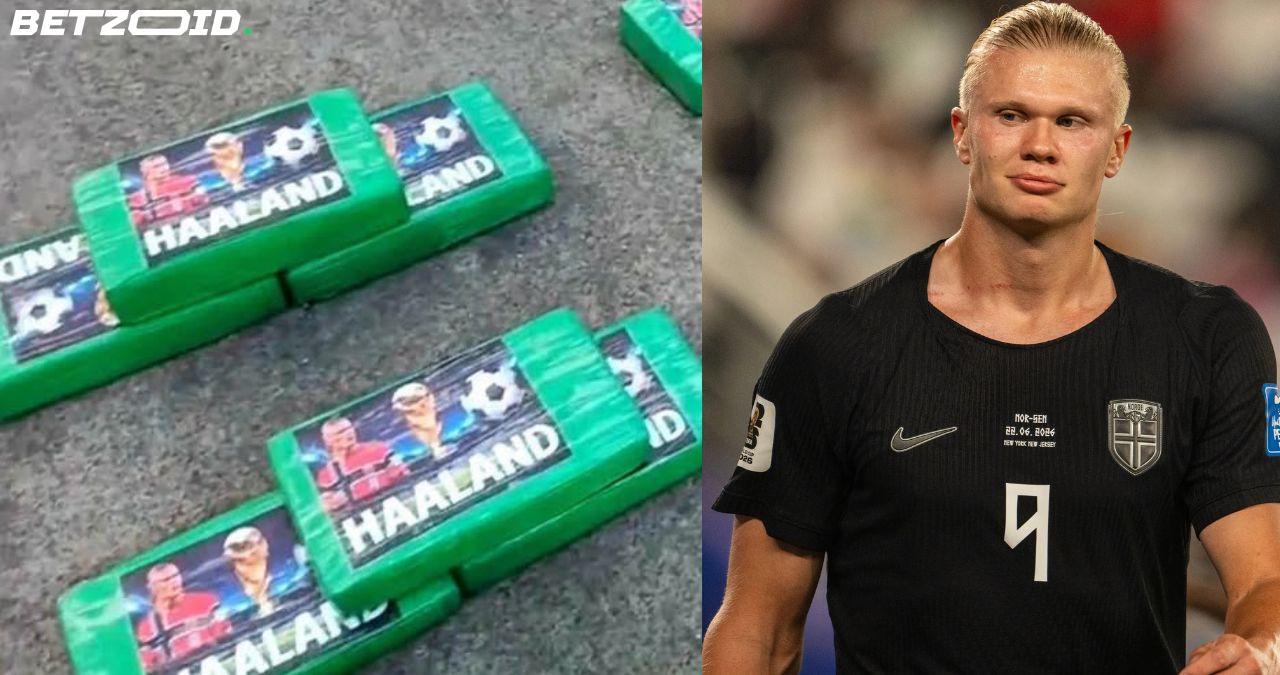
Ecuadorian anti-narcotics police intercepted a truck near the Colombian border carrying 370 blocks of cocaine — each one stamped with the face of Erling Haaland. The Manchester City striker, currently one of the most recognisable athletes on the planet, had absolutely nothing to do with it.
The haul weighed in at 469 kilograms, hidden in a false compartment beneath the truck's floor on the Pan-American Highway. The driver — a woman carrying Colombian identification — was arrested at the scene. Authorities released footage showing the packages tumbling out, every one of them wrapped in green and marked with Haaland's now-infamous sticker.
Why traffickers use footballer faces
This isn't coincidence, and it isn't fans being weird. Drug trafficking networks routinely brand shipments with celebrity images as coded identifiers — a way to signal origin, cartel affiliation, or intended recipient without written communication. Haaland isn't the only footballer caught up in this. Similar operations have turned up packages bearing Lionel Messi's likeness, suggesting football's biggest names have become an unofficial tagging system for organised crime.
The cocaine's value inside Ecuador sits around AED 3.09 million. By the time it reaches the United States, that figure climbs to roughly AED 40.4 million. European markets would push it close to AED 72 million. Ecuador sits at a critical transit point between Colombian and Peruvian production and the consuming markets of North America and Europe — and this bust illustrates exactly how that pipeline operates.
To be absolutely clear: Haaland is a victim of his own fame here, not a participant. His face ended up on cocaine bricks for the same reason it ends up on billboards — he's everywhere right now, and that visibility makes him useful. Even to people he'd never want associated with his name.
370 blocks. 469 kilograms. One very confused Norwegian striker.