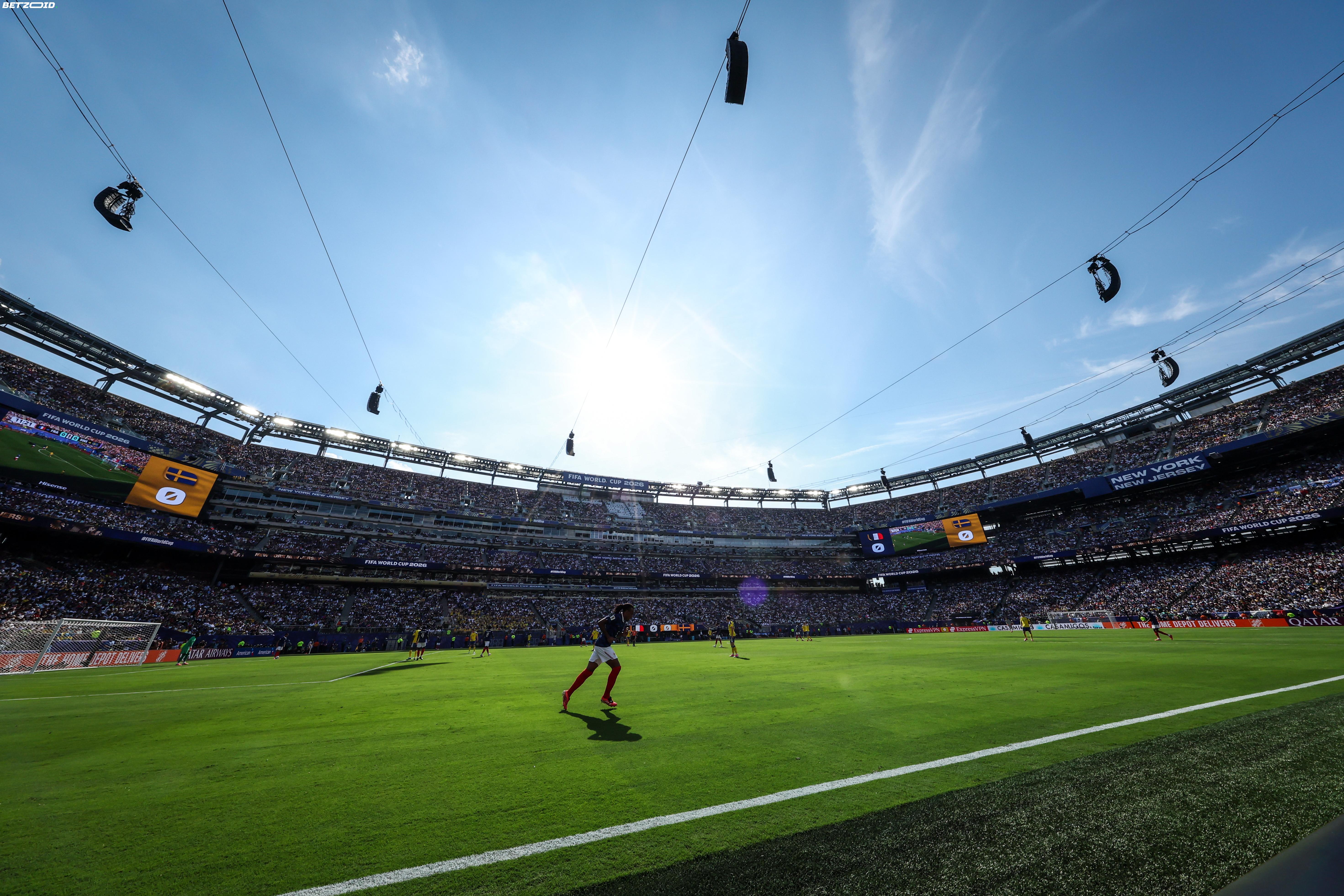
"My jaw dropped to the countertop." That was Dr. John Sorochan's reaction in a London coffee shop in 2018 when FIFA's pitch manager Alan Ferguson laid out the scale of what they were about to attempt for the 2026 World Cup. Seven years later, that conversation produces the surface Spain and Argentina will contest the World Cup final on at MetLife Stadium.
The pitch looks like grass. It is grass — Bermuda grass, specifically, which FIFA mandates across all World Cup venues. But what's underneath it is an engineering project that began before Lionel Messi had won his first Copa América.
What's actually under your feet
MetLife Stadium's permanent surface is artificial turf. To make it World Cup-ready, a temporary natural grass surface had to be built on top of it — a process that took roughly a month to complete. The Bermuda grass itself was grown at Carolina Green Corp in Indian Trail, North Carolina, then transported to New Jersey in approximately 20 truckloads of sod.
Once laid, the grass was stitched with five percent artificial turf for reinforcement — the standard approach at most World Cup venues. Below that surface sits a carefully engineered stack of layers: a geotextile base, aluminum flooring to counteract the synthetic turf underneath, an impermeable protective layer, an 85-millimeter drainage system, an irrigation network, and finally 8-10 inches of sand to buffer the whole thing and give players something approaching a natural feel.
The researchers tested 27 different construction scenarios to eliminate what they called the "trampoline effect" — the unnatural ball bounce that plagued temporary pitches at Copa América two years ago. They built a synthetic turf testing block at the University of Tennessee and ran through everything from concert flooring to drainage layers to plywood. Getting rid of that bounce was non-negotiable.
Why this took eight years and two universities
Dr. Sorochan at Tennessee and Dr. Trey Rogers at Michigan State led the research. Rogers got the call in 2019 while visiting Augusta — "what World Cup?" was his first response — and spent the next seven years developing pitches for 16 different geographic environments across North America. Outdoor stadiums. Domed stadiums. Sea level. 7,000 feet above sea level. Temperate climates, tropical heat, regular thunderstorms.
Miami got straight Bermuda grass. Other venues required carefully calibrated mixes of Kentucky bluegrass and perennial ryegrass — the ratios determining how quickly the sod could be harvested without sacrificing durability. That specific research came from Dr. Jackie Guevara, then a graduate student, whose dissertation on seeding ratios for sod grown on plastic was central to the whole project.
One of the biggest breakthroughs was developing a method to grow grass into a plastic layer so it could be transported and installed with minimal trauma to the root system. "It doesn't go into physiological shock when it's cut, doesn't go into physiological shock when it's transplanted," Rogers said. That solved a problem that had undermined temporary pitches in the US for years.
FIFA also built a 5,000 square foot climate-controlled dome at Tennessee to simulate indoor stadium conditions — particularly relevant for Dallas, which hosts nine matches and needed its schedule stress-tested in a controlled environment before a single game was played.
The complaints, and what FIFA did about them
The MetLife pitch has not been without criticism. Vinicius Jr. flagged it as too dry after Brazil's draw with Morocco. France's Didier Deschamps called it "really tough" on players' muscles after the win over Senegal. Adrien Rabiot said it "seemed more like an artificial pitch, hard and rigid." Manuel Neuer noted Germany had "played on better pitches before here."
But the response to those complaints matters. FIFA started watering the pitch significantly more, and the dryness issues faded. Norway manager Stale Solbakken — after heavy rain ahead of his side's match — put it bluntly: "The pitch was much better because of the rain. The ball doesn't hang on the foot, it's going faster, smoother." That's exactly what a World Cup final surface needs to do.
For context on how far this has come: Copa América pitches two years ago were widely criticized for breaking down mid-tournament and producing erratic ball behavior. The 2026 pitches, developed under FIFA's direct oversight and backed by nearly a decade of university research, have drawn a fraction of that criticism. That's the real benchmark.
Meanwhile, NFL players watching the World Cup on grass at stadiums they normally play on with artificial turf have started a social media campaign pushing the league to follow suit. Whether NFL owners fund that shift is a different conversation — but the research that makes it possible now exists, and it was built for this final.