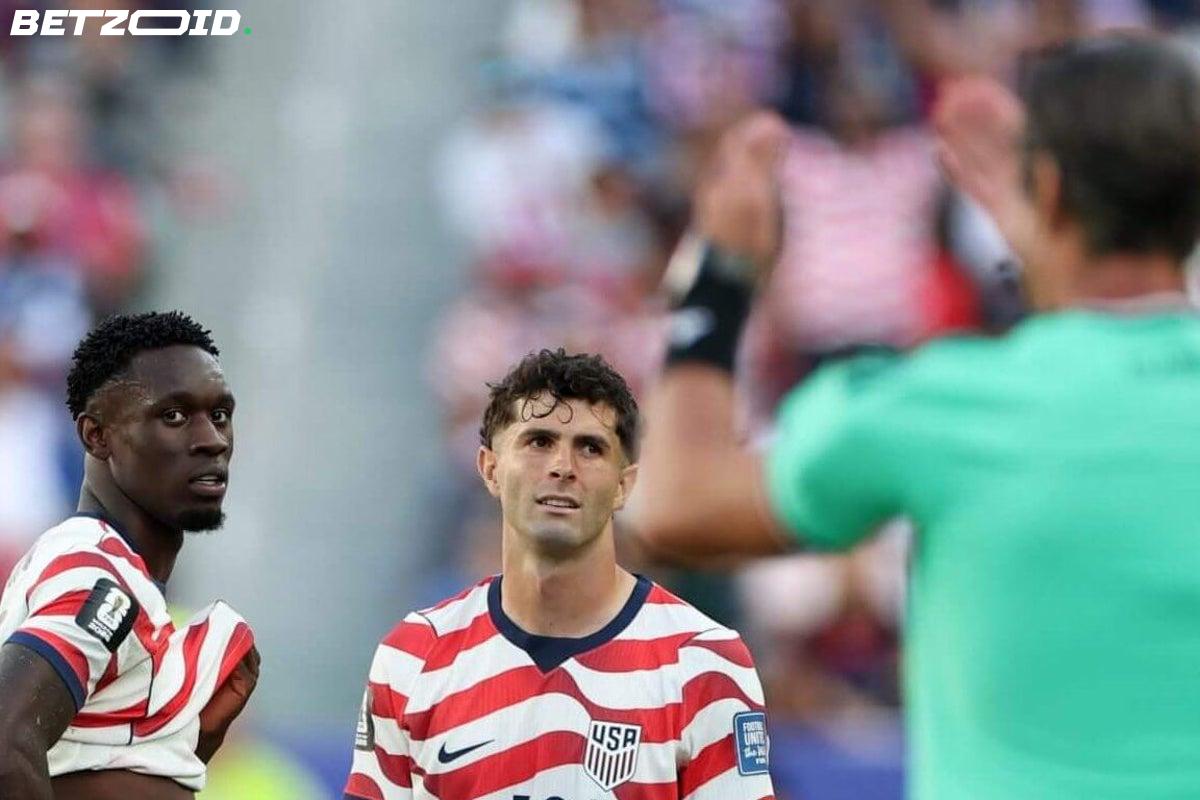
Folarin Balogun didn't commit serious foul play. VAR made it look like he did. That's the problem.
In a Copa America group stage match against Bosnia & Herzegovina, the USMNT's most dangerous striker was shown a straight red card for a challenge that, in real time, barely registered as a foul — let alone a sending-off. A forward, knocked off balance, landing awkwardly on a defender's ankle. Unfortunate. Clumsy, at most. The kind of physical contest that happens thirty times a match and ends with both players running to the next ball.
Yet Brazilian referee Raphael Claus sent Balogun off. And he did so after being walked through a VAR presentation that showed the incident frozen at the most incriminating frame first, then replayed in slow motion not once, not twice, but multiple times — each replay stripping away more context until what remained was a still image designed to prosecute, not inform.
The replay sequence tells you everything
Here's how it unfolded: the first image shown to the on-field referee was a freeze frame of the point of contact. The worst possible moment, presented without movement, without speed, without the chaos that preceded it. Then a slow-motion replay. Then another, this one starting at normal speed before grinding down to slow-motion exactly at impact. Two wider-angle replays at normal speed came after — showing the incident looked more like a physical battle for a loose ball — but by then, Claus had already made up his mind.
That sequencing matters. You don't un-see the freeze frame. The slow-motion images that dominate the review are precisely the images that dominate the decision. The normal-speed footage, which tells the real story, arrived too late to matter.
Nobody on the pitch — not the Bosnian players, not the on-field referee — initially treated this as a red-card incident. A couple of Bosnia players showed concern for Muharemović, who was clearly in pain. Nobody appealed for a sending-off. The call only escalated when officials in a remote studio intervened.
IFAB's own rules were apparently ignored
IFAB — the body that writes football's laws — is explicit in its VAR guidance: normal speed should be used to judge the intensity of an offence. Slow motion is permitted for facts like the point of contact, not to assess how bad a challenge was. Yet that's exactly what happened here. Repeated slow-motion replays were used to amplify the look of the challenge, not to clarify a factual dispute.
The word "generally" in IFAB's protocols is doing an enormous amount of work if referees can use it to justify this kind of replay sequence. Either the guidance means something or it doesn't.
Balogun now misses the round of 16 against Belgium — the most consequential match the USMNT will play in this tournament. The man who gives them their best chance of causing an upset is watching from the stands because a video official decided a freeze frame was sufficient evidence for a career-altering punishment.
Football has changed its laws before when injustice at major tournaments demanded it. The backpass rule. Goal-line technology. Both came because a single high-profile moment made the status quo untenable. Balogun's red card should be that moment for slow-motion VAR abuse.
If it isn't, the next striker to land awkwardly on an opponent's ankle in a knockout game won't be nearly as unlucky. He'll just be the next one.