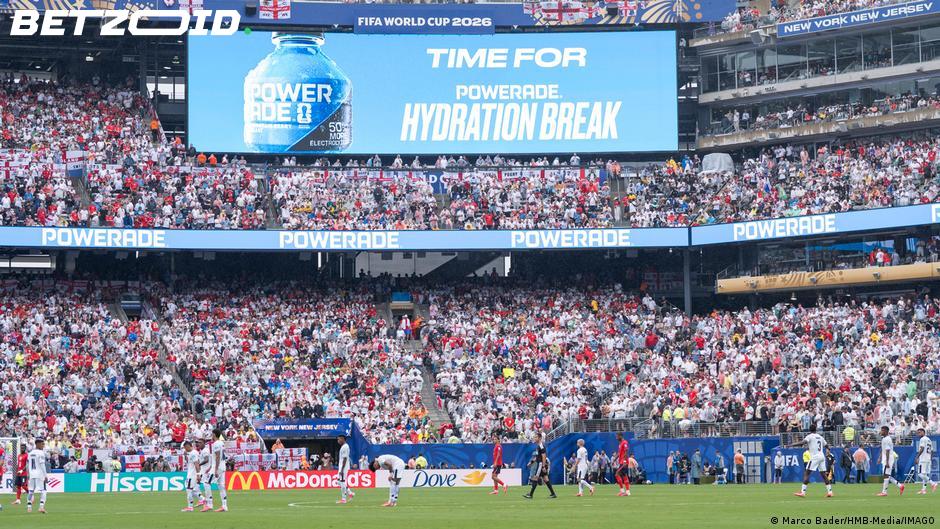
"If the players really need a drink, they should just do it before taking a corner kick." That Iraq fan in Philadelphia said what a lot of people in the stands are thinking. The mandatory hydration breaks at the 2026 World Cup were sold as a health measure. They've become something considerably more complicated.
Matches are stopped twice per game — around the 22nd and 67th minutes — regardless of temperature, regardless of whether play is suspended in an air-conditioned Dallas dome where, as one Argentina fan drily observed, the heat argument falls completely flat. The rule was shaped by extreme conditions at last summer's Club World Cup, but at this tournament it applies universally. That's where the friction starts.
When a water break becomes a timeout
The momentum numbers are damning. Research using Opta data, published by The Times, found that a significant shift in match momentum occurred after the first water break in 32% of group-stage games, and 26% after the second. On average, momentum dropped 17% following an interruption. Crucially, the team that held the advantage going into the break felt the sharpest decline afterward.
In other words: these breaks don't just pause football. They reset it.
Coaches know this. Jürgen Klopp admitted he'd have loved the extra windows for tactical instructions — while also criticizing how FIFA and broadcasters handle the stoppages. Paraguay's Gustavo Alfaro went further, suggesting the sport is drifting toward a four-quarter structure, a comparison that lands differently when you're hosting a tournament in North America surrounded by the NBA and NFL.
Thomas Tuchel flagged the obvious: these breaks make matches longer. Virgil van Dijk acknowledged they're far from ideal for neutral viewers. The sporting argument for applying them universally, irrespective of conditions, is thin.
The commercial angle FIFA won't quite own
Then there's the money. In multiple countries, broadcasters are filling the breaks with advertising — scheduled, guaranteed stoppage time, something the sport has never reliably offered before. The breaks even carry a sponsor, whose branding lights up stadium screens the moment play stops.
FIFA president Gianni Infantino denied the governing body profits from the breaks directly, pointing out that broadcast contracts were signed before the rule was introduced. That may be technically accurate. It doesn't explain why the rule applies on cold nights in covered stadiums.
Sports medicine gives the breaks genuine backing in extreme heat — Dr. Tim Meyer confirmed that cooling breaks do measurably reduce body temperature and have real physiological benefit. But he also noted the side effect: players run less, play safer, take fewer risks. "That is probably sensible," he said, "but it certainly isn't in the spirit of the sport."
Infantino says FIFA will evaluate the experiment before deciding on the breaks' future. Given what the Opta data already shows about momentum disruption — and what any viewer can see when a team goes from pressing high to reorganizing in a defensive shape after a 90-second pause — there's enough evidence to work with right now.