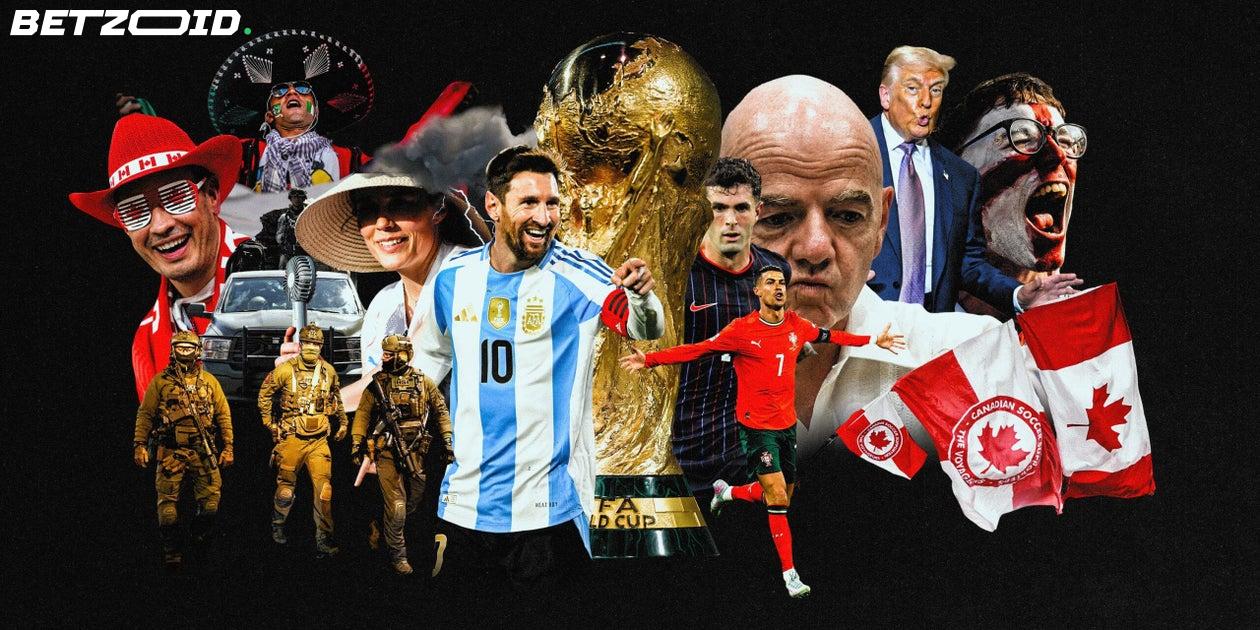
We're just 100 days away from the biggest World Cup ever. Forty-eight nations. One hundred and four matches. Three host countries. FIFA president Gianni Infantino is calling it "the greatest event that humanity, mankind, has ever seen."
But here's the thing – this tournament feels different. And not in a good way.
The numbers are staggering. Six billion people are expected to watch. That's nearly three-quarters of everyone on Earth. Ticket requests hit 50 million in the first month alone. The talent on display will be incredible – Messi, Ronaldo, Haaland, Mbappe, and breakout stars like Lamine Yamal.
We'll also see four nations make their World Cup debut: Cape Verde, Curacao, Jordan, and Uzbekistan. Those underdog stories alone should have us all excited.
Political Tensions Threatening the Tournament
But the political situation is making everyone nervous. First, it was tensions between the U.S., Canada, and Mexico – the three co-hosts. Then immigration crackdowns threatened to deny visas to fans from Senegal, Ivory Coast, Haiti, and Iran.
Trump's threats to annex Greenland upset Denmark and much of the European Union. Violence in Minneapolis involving ICE agents sparked protests. Drug cartel battles escalated in Guadalajara, one of the host cities.
Then came the real shockwave. The U.S. and Israel launched military strikes against Iran. Iran's Supreme Leader was reportedly killed in the attacks. Iran responded with strikes across U.S. bases in the Middle East.
Now there's genuine uncertainty about whether Iran will even participate in Group G alongside Belgium, Egypt, and New Zealand. No nation has withdrawn from a World Cup since 1950.
What This Means for the Tournament
For bettors and fans planning trips, this creates massive uncertainty. Ticket prices are already astronomical. Hotel costs are through the roof. And now there are warnings about "catastrophic" security issues if funding remains frozen due to government shutdowns.
If Iran withdraws, it would reshape Group G entirely. Belgium would become heavy favorites, but Egypt and New Zealand's chances would shift dramatically. Anyone who's already placed futures bets on group winners needs to watch this situation closely.
Despite all this chaos, the tournament will kick off June 11 when Mexico faces South Africa at the Azteca Stadium. Canada starts their campaign June 12 in Toronto. The U.S. opens against Paraguay at SoFi Stadium that evening.
Previous World Cups have faced controversy too. Russia 2018 became a propaganda event before FIFA suspended Russia after invading Ukraine. Qatar 2022 brought focus to migrant worker conditions and LGBTQ+ rights. South Africa 2010 and Brazil 2014 had safety concerns.
But this feels different. The scale of political turbulence is alarming even to seasoned reporters. The "United" bid that won hosting rights promised unity, certainty, and low risk. Right now, we're seeing none of that.
The hope is that once the football starts, it provides an escape. World Cups have always brought people together. Anyone who's attended one has stories about rival fans sharing drinks and swapping jerseys. That magic between Mexico and South Africa fans in 2010 was special. Brazil and Scotland supporters partying together in past tournaments created unforgettable moments.
This World Cup will break every attendance and revenue record. That's guaranteed. We'll see Messi and Ronaldo on the biggest stage one last time. The final at MetLife Stadium on July 19 will draw billions of viewers worldwide.
But beneath all that excitement sits real uncertainty. The tournament that's supposed to unite the world is happening while global tensions reach dangerous levels. Can football bring us together when everything else is pulling us apart? We're about to find out.