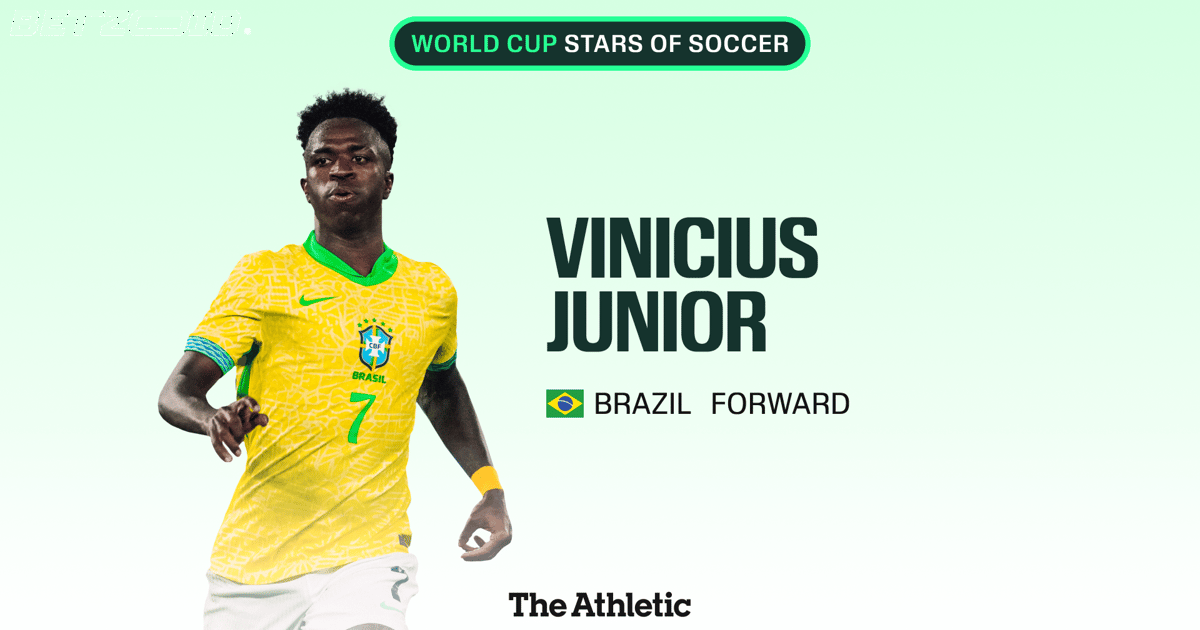
"Every time it happens, my desire to play decreases." That's Vinicius Junior talking about racist abuse in Spain — and the fact that he keeps playing at the level he does, despite carrying that weight, tells you almost everything about who he is.
He turns 26 during this summer's World Cup. Twenty-six. With five consecutive 20-goal seasons at Real Madrid, a Champions League winner's medal, and a second-place Ballon d'Or finish already on his CV, the idea that we might be watching the opening chapters of this story rather than the climax is genuinely disorienting.
From scattershot to unstoppable
The early years at the Bernabeu were not smooth. Talent was obvious, end product was not. Carlo Ancelotti's arrival in 2021 changed the trajectory — Vinicius went from six goals in 2020-21 to 22 the following season, including the winner in the Champions League final. The number has stayed above 20 in every campaign since.
For Brazil, the story was more complicated. His first 31 international appearances produced three goals — one a penalty — and a lot of footage of him looking isolated, double-marked on the left flank, going nowhere. The Neymar era cast a long shadow, and Vinicius never quite stepped out of it.
Until now. Ancelotti has taken charge of the Selecao and shifted Vinicius into a central roving striker role rather than pinning him wide. The early returns are promising. Brazil's World Cup odds look considerably more interesting with a player finally built around him rather than despite him.
The racism fight runs parallel to everything else
Between October 2021 and February 2026, 26 separate incidents of racist abuse against Vinicius were reported across 10 different Spanish stadiums. That's not a pattern — that's a sustained campaign. He's called it out publicly every time, become one of the most prominent voices in football on the subject, and kept performing at the highest level while doing it.
The cost is real. He said so himself at a press conference before a Brazil-Spain friendly in March 2024, visibly emotional. The bravery it takes to keep showing up — keep dancing after goals, keep dribbling defenders inside out — while absorbing that kind of treatment is genuinely difficult to quantify.
Carlos Noval, who ran the Flamengo academy, summed up the player underneath all of it: "He would tell defenders that he was going to twist them inside out. And then he'd do it."
Ancelotti, for his part, has no doubts about what's coming: "If he hasn't produced his best for Brazil in the past, he will now."
This World Cup will go a long way toward deciding whether the Ballon d'Or — still an explicit personal goal — arrives in Paris with a Brazilian passport.