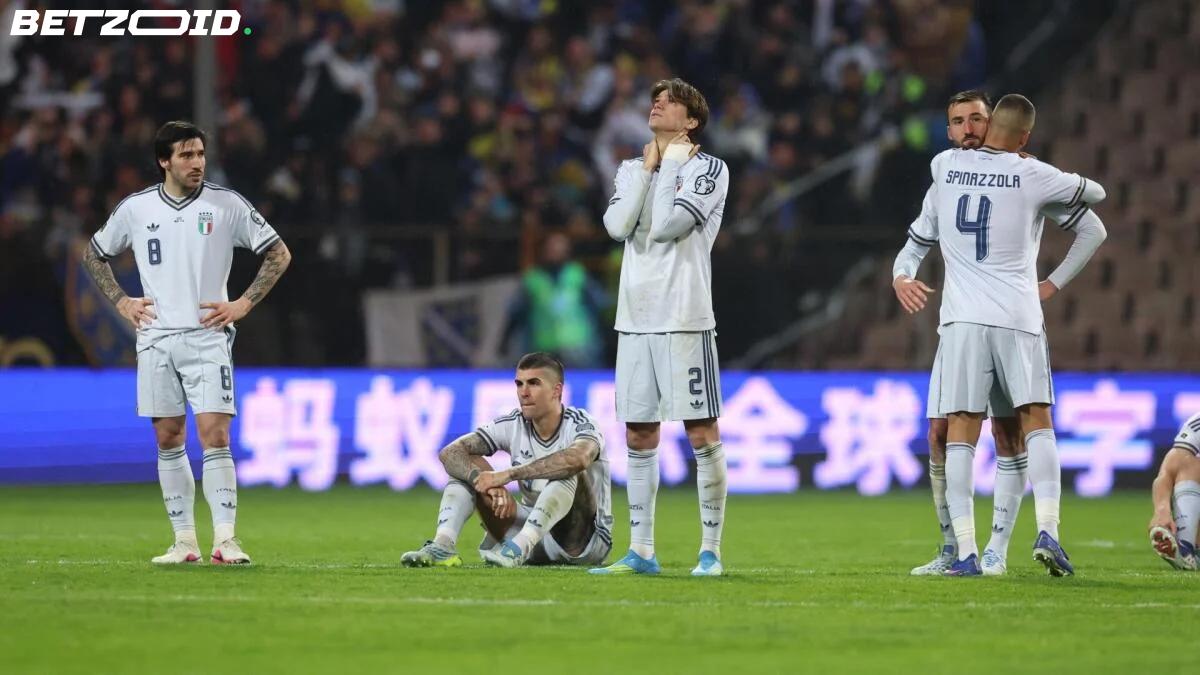
An 11-year-old child in Italy has never watched the Azzurri play at a World Cup. After the penalty shootout defeat to Bosnia and Herzegovina, that child won't be watching this summer either. Three consecutive absences from the world's biggest tournament. This isn't a bad cycle. This is structural collapse.
Gennaro Gattuso took the blame publicly, emotionally, and with more dignity than the situation demanded of him. But pinning this on a manager misses the point entirely. Italian football has been quietly rotting for years — outdated stadiums, weak infrastructure, dwindling financial power, and no coherent long-term vision to replace any of it.
The talent drain says everything
When Giovanni Leoni and Riccardo Calafiori are choosing the Premier League over Italian clubs, that's the system speaking. The best young players aren't leaving because they want to. They're leaving because Italian football isn't giving them a reason to stay. The Premier League spent 30 years building a product. Serie A spent those same years assuming individual talent would carry the load. When the talent dried up, there was nothing underneath it.
The tactical decisions didn't help either. Leaving Marco Palestra out of both qualifying matches — a player who has been among the standout right wingers in Serie A this season — is exactly the kind of self-defeating conservatism that has dogged this squad. Meanwhile, Francesco Pio Esposito stepped up to take the first penalty in a shootout and missed. He had more courage than most of the system that produced him. Gianluigi Donnarumma made crucial saves, again, as he does, and it still wasn't enough.
Italian FA president Gabriele Gravina refusing to resign after all this tells you everything about why the problem persists. In Italy, accountability rarely becomes action — in football or in politics. Gravina is expected to eventually step down, but the fact that it's a matter of weeks and not hours says plenty about the culture of responsibility that has infected the sport at every level.
Forget 2030. Start from scratch.
Back in 2010, Roberto Baggio wrote a 900-page document outlining how to save Italian football. It was four years after the 2006 World Cup win. Nobody acted on it. The indifference to that report and the failure to qualify for three straight World Cups are not unrelated facts.
Anyone betting on Italy to make a deep run at a major tournament in the near future should probably look elsewhere. The rebuild required isn't a transfer window or a new manager — it's a decade-long structural overhaul of the entire system, from academies to infrastructure to the top of the federation. The 2030 World Cup should be removed from conversation entirely. Set a longer horizon, build something real, or keep watching 11-year-olds grow up without ever seeing the Azzurri in June football.
Roberto Baggio saw this coming fifteen years ago. The document is still sitting there, all 900 pages of it, largely unread.