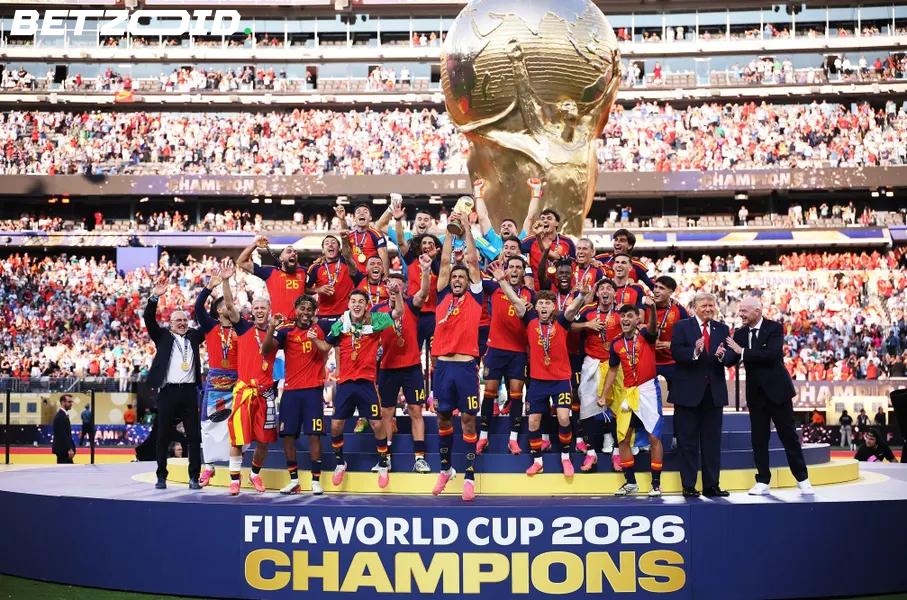
The 2026 World Cup didn't just transcend sport. It became something else entirely — a geopolitical instrument, a commercial product, a platform for power. And the 2030 edition, spread across six countries on two continents, is shaping up to be even messier.
Before a ball was kicked this summer, the concerns were obvious. ICE agents at stadiums. Eye-watering ticket prices. Empty seats in sold-out venues. FIFA handing Donald Trump something called a "Peace Prize." But once the football started, most of it faded. The goals and the drama took over, as they usually do.
Then came Trump's intervention in the Balogun red card case, and the illusion of a clean, apolitical tournament collapsed. It was a reminder that this version of the World Cup — more than any before it — operates at the intersection of football, money, and geopolitical muscle-flexing.
2030's problems are already queuing up
The centenary World Cup will be hosted by Argentina, Paraguay and Uruguay in South America, with Morocco, Portugal and Spain holding the European matches. Six nations. Potentially 64 teams. The logistics alone are a nightmare. The politics are worse.
Morocco is already staking a claim to host the 2030 final, having built what would be the world's largest football stadium. Spain's government disagrees — loudly. That dispute alone could dominate the next four years of World Cup coverage before a single qualification game is played.
Morocco also has an unresolved border dispute with Algeria and ongoing tensions over Western Sahara. Meanwhile, Trump's administration has already recognized Western Sahara as Moroccan territory, and Morocco has been quietly deepening ties with Israel — a detail that sits uncomfortably next to Spain's vocal pro-Palestine foreign policy stance.
The 2026 final between Spain and Argentina was already being framed in some quarters as a geopolitical proxy match, given the ideological gap between Madrid's left-wing government and Javier Milei's Buenos Aires. In 2030, those same countries will be co-hosts. The framing will be harder to escape.
Trump won't be in office, but his fingerprints will be everywhere
Trump is constitutionally barred from a third term by 2030, but his influence — over FIFA, over Morocco, over Milei's Argentina and Santiago Peña's Paraguay — won't simply evaporate. His relationship with Gianni Infantino remains close. His ties to the King of Morocco are well documented. His contempt for Spain's current government is on the record — he's called it a "wasted cause" and a "terrible partner."
That last point matters for anyone pricing up host-nation advantages or following the politics around 2030 venue decisions. If the Infantino-Trump axis holds, Spain's position in the hosting hierarchy could be weaker than the geography suggests.
None of this is new in isolation. In 1962, the presidents of Chile and Peru lobbied FIFA directly over Garrincha's red card. Adidas and FIFA have been commercially intertwined since 1974. The World Cup has always carried political weight.
But 2026 felt like a threshold. Dynamic ticket pricing turned the tournament into a commodity priced beyond ordinary fans. A sitting U.S. president publicly intervened in a refereeing decision. Immigration policy became a sporting issue when Iran's squad faced entry restrictions and a Somali FIFA referee was denied a visa.
- Iran's players faced U.S. immigration restrictions tied to ongoing geopolitical tensions
- A Somali FIFA referee was denied entry to the United States
- Trump intervened publicly in the Balogun red card controversy
- Morocco and Spain are already in dispute over who hosts the 2030 final
The World Cup has always had an off-pitch story. The difference now is that the off-pitch story threatens to become the main event. In 2030, with six host nations spanning two continents, competing political agendas, and a tournament that may involve 64 teams for the first time, there's simply more surface area for things to go wrong.
FIFA's original mission in 1904 was straightforward: unify football associations, standardize the laws, run a world championship. The 2030 edition will celebrate 100 years of the World Cup. It will also be the clearest evidence yet of how far that mission has drifted.