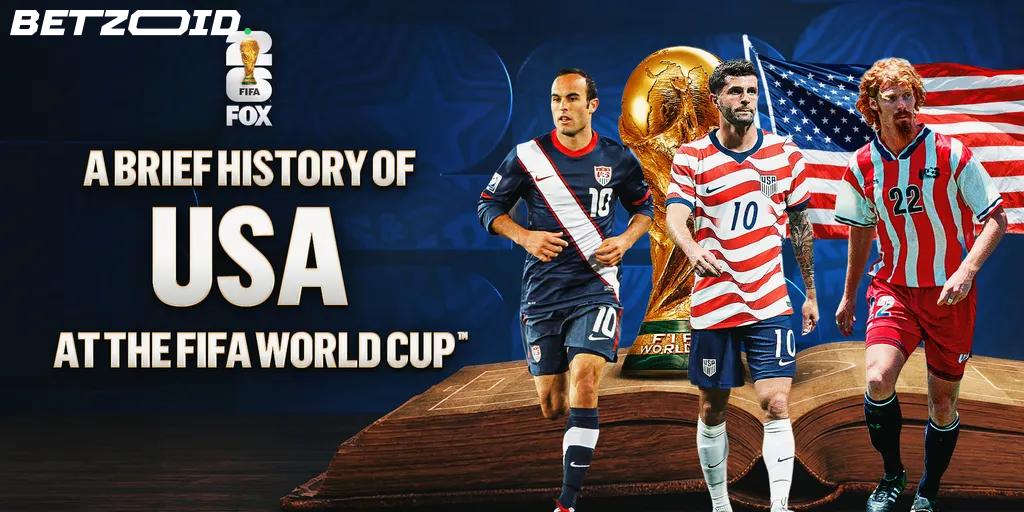
The United States finished third at the very first World Cup in 1930. Then didn't qualify for another 40 years. That gap tells you almost everything you need to know about the complicated, stop-start history of American soccer on the global stage.
With the 2026 World Cup now arriving on home soil — co-hosted by the U.S., Mexico, and Canada — it's worth understanding exactly how the USMNT got here, because the road was anything but smooth.
The early years: bronze medals and miracles
The U.S. Soccer Federation was founded in 1913, and the men's team played its first official international match in Stockholm in August 1916 — a 3-2 win over Sweden. But it was 1930 in Uruguay where American soccer first made a mark on the world stage.
A squad of semi-pros, British immigrants, and one Belgian-born goalkeeper opened the inaugural World Cup by hammering Belgium 3-0, then Paraguay 3-0. The semifinal against Argentina ended badly — a 6-1 thumping — but FIFA retroactively awarded the U.S. bronze based on overall record. No third-place match was played. It still counts.
The 1950 World Cup produced the result that defined a generation. Joe Gaetjens scored in the 37th minute, and the U.S. beat England 1-0 in Belo Horizonte. England were making their World Cup debut and were among the favorites. The American squad featured a grave digger, a postman, and Gaetjens himself — a Haitian-born dishwasher living in New York who wasn't yet a U.S. citizen. The game became known as the Miracle Match, spawned books and a 2005 film, and was followed immediately by a 40-year absence from the tournament.
That drought — from 1950 to 1990 — wasn't a blip. It was structural. Without a professional domestic league, the national team couldn't build depth. The North American Soccer League arrived in 1968 and attracted Pelé, Franz Beckenbauer, and Johan Cruyff, but it did almost nothing for American players. The NASL folded in 1984. The U.S. missed World Cup after World Cup.
1994 changed everything — then 2018 nearly broke it
FIFA controversially awarded the 1994 World Cup to the United States in 1988, which forced U.S. Soccer to get serious about qualifying. The team returned to the World Cup in 1990 in Italy — young, inexperienced, and outclassed. They lost all three group games, conceding eight goals. But they were back.
The 1994 tournament on home soil was the real turning point. Over 3.5 million fans attended matches — a record that still stands. The team, led by newcomers Alexi Lalas and Cobi Jones, advanced from the group stage for the first time in 64 years before losing 1-0 to Brazil in the round of 16. That tournament directly led to the founding of Major League Soccer two years later.
What followed was a cycle of promise and frustration. The 2002 World Cup in South Korea and Japan remains the high point of the modern era — a 3-2 win over Portugal, a 2-0 demolition of Mexico, and a quarterfinal exit against Germany where a Torsten Frings handball that bounced off his arm was waved away by the referee. Germany advanced. The U.S. had a legitimate case they were robbed.
- 2006: Knocked out in the group stage by a brutal draw including Italy, Czech Republic, and Ghana
- 2010: Landon Donovan's last-gasp winner against Algeria sent the U.S. through; lost in the round of 16 to Ghana
- 2014: Tim Howard set a World Cup record for saves in a single match against Belgium — 16 — and still ended up on the losing side in extra time
- 2018: Failed to qualify. Full stop. The lowest point in 32 years.
- 2022: Returned under a new generation with Christian Pulisic and Weston McKennie, reached the round of 16, lost to the Netherlands
The 2018 failure to qualify for Russia shook the program hard — and rightly so. It cost Bruce Arena his job, Arena who holds the record for most wins as USMNT coach with 81. The rebuild that followed produced a roster built around genuine European professionals, which is a sentence that couldn't have been written in 1994.
Now the U.S. opens the 2026 tournament on June 12 against Paraguay at Los Angeles Stadium, followed by a June 19 match in Seattle and a June 25 group finale back in Los Angeles. Thirteen players from the 2022 Qatar squad are back. Pulisic and McKennie lead the group. Playing in front of home crowds, in a 48-team tournament that adds a third group-stage game and more paths to the knockout rounds, the structural conditions have never been more favorable for a deep run.
The all-time scoring record belongs jointly to Clint Dempsey and Landon Donovan — 57 goals each. Cobi Jones holds the caps record with 164 appearances between 1992 and 2004. The records say something about which eras produced which players, and this current generation is still writing theirs.