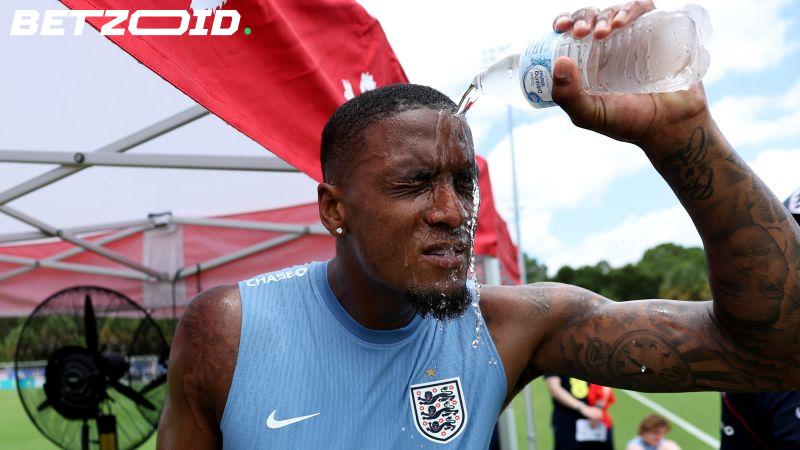
"If you have two equally capable teams like Spain and France, the one that manages these key pillars right will have the best advantage." That's not a coach making excuses. That's Dominic Rae, a physiotherapist who works in UAE summer heat regularly exceeding 40°C, telling you exactly what the 2026 World Cup is going to come down to.
Forty-eight teams. Three countries. Sixteen cities. Thirteen different kickoff times. The tournament starts June 11, and before a single group-stage result is in, the physical demands of this competition are already unlike anything football has seen.
Ten venues at extreme heat risk
The heat problem is serious, and it was already being flagged last September when the "Pitches in Peril" climate report identified 10 of the 16 venues as facing "very high risk" of extreme heat stress. Last month, 20 international health and climate experts wrote directly to FIFA calling its heat policy "inadequate." FIFA's current threshold for even considering postponement sits at a Wet Bulb Globe Temperature of 32°C. Those same experts argue conditions above 26°C already constitute a high-risk environment for competitive football — and World Weather Attribution estimates 25% of all matches, including the final at MetLife Stadium, could be played above that level.
To translate: a WBGT of 31.9°C — just under FIFA's action threshold — can feel equivalent to 45°C air temperature in low humidity without direct sunlight. FIFA says it'll monitor conditions in real time and has scheduling built around heat risk. The experts aren't convinced that's enough.
All 104 matches will have mandatory water breaks. But as Rae puts it bluntly: "If you're relying on a water break as your hydration strategy, you've already got it wrong." Heat affects decision-making, cognitive clarity, physical output. It compounds with everything else players will be navigating.
England travel 1,721 miles in the group stage. France travel 334.
The travel disparity between squads is stark. FIFA has grouped teams into regional clusters to limit movement, but the gaps still tell a story. France's group-stage journey covers just 334 miles between New Jersey, Philadelphia and Boston. Argentina navigate 461 miles between Kansas City and Dallas.
England and Spain are not so fortunate. England cover 1,721 miles between Arlington, Massachusetts, and New Jersey. Spain travel 1,469 miles between Atlanta and Zapopan, Mexico — where they'll face Uruguay on June 26 at 8pm ET. That's 2am on Spanish soil, after a cross-border journey, for a must-win group match.
It's not purely a fatigue issue either. Cabin pressure on long flights accelerates dehydration. Players managing knee injuries can swell up on a two-hour Champions League flight — Rae has seen it happen. Across a six-week tournament with multiple long-haul legs, that's a variable that compounds quietly until it doesn't.
Of the 52 players in England and Spain's squads combined, only Ivan Toney currently plays his club football outside Europe. Long-haul travel at tournament intensity is a relatively unfamiliar environment for most of them.
Sleep kits and the 1am problem
Nearly half of the 72 group-stage matches kick off between 7pm and midnight ET — which translates to between 1am and 6am Central European Time. European players competing in those windows aren't just playing late. Their circadian rhythms are telling them it's the middle of the night.
England have reportedly responded by bringing customized sleep kits to their Kansas City base: mattress toppers tailored to each player's body type, cooling pillows to counter heat and humidity. It sounds fussy. It isn't. Sleep is where recovery actually happens, and disrupting it — even slightly, for weeks — accumulates.
Rae's point about routine is the one coaches should tattoo somewhere: "Whatever the normal sleep routine is a player just did for the whole season, stick to that within the camp." Dinner at 9pm when a player has eaten at 7pm all season. Meetings at 10pm. Air conditioning settings that change room ventilation. A different pillow. Each one is small. Together they erode the recovery that elite performance depends on.
Talent, tactics, and execution will still decide matches. Nobody wins the World Cup because they had the best mattress topper. But among the genuine contenders — France, Spain, England, Argentina — the quality gap is narrow enough that the teams who arrive at the knockout rounds physically fresher, sharper, and better recovered will carry a real edge. The odds on those teams deserve a second look once group-stage travel schedules and kickoff times are factored in.
France's light travel load and manageable match times aren't luck — they're a structural advantage. Spain's schedule is the opposite.