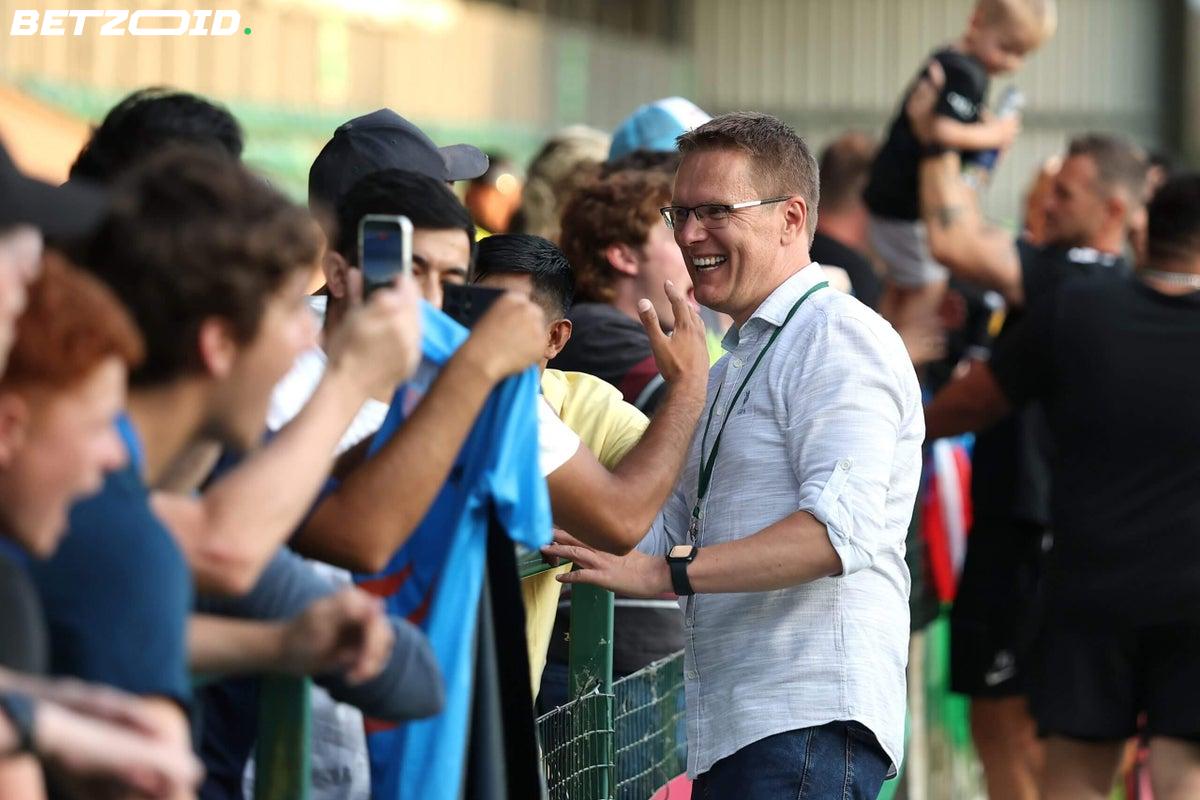
Valdas Dambrauskas once cleaned pub floors in north London to fund his coaching badges. On Thursday, he walks out at Old Trafford for a Champions League group stage fixture. The line between those two moments is not luck — it's 24 years of relentless, deliberate work.
The 49-year-old Lithuanian head coach has guided Sabah FK — a club that didn't exist until 2017 — to Azerbaijan's first Champions League league phase berth by a club other than Qarabag. To get there, Sabah beat Welsh side TNS, KuPS of Finland, Danish outfit Aarhus, and Israeli club Hapoel Beer-Sheva. Unseeded in every round. Zero European pedigree. Doesn't matter — they're in.
How a game show started everything
The origin story is genuinely strange. In 2002, a 25-year-old Dambrauskas appeared on Sesi nuliai — milijonas, Lithuania's version of Who Wants To Be A Millionaire? He walked away with 4,000 litas — roughly £725 — equivalent to six months of average Lithuanian wages. That money paid for his move to London.
Once there, he and his wife Ingrida survived on whatever work came their way: handyman, newspaper delivery, childminding, nursery school, retail, cleaning pub floors. At one point they were juggling four or five jobs simultaneously while Dambrauskas studied full-time. He came out the other side with first-class honours in sports science and coaching from London Metropolitan University. The money funded the degree. The commutes between shifts were spent studying.
His first coaching break came at Manchester United Soccer Schools in 2004. Then Fulham. Then Brentford. His first managerial role was at Kingsbury London Tigers in the FA Cup preliminary rounds — a semi-professional side that regularly fielded 11 nationalities at once. "It was eye-opening for me," he says. "I learned about so many different cultures, languages and backgrounds." When Sabah beat Hapoel Beer-Sheva to reach the Champions League, they also started with 11 players from 11 different nations. The symmetry is almost too neat.
What Sabah's rise actually means
Domestically, this is a seismic shift in Azerbaijani football. Qarabag had won 11 of the 12 previous league titles and were the established European representatives of the country. Sabah went 33 matches undefeated, won the league-and-cup double, and finished nine points clear of Qarabag, whose own European exertions arguably cost them domestically. A six-year-old club just ended a dynasty.
Sabah are based in Masazir, 15km outside Baku, named after a lake whose distinctive pink colouring gave the club its nickname — the Pink-Blacks. They are, per the facts available, the first club to reach the Champions League knockout phase with pink as a primary colour. Odd detail. Genuinely true.
Dambrauskas has now won 13 trophies across five countries — Lithuania, Bulgaria, Azerbaijan, Latvia, Croatia — with separate stints in Greece, Cyprus, and Hungary along the way. He used the Champions League anthem as his ringtone for years without ever coaching in the competition. That changes this week.
For those tracking Sabah's odds in the league phase, context matters: they arrive as heavy underdogs against established European clubs, with a squad built on depth of nationality rather than depth of budget. The run to get here required four knockout victories against unseeded opposition — Hapoel's tie was settled in the fourth minute of stoppage time in the second leg, then won in extra time. That's not a soft draw. That's a team that found ways to win.
Dambrauskas, predictably, is already looking past the milestone. "Every achievement brings a lot of responsibility," he says. "I have more dreams to follow."
The question he got wrong on that game show in 2002, by the way? The first winner of the Academy Award for Best Actor — Emil Jannings, 1929. He still remembers it. Some lessons stick harder than others.