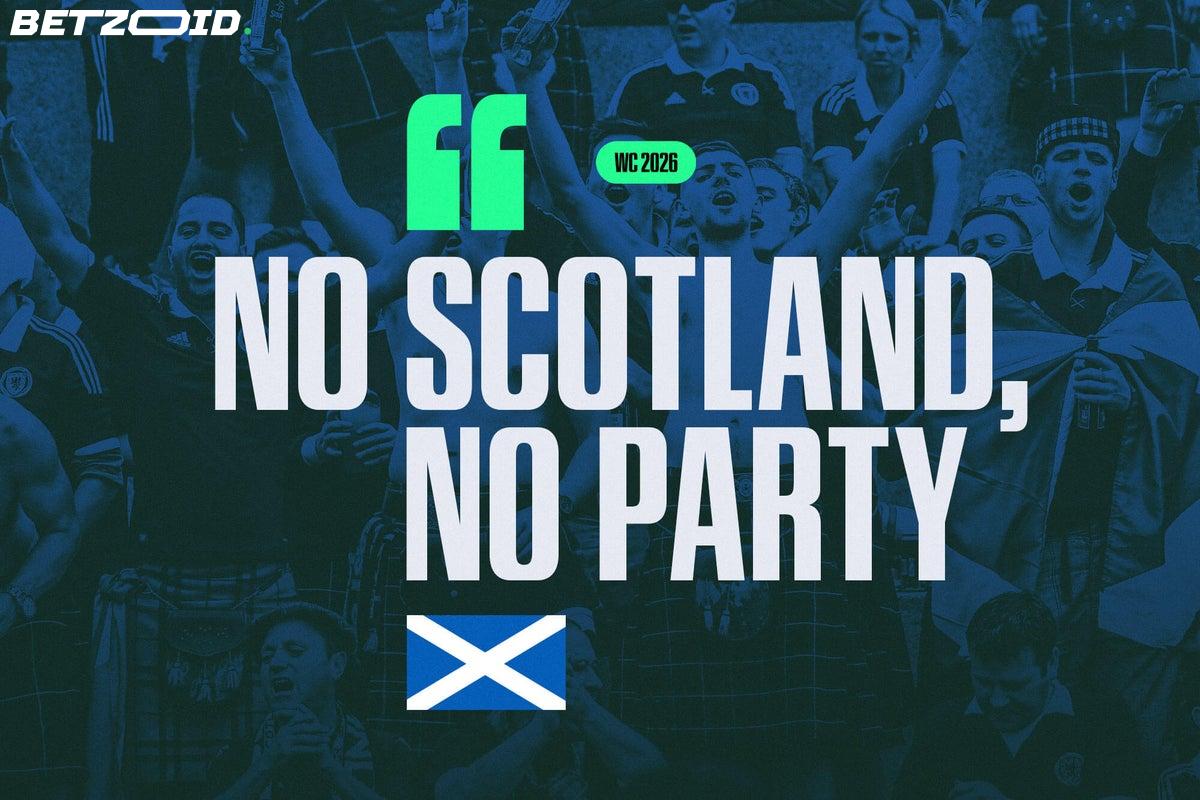
"When Munich, the beer capital of the world, was drunk dry before a ball had even been kicked" — that sentence alone tells you everything about what the Tartan Army brings to a tournament. But the drinking is just the surface. Underneath it is something genuinely unusual in football: a fanbase that has donated £5,000 to a local children's charity at every single away match since 2003.
That's 110 consecutive games. From Kaunas, Lithuania to Liverpool, without missing once. Scotland's friendly against Ivory Coast in March was the latest entry in a run that most supporter groups couldn't sustain for a single season, let alone two decades.
Where it started — and where it's going
The origin is as affecting as the streak itself. In 1999, Tartan Army members visited an orphanage in Sarajevo for children who had lost parents to land mines. They handed over football tops — including, somehow, a Meadowbank Thistle shirt — and the kids sang their national anthem back to them. Martin Riddell, Edinburgh Tartan Army chairman, had become a father three months earlier. He doesn't need to say how it landed.
"The birth of the support's charitable side," he calls it.
The Sunshine Appeal — strictly non-political, non-religious, non-government — has been running ever since. A Boston homeless children's organisation is already lined up for the 2026 World Cup, where Scotland will open against Haiti in Foxborough on June 22. They've thought ahead. They always do.
The famous eve-of-tournament parties — first at Buddha-Bar in Paris in 1998 (Sean Connery dancing, Alex Ferguson in a Viking helmet, Ally McCoist doing Bruce Springsteen on karaoke) and then in Munich ahead of Euro 2024 — raise serious money too. The Munich version pulled in £100,000 for Street Soccer Scotland, a homeless charity run by David Duke, who played in the Homeless World Cup and rebuilt his life through football. Another party is set for the night before the Haiti game.
Why the culture is what it is
The identity didn't form in a vacuum. There was a conscious decision, somewhere along the way, to be the antithesis of everything associated with English football hooliganism. "There was definitely a feeling that because England were so bad, Scotland thought, 'Well, we are going to be f***ing angels'," says Riddell. Self-policing became the norm. Reputation followed.
What's fascinating is how it coexists with genuine heartbreak. This is a fanbase that watched Leigh Griffiths score two late free kicks to lead England 2-1 at Hampden — and then watched Harry Kane equalise in the 94th minute. A Gary Caldwell diving header against France. Ikechi Anya's equaliser against Germany. Glorious individual moments that never translated into anything.
"The high, the ultimate high... and then it all comes crashing down," says Riddell. The Tartan Army made a virtue of that too. If the football was going to break your heart, you might as well have a party first and do some good while you're at it.
Scotland's squad in 2026 — better than the reputation
The team arriving at this World Cup is quietly the most stable Scotland have had in a generation. The squad that had roughly 200 caps between them in 2019 now has over 800. Andy Robertson is nine appearances from Kenny Dalglish's all-time record. John McGinn and Scott McTominay are both closing in on the Dalglish-Denis Law shared goal record of 30.
They qualified with a campaign that contained a Kenny McLean goal scored from inside his own half in the 90th minute to seal a 4-2 win over Denmark. BBC radio commentator Alasdair Lamont, for once, had no need for a famous Scottish lament. "Glorious! Glorious! Glorious!" was all he said.
Euro 2024 in Germany was, by contrast, a flat-out failure — beaten by Germany and Hungary, a draw with Switzerland, three games and out. Scotland's group-stage exit odds at this World Cup will reflect those memories. Probably too harshly.
"Most of that squad have played at two tournaments now, so they know what to expect," says Duke. "You feel that it is country first, club second with this group." Steve Clarke's side have reached three of their last four qualifying campaigns, with no injury withdrawals and a cohesion that has been years in the building. A 1-0 win over Haiti to open the tournament — their first major-tournament victory since beating Switzerland at Euro 96 — isn't a stretch to imagine.
The last monkey on Scotland's back, as Riddell puts it, is making it through to a knockout round for the first time ever. Whether this squad has what it takes to do it is genuinely uncertain. But whatever happens on the pitch, the party has already been planned. The charity donation is already lined up. And somewhere in Sarajevo, a kid in a Meadowbank Thistle shirt is probably wondering what all the fuss is about.