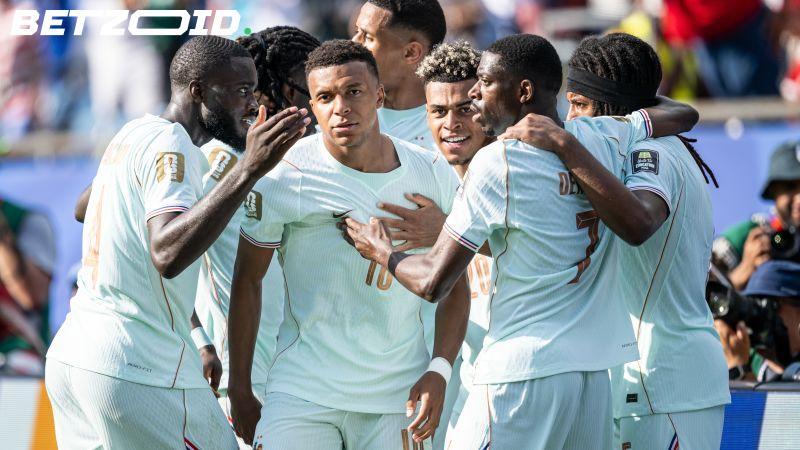
"If I score, I'm French. If I don't score, I'm Arab." Karim Benzema said that in 2011. Fifteen years later, Kylian Mbappé is living the same sentence — just with higher stakes, more goals, and uglier attacks.
France are in the 2026 World Cup semifinals, set to face Spain on Tuesday. Mbappé is their captain, their top scorer, and the second-highest scorer in World Cup history with 20 goals — behind only Lionel Messi. By any footballing measure, he is France's greatest active player. None of that has settled the question of whether France truly claims him.
The abuse doesn't stop when the goals go in
After France knocked out Paraguay in this World Cup, Paraguayan senator Celeste Amarilla called Mbappé a "colonized Cameroonian, pretending hard to be French" and wrote that "instead of mother's milk, he sucked on coconuts." She later said the remarks were made "in the heat of the moment" — then, extraordinarily, tried to frame Mbappé's rejection of her racism as gender-based violence against her.
Emmanuel Macron publicly defended him. Marine Le Pen said nothing.
That silence is instructive. Le Pen — widely considered a frontrunner for the 2025 French presidential election — has spent years suggesting players like Mbappé aren't really French. When France won the 2018 World Cup, the only person she congratulated by name was Didier Deschamps. The white coach. She didn't mention the 19-year-old from Bondy who tore Brazil apart.
Her argument has evolved to fit modern sensibilities without changing its core logic: because Mbappé is rich and famous, he no longer represents immigrants. "There are far more of them living on the minimum wage, who can't afford housing," she told CNN. It sounds almost sympathetic until you realize the implication — that the moment a non-white player succeeds, he forfeits his immigrant identity. And if he fails, he's foreign again.
Defender Patrice Evra put it plainly in 2022: "When you win with France, you're a French player. When you lose, suddenly, you get your Senegal passport."
1998 and the myth that football fixed anything
There was a moment — briefly — when France's multicultural squad felt like a national statement. The 1998 World Cup winners, led by Zinedine Zidane, Thierry Henry, Marcel Desailly, and Lilian Thuram, were celebrated under the banner "Black, Blanc, Beur." When they lifted the trophy, Marcel Desailly recalled: "No racism, no discrimination, everybody was happy in France."
Jean-Marie Le Pen — Marine's father — called that team "artificial." Too African. "None of them has any place in a French team." The celebration was real. So was the backlash.
The cycle has never really broken. After Euro 2020, when Mbappé missed the decisive penalty against Switzerland, he was subjected to racist abuse so severe he told FFF president Noël Le Graët he was done: "I cannot play for people who think I'm a monkey. I'm not gonna play." He was 22. He'd just helped France win a World Cup four years earlier.
He played. A year later, he led France to the 2022 World Cup Final in Qatar, where they lost on penalties to Argentina. The racist abuse after that loss was just as bad as after the Swiss shootout.
This is the loop. Score, get called French. Miss, get called African. Win a final, hear nothing from Le Pen. Lose a final, get the passport comment.
On Tuesday, Mbappé wears the badge again. If France beat Spain and reach a third consecutive World Cup Final, he'll be a national hero for about 72 hours. The more interesting question — the one that actually matters — is what happens if they don't.