"People forget that football is played on the field. They look at statistics and rankings and assume Haiti can't compete. But at the end of the day, it's 11 against 11." Tamy Michel, one of the most connected figures in Haitian football, doesn't say it defensively. She says it like it's obvious.
Haiti are at the 2026 World Cup for the first time since 1974. Fifty-two years. And they qualified while playing every single home qualifier away from home. That's not an underdog story. That's something else.
A squad built across continents — but not a diaspora project
Only 10 of Haiti's 26 players were born in the country. Jean-Ricner Bellegarde plays for Wolves. Wilson Isidor just finished helping Sunderland to seventh in the Premier League. Ricardo Adé, 36, is one of South America's most respected defenders at LDU Quito. Duckens Nazon has played across France, England, Turkey, and Iran.
Michel is clear that this is not a diaspora side stitched together from players who couldn't get into stronger national teams. Each of these players made a choice. Bellegarde came through France's youth system, earned caps for French youth sides, and still picked Haiti. "It's home," Michel says. "It connects them to their parents and where their families come from."
That distinction matters more than it might seem. A squad that chose to be here carries a different weight than one assembled by default.
What this team means beyond the results
Adé, who actually grew up in Haiti before building his career across the Americas, frames it plainly: "People see too much bad news. Once you step foot in the country, you're going to see other things." He's not asking for sympathy. He's asking for attention — a different kind.
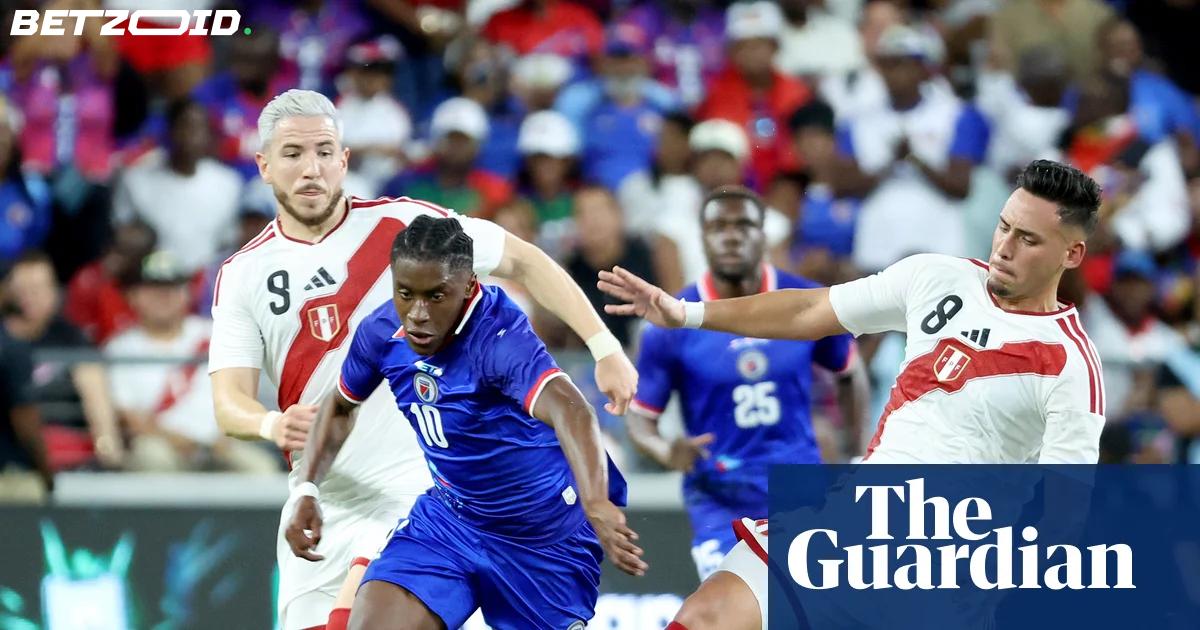
Haiti haven't played a home match since 2021. Their support comes from everywhere else. A friendly against Peru in Miami last week drew around 27,000 fans — Michel estimates over 20,000 were Haitian. Boston's opening match against Scotland on Sunday is expected to follow a similar pattern, with the Haitian diaspora potentially outnumbering the Tartan Army in Foxborough.
On June 19th — Juneteenth — they face Brazil in Philadelphia. Fans are traveling from New York, Boston, Montreal, and south Florida. Whatever happens on the pitch, that match will be a gathering of a nation scattered across the world.
Haiti's history carries dimensions the standard coverage rarely touches. It was the world's first nation founded by formerly enslaved people after a successful revolt. FIFA this year forced the team to alter a World Cup jersey that featured imagery from that revolution. Olympic officials had raised similar objections to Toussaint Louverture appearing on Winter Games uniforms. The fights over symbols say as much as the football does.
In terms of where to place them on the market, the group stage picture is complicated. Scotland and Brazil are both priced ahead of Haiti for obvious reasons. But a team that qualified under those conditions, with that quality across the squad, isn't padding. Anyone dismissing them as a third-game banker for group opponents should look at the qualifier record first.
"The thing we are doing," Adé says, "is showing Haiti in a different way. Showing that we can have less, but we can do much."
That's not a soundbite. That's the whole story.