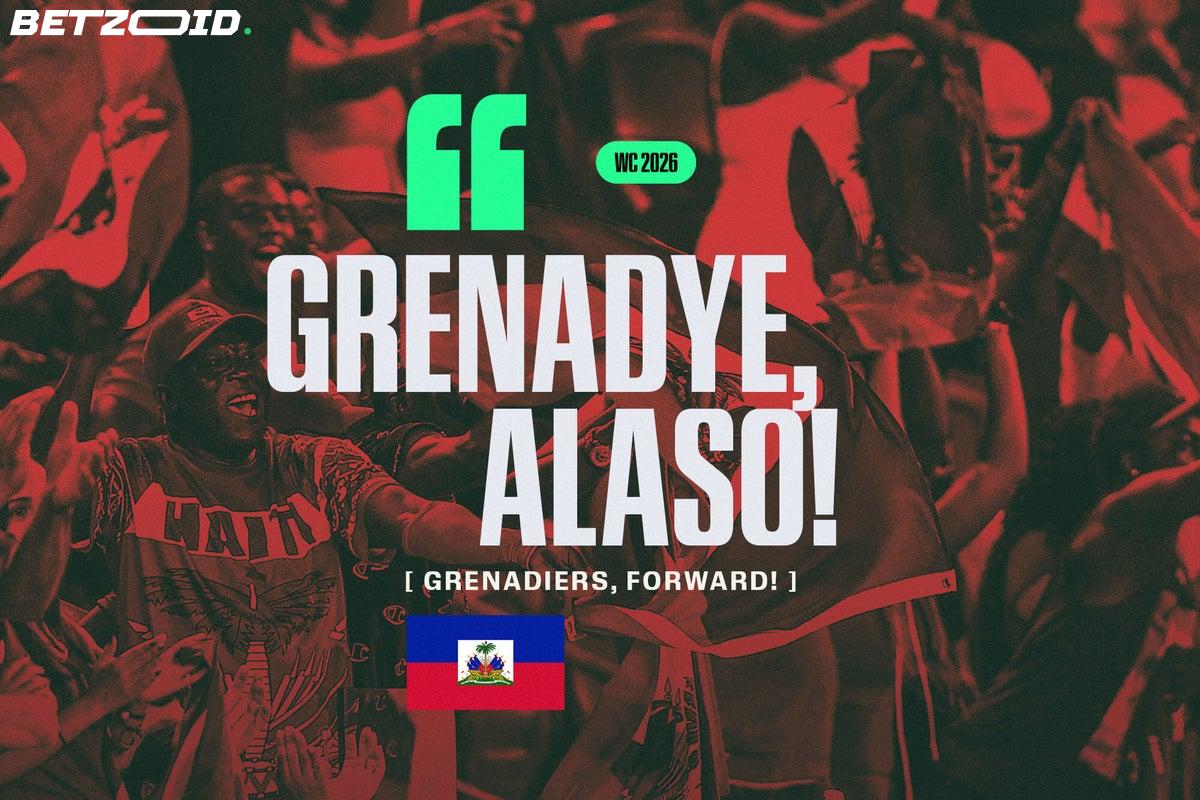
"Supporting the national team is more than football. For me, it's about identity. It's about pride and hope for the country." Jude Bernard has been following Haiti's national team for years, travelling to games across the region. He knows exactly what this World Cup appearance means — and it has very little to do with group stage odds.
Haiti qualified for the 2026 World Cup without playing a single home game. Gangs control an estimated 80 to 90 percent of Port-au-Prince, including the national stadium, forcing the Grenadiers to stage their 'home' qualifiers in Curacao. Some players in the squad have never even set foot in the country they represent. Despite all of that, Haiti topped a Concacaf qualifying group that included Costa Rica and Honduras — two nations with far more stable footballing infrastructure and recent World Cup experience.
A rallying cry rooted in revolution
The phrase Haitian fans use to get behind the team — Grenadye, alaso!, meaning "Grenadiers, forward!" in Haitian Creole — didn't come from a marketing campaign. It dates to the early 1800s, when Napoleon sent what was then the largest expedition ever to sail from France, aiming to reinstate slavery in Haiti after Haitian revolutionaries had forced the French to formally abolish it.
French troops used the call "Grenadiers, a l'assaut!" to charge. The Haitian revolutionaries took it, transformed it into a song, and turned the enemy's battle cry into their own. "They basically reinterpreted it to be something that would inspire them instead of cause them to retreat," says Marlene Daut, Yale professor and co-winner of the 2024 Frederick Douglass Book Prize for her monograph on the Haitian Revolution.
That context matters when you're watching this team play. The phrase isn't nostalgia. It's a living piece of identity.
What to expect in Boston, Philadelphia and Atlanta
Haiti's World Cup group is steep. Morocco and Brazil are their opponents — one of the most tactically organised teams in recent tournament history and the most decorated nation the sport has ever produced. Haiti are not expected to advance. Their odds of reaching the knockout stage sit at the very long end of any market.
But anyone framing this purely as a sporting exercise is missing the point. The Haitian diaspora in the United States is enormous, vocal, and currently navigating a political climate that has made simply being Haitian a flash point. The World Cup, hosted across American cities, arrives at a charged moment.
- Boston, Philadelphia and Atlanta are Haiti's three match venues
- Fans are promising rara bands — drums and trumpets, street processions after games regardless of result
- "Whether we win or lose, we are going to celebrate just because we are there," says Atlanta-based fan Jean Rene Destin
- After Copa America Centenario, Haitian supporters kept New York streets busy for two to three hours post-match — police had to manage traffic
There's genuine belief in the fanbase that Haiti could pull off something similar to Costa Rica's 2014 run — when Los Ticos emerged from a group containing Uruguay, Italy and England, then beat Greece on penalties before falling to the Netherlands in the quarter-finals. That's not a realistic benchmark by any statistical measure. But Haiti's supporters have never particularly cared about statistical measures.
"Being a fan of the Haitian national team is... you never lose hope, no matter what happens," says New York-based fan Dominique Bernard. "No matter how bad it looks, you're always rooting for the team."
"We're proud to be Haitians and we're not hiding it," adds Destin. "People are constantly trying to belittle you. And then we still rise up. We're still proud."
Nou la toujou. We are still here.