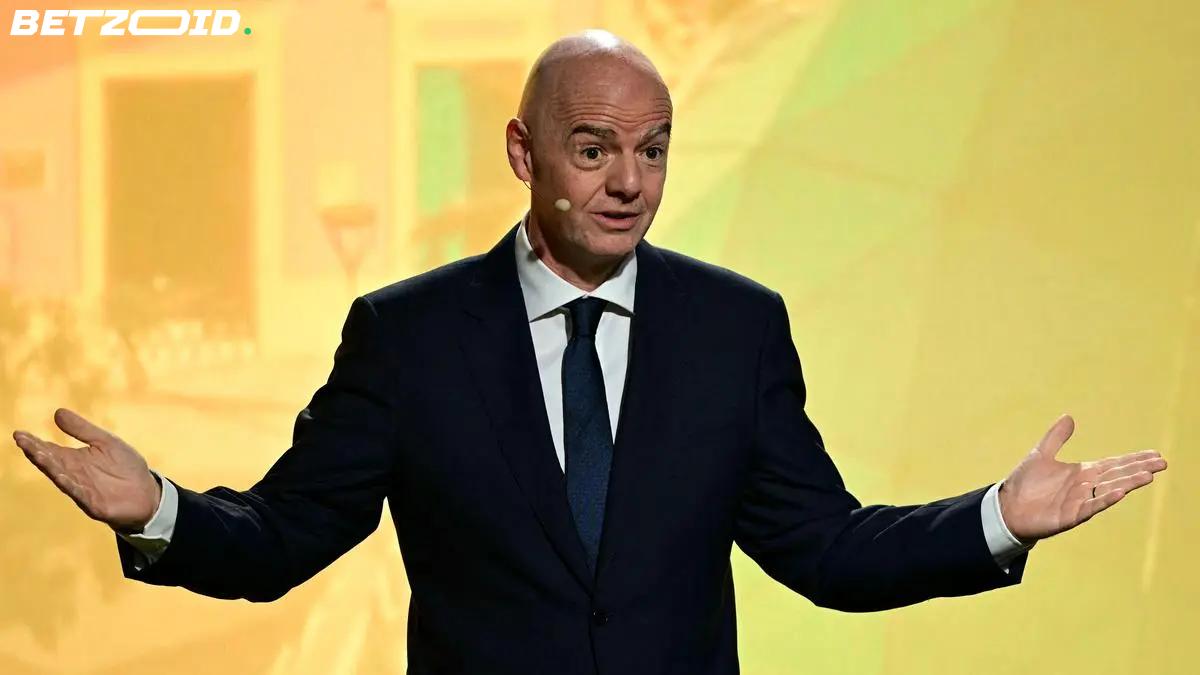
Gianni Infantino tried to sell a piece of football's most valuable engine, and the sport's governing bodies just slammed the door in his face. The plan is dead. The questions it raised aren't.
The scheme — known internally as FIFA Forward Enterprise (FFE) — would have spun off FIFA's commercial operations (ticketing, broadcasting, licensing, sponsorship) into a separate corporate entity, with 20% of the equity sold to private investors. The projected raise: $4.2 billion. To get the votes of a majority of FIFA's 211 member associations required to pass it, Infantino dangled $20 million one-off payments to each association, plus a bump in annual transfers from $2 million to $5 million between 2027 and 2030.
For smaller football federations running on empty, that's a difficult offer to refuse. Which was precisely the point.
JPMorgan and the Kushner Connection
What torpedoed this wasn't the concept of monetising future revenues — that's standard practice in modern finance, and it's already happening across English and European club football. What killed it was who was involved and how the deal was structured.
JPMorgan Chase, the same institution that backed the ill-fated European Super League breakaway five years ago, was the driving force again. And the lead investor lined up for the FFE was a company called Thrive Eternal, run by Joshua Kushner — brother of Jared Kushner, son-in-law and close adviser to Donald Trump. The optics alone were catastrophic. The substance was worse.
Whistleblower reports suggested Infantino, who already earns 4.8 million Swiss francs annually, had arranged to pocket $30 million plus bonuses as head of the FFE upon stepping down from FIFA after what he anticipated would be a third presidential term. Whether that's accurate or not, it coloured everything.
UEFA's Emergency Vote and What It Actually Means
UEFA convened an emergency meeting and voted unanimously to boycott all FIFA-organised events — including the 2030 World Cup — if the plan went ahead. CONCACAF and the Asian Football Confederation also rejected it. That's the majority of world football organised against a single proposal. It rarely gets that clean.
But let's not confuse principle with territory. UEFA's fury isn't primarily about protecting football's soul. It's about protecting UEFA's commercial power. FIFA under Infantino has been systematically expanding — more member nations, more events, more World Cup qualifying spots — all of which dilutes UEFA's grip on the sport's money. A privatised FIFA backed by Wall Street and connected to the Trump orbit would have accelerated that shift dramatically, with investors pushing hard to centralise revenue streams away from the confederations.
- FIFA's 211-member voting bloc increasingly favours smaller nations, shifting power from traditional European heavyweights
- An expanded 48-team World Cup already routes more revenue through FIFA than previous editions
- Private investors in the FFE would have had structural incentives to maximise FIFA's centralised income at UEFA's expense
The plan has collapsed for now. But the underlying tension — between FIFA's expanding ambitions and UEFA's determination to protect its commercial dominance — isn't going anywhere. Infantino still holds the presidency. JPMorgan is still circling. And football's revenue streams, growing every cycle, remain exactly the kind of asset that finance doesn't stop eyeing just because one deal falls through.
The vote failed. The appetite didn't.