"Honestly? We can win it," says Ricardo Carrasco, 26. "Quarter-finalists or champions. Nothing less."
That is not the kind of sentence an Ecuador fan would have said twenty years ago. Between 1938 and the turn of the millennium, La Tri qualified for precisely zero World Cups. They were not even a footnote in global football — they were the blank space on the page. Fans spent every tournament living vicariously through Brazil or Argentina, borrowing someone else's drama, then going home to nothing.
One result of all that absence: Ecuador never accumulated real rivals. While Argentina and Brazil were busy building decades of mutual contempt, Ecuador were on the sidelines. There is some tension with Peru, but that is political, not sporting. Colombia has never regarded them as a worthy adversary. No grudge matches, no needle — just a country finding its feet, very quietly, over a very long time.
March 2001 changed everything
On March 28, 2001, Ecuador beat Brazil for the first time in their history. Seven months later, they finished second in South American qualifying — above Brazil, Uruguay, and Colombia — and booked their first-ever World Cup berth. That 2002 tournament was a coming-out party. The team missed out in 2010 and 2018, but an entire generation has now grown up believing La Tri belong on the biggest stage.
Moises Caicedo at Chelsea. Piero Hincapie at Arsenal. Foreigners who follow the Premier League now know what Ecuador is. "I travelled around the world as a backpacker and people confused us with Colombia or Venezuela," says New York-based fan Danilo Carrion, who left Ecuador at 14. "Now you hear foreigners saying, 'Wow, look at Caicedo, look at Hincapie'. That never used to happen."
That visibility matters beyond football. Ecuador is not a default destination for South American tourists. Greater name recognition from World Cup appearances is a slow-burn national benefit that has nothing to do with group stage points.
The culture is still catching up
The mentality shift is real, but the matchday culture is still evolving. Hugo Erazo, part of fan group La 593 — named after Ecuador's international dialling code — is candid about it. "I remember visiting Brazil and Argentina, seeing all this food and dancing outside the ground. In Ecuador, people just go to the stadium, sit down and that's it. We want to transform that spirit, start the party hours before kick-off."
What the fanbase already has is unity. Set against a backdrop of escalating gang violence and social tension inside the country, La Tri games function as a rare shared space. "When the national team plays, the country stops," says Ricardo Thurdekoos, who has followed Ecuador since the 1980s. "It gives everyone a shared goal."
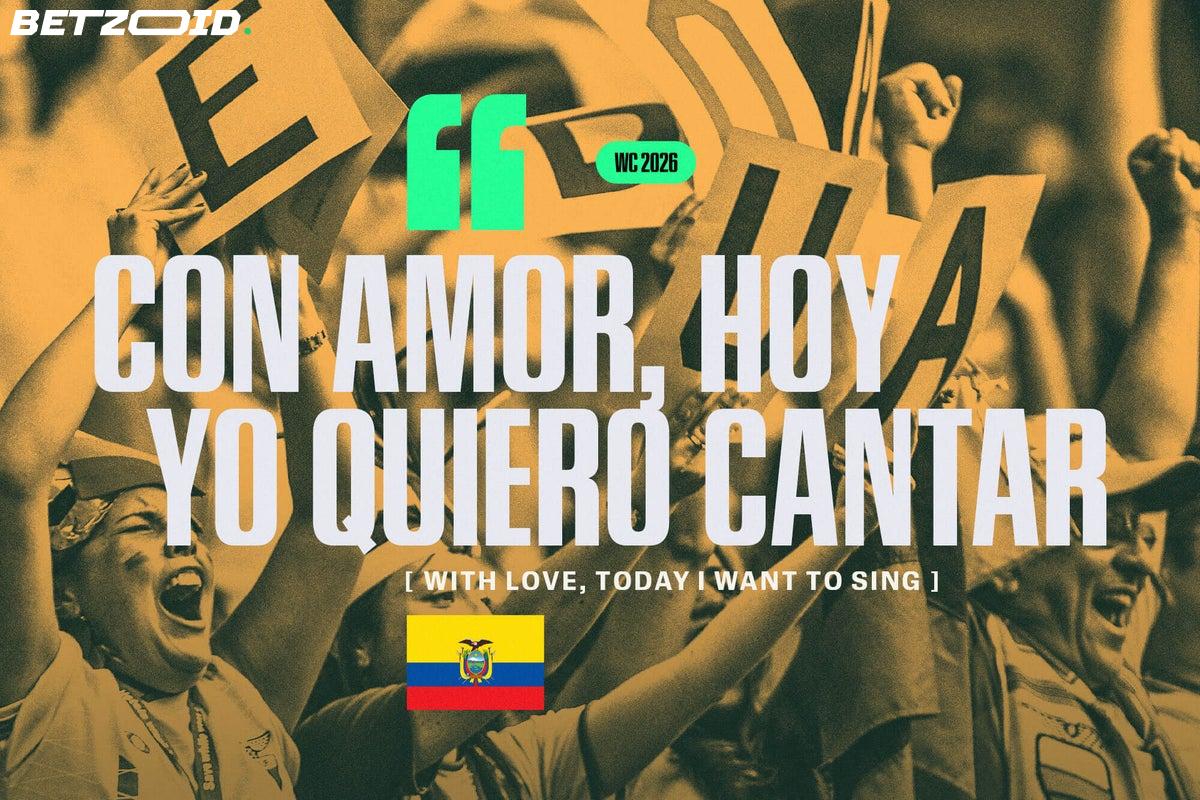
Their fan anthem, A Mi Lindo Ecuador, opens with the line that has become the motto for this generation: "Con amor, hoy yo quiero cantar" — with love, today I want to sing. It is a love letter to the country, urging its diaspora to come home. For decades, there was not much to sing about. There is now.
As for the World Cup itself — Ecuador's odds will not trouble the bookmakers at the top end of the market, but a team with Caicedo pulling the midfield strings and a generation raised on genuine expectation is not one to wave through cheaply in the round of 32 either. Carrasco's dream of a semi-final is ambitious. His insistence that the last 16 is "an obligation" is not.