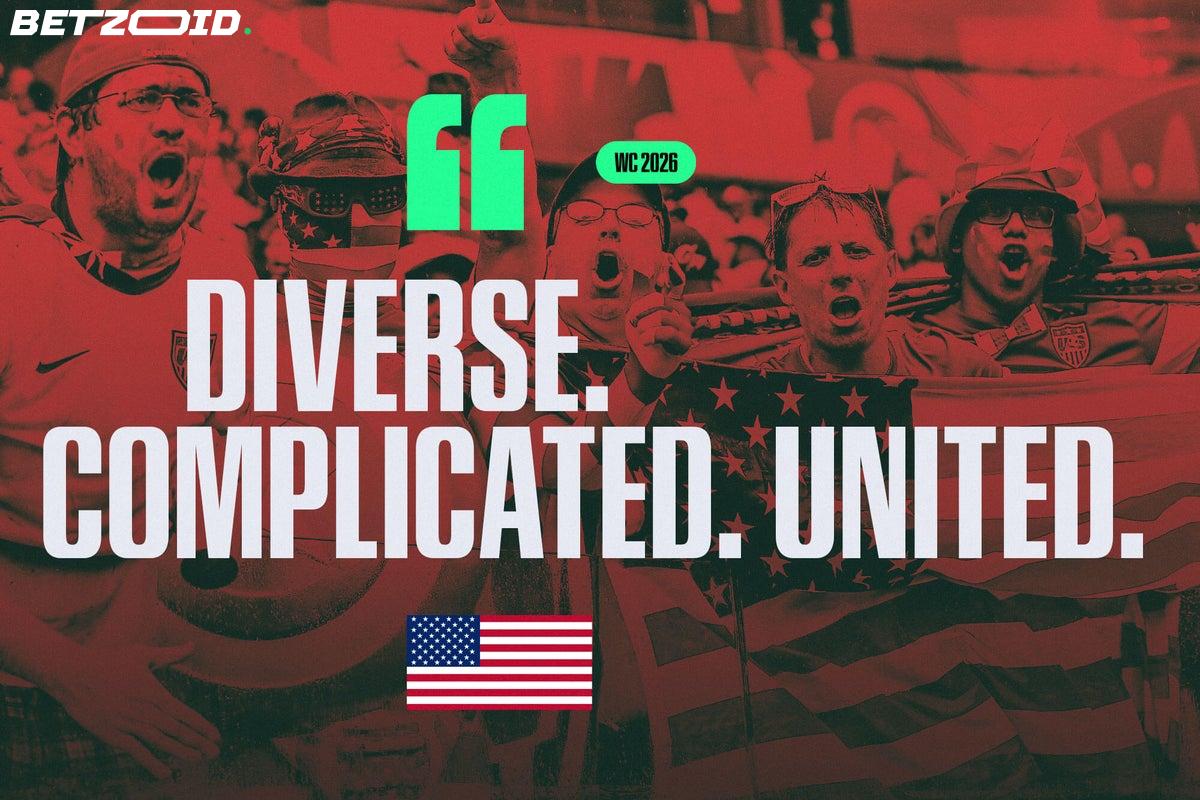
"It's a relentless optimism," says Antonio Borjon, a U.S. fan from Southern California. That phrase cuts to the core of what makes supporting the USMNT unlike following any other national team on the planet.
No generational handover from parent to child. No single national stadium to anchor a supporter culture. No guaranteed expectation of winning. Just millions of people — spread across a continent-sized country, split between dozens of leagues and loyalties — choosing to care, every four years, about a team the world still underestimates.
A fanbase unlike any other
The USMNT's support base is genuinely difficult to map. It includes the hardcore travelers who follow qualifiers across the country, outnumbered at home by Morocco, Colombia, Mexico, or Guatemala supporters in their own backyard. It includes the NFL and NBA obsessives who tune in precisely because U.S. soccer isn't supposed to win. And it includes the children of immigrants who grew up in Ecuadorian jerseys but now wear both, singing two national anthems with their fathers.
Elliott Montalvan, now president of supporters' group Barra 76, lived that exact story. "We'd sing both national anthems, and we'd celebrate every goal, no matter who it came from," he says of watching USMNT vs. Ecuador with his dad. That kind of dual identity isn't a contradiction — it's the product of a country that doesn't have one soccer story.
Craig Hahn, a member of the Sammers supporters' group, is blunt about what that means in practical terms: "The hardcore fanbase for the USMNT that travels around to different games is actually quite small." The deep, generational tribal loyalty that makes Newcastle or Penarol feel like a birthright simply doesn't exist yet in American soccer.
The 2026 opportunity is real — but so is the work
What does exist is something harder to manufacture: genuine underdog energy. The U.S. isn't playing with the weight of expectation the way it does in basketball or baseball. As Christine Mule of the American Outlaws puts it, "The USA basketball team plays in the Olympics and they're pretty much gonna crush anybody they come up against." Soccer is different. That's not a weakness — it's the draw.
From a betting perspective, that underdog status is priced into every market the USMNT appears in, and the 2026 tournament, played on home soil, is the first time in a generation that the casual American sports fan will have a genuine reason to engage. When the base expands — and it will — those early-round odds on the U.S. tend to tighten fast as public money piles in.
Outside critics have long dismissed U.S. supporter culture as thin. Montalvan doesn't shy away from it. "It looks very Chucky Cheese, or it looks very cringe... It sounds very nursery rhyme-ish." But he sees the 2026 World Cup as the chance to start building something with real identity — not borrowed from South America or Europe, but shaped by the actual mix of cultures that shows up in the stands.
- U.S. fans have been outnumbered at home games by Morocco, Colombia, Turkey, Guatemala, South Korea, and Mexico supporters in recent years
- Supporters groups including the American Outlaws, Sammers, and Barra 76 are actively working to define and grow a distinct U.S. fan culture
- The 2026 World Cup will be hosted across the United States, giving the USMNT a rare extended moment in the national spotlight
"Get in on the ground floor and work your way up," says Boston-area fan Jon Strauss, who has followed the team since the 1990s. It's the opposite of frontrunning, and for a country that usually arrives already winning, it's a genuinely unfamiliar feeling.
Whether the team delivers or not this summer, the story of U.S. soccer fandom is still being written. And right now, it belongs to everyone and no one — which, depending on how you look at it, is exactly the point.