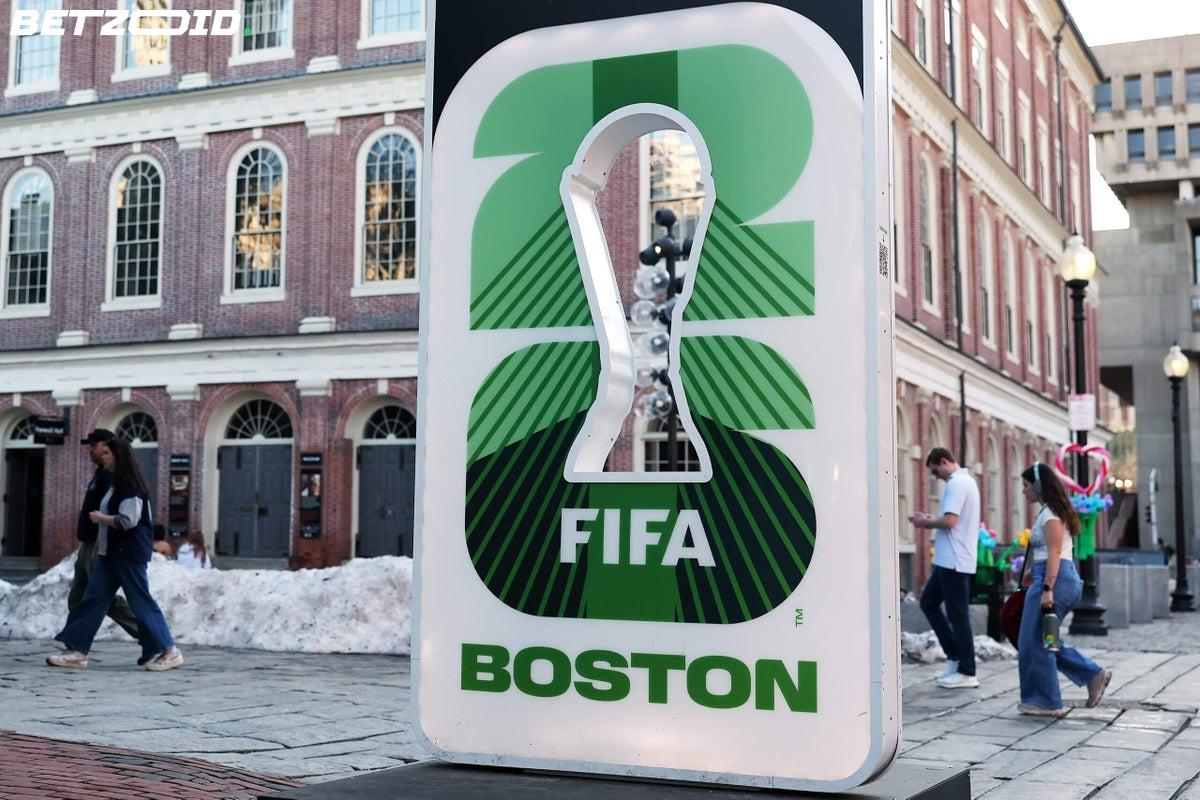
Ronan Evain, executive director of Football Supporters Europe, said the $80 train prices for World Cup matchdays were "completely unprecedented" and that the single objective of this tournament now appears to be "extracting as much money as possible from a captive audience." Then Boston went ahead and announced a bus service at $95 a seat.
The Boston Stadium Express — operated with Massachusetts motorcoach company Yankee Line — will run fans from over 20 pickup points across Greater Boston to Gillette Stadium in Foxboro. Pickup locations include Boston Logan International and the Rhode Island Convention Center in Providence. Over 100 hotel properties in the region are also on the route. The buses start three hours before kickoff, and the return leg leaves roughly 30 minutes after the final whistle.
No discounts. Not for children. Not for over-60s. Not for passengers with accessibility needs.
A Captive Market, By Design
This isn't just gouging — it's structurally guaranteed gouging. There will be no free or general parking at Gillette Stadium during the World Cup. FIFA's stadium perimeter rules ban tailgating entirely. So you either pay the $95 bus, take the $80 round-trip train (quadruple the usual $20 NFL-day price), or stump up $175 for official parking during the group stage — rising to $270 for the quarter-final. Oversized vehicles hit $980 for that same game.
The host committee argues the pricing reflects genuine operational costs and points out that bus services to Taylor Swift's Eras Tour at Gillette were already around $75. The World Cup, they say, requires more coordination and more pickup points — hence the extra $20. That reasoning holds some logic. It doesn't make the number any easier to swallow.
What makes this sting harder is the contrast with recent tournaments. At the 2022 World Cup in Qatar, official ticket-holders rode Doha's metro free throughout the tournament. At Euro 2024 in Germany, match tickets doubled as public transport passes on game day. Neither of those models was ever realistic in the U.S., but knowing they existed makes $95 for a coach ride feel like a different sport entirely.
FIFA Keeps the Upside, Cities Eat the Cost
The deeper issue sits above Boston's host committee. FIFA president Gianni Infantino has projected $11 billion in revenue from this tournament — drawn from ticket sales, broadcast rights, in-stadium sponsorship, and even official parking fees, all of which flow directly to FIFA. The host cities, meanwhile, carry costs including safety, security, police escorts for teams and referees (and Infantino's own delegation), medical services, fire protection, and fan fest operations — all provided free of charge to FIFA.
In return, FIFA cites $30 billion in projected economic impact across U.S. host cities. Several city executives, speaking anonymously to protect working relationships, are already skeptical those numbers will materialise.
Gillette Stadium — owned by billionaire Robert Kraft's Kraft Group — will host seven matches, including a round-of-32 game and a quarter-final. Group-stage fixtures include Scotland vs Haiti, Scotland vs Morocco, England vs Ghana, and Norway vs France. There will be crowds of 65,000 inside the stadium. Getting them there, it turns out, is a business in itself.
Evain's parting shot deserves repeating: "Charging fans for making the safe and environmentally responsible choice of using public transport also makes a mockery of FIFA's climate strategy and its net-zero commitments." Hard to argue with that when a bus seat costs nearly a hundred dollars.