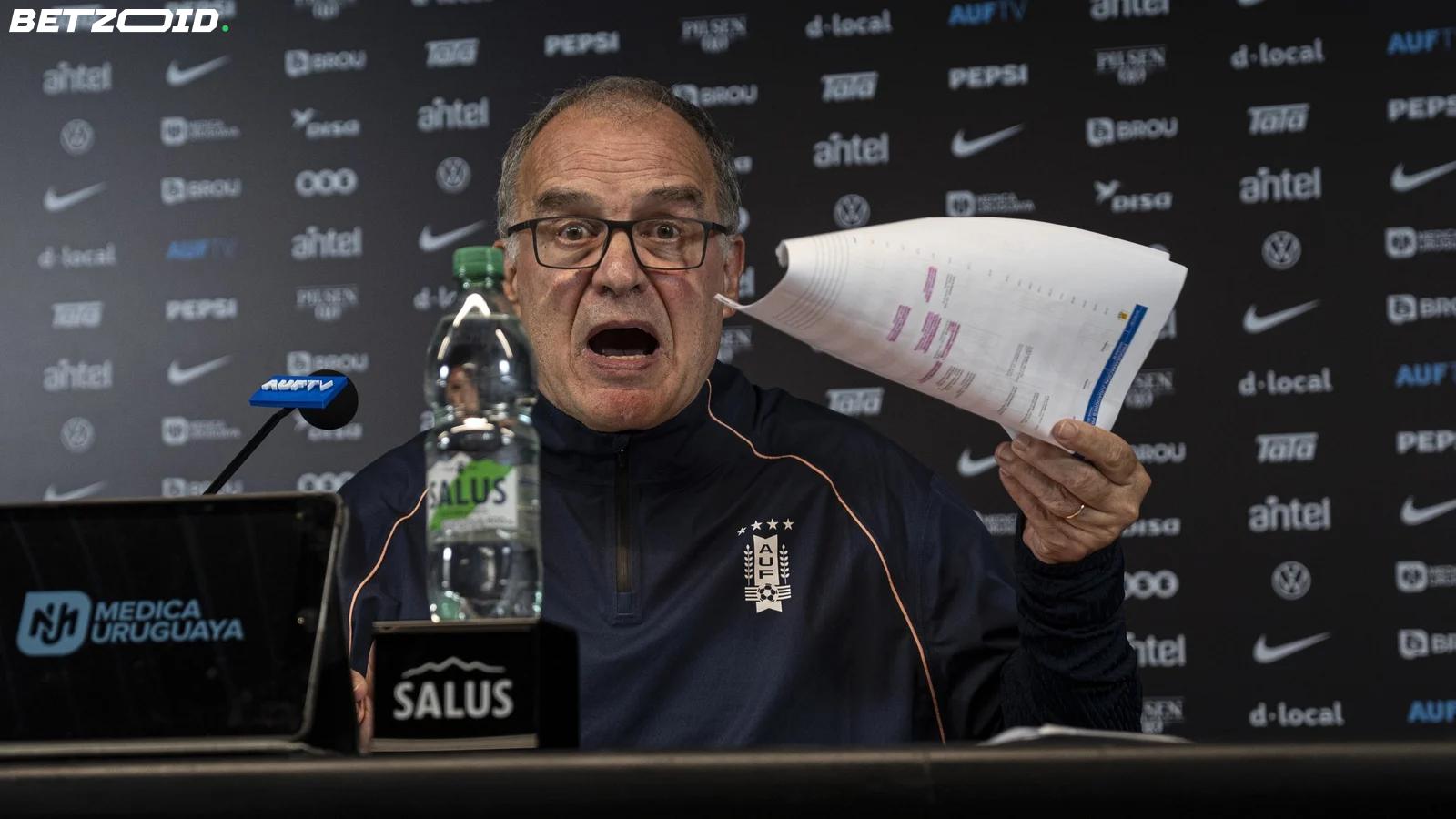
"Nobody was interested in what I transmitted. I don't have the smallest doubt of that." That's how Marcelo Bielsa chose to close his chapter with Uruguay — not with diplomatic platitudes, but with a 100-minute press conference that read more like a public autopsy.
The 70-year-old former Leeds United manager oversaw a group stage exit that, on paper, looks straightforward but carries the sting of underachievement. Uruguay drew with Saudi Arabia, drew with Cape Verde, then lost 1-0 to Spain. Two points. Third in Group H. Not enough.
A manager who felt ignored
Bielsa's philosophy is famously demanding — tactically dense, physically exhausting, intellectually uncompromising. What he made clear in this farewell is that he doesn't believe the players ever truly bought in.
"I know when someone cares what I know," he said. "Nothing I tried to transmit was important, at any level." He even offered a telling contrast — an engineer from Australia who came to Montevideo specifically to learn from him. "He's the only one who I remembered being interested." The implication about the rest of the squad is not subtle.
He also addressed two moments that raised eyebrows during the tournament. His deliberate downward gaze during pre-match FIFA photo sessions, which he framed simply as being "no good at posing for photos." And a terse post-match interview after the Spain defeat, where he acknowledged he "perhaps wasn't as polite as I should have been" — though he put the blame squarely on broadcasters who "manage times of anguish as if they were times of happiness."
What this means beyond the exit
Uruguay came into this World Cup with genuine talent in their squad and a manager with a track record of transforming teams. The group stage disposal — against opponents that included Saudi Arabia and Cape Verde — will raise serious questions about the squad's mentality and technical direction going forward.
For anyone who had backed Uruguay to reach the knockouts, Bielsa's words confirm what the results already suggested: this wasn't bad luck. Something was broken at the core of it.
"Case closed," he said. He meant it.