FIFA just listed a $32,970 seat for the World Cup final at MetLife Stadium. That's not a premium hospitality package with a helicopter transfer. That's a single seat to watch a football match.
The July 19 final ticket — unveiled last Thursday — is triple what FIFA's most expensive ticket cost before that moment. And it's the logical endpoint of a pricing strategy that has turned the supposed global game into something closer to a monthlong luxury event for those who can afford it.
What it actually costs to go
If you want to take a family of four to Norway vs. Senegal — one of the cheapest group stage games available in the New York area — the math goes like this: four upper-corner seats in Section 306 at MetLife will cost you $402.50 each on FIFA's official resale platform, the cheapest available option. That's $1,610 before you've bought a single hot dog.
Coming in from New York City? NJ Transit is charging $105 per person on matchdays. That pushes your family's total to $2,030 just to get there and sit down. Parking at American Dream is $225, and you're walking from there because the general lots have been repurposed for fan engagement and security. For a 90-minute game, that works out to roughly $5.64 per person, per minute.
The Mets are playing at Citi Field that same night. Tickets start under $50. Make of that what you will.
Compare this to Qatar 2022, where the most expensive Category 1 seat at the final was $1,606 — and group stage tickets started at $69. Fans also got free metro access for the tournament. In 2022. In Qatar.
FIFA's defence doesn't hold up
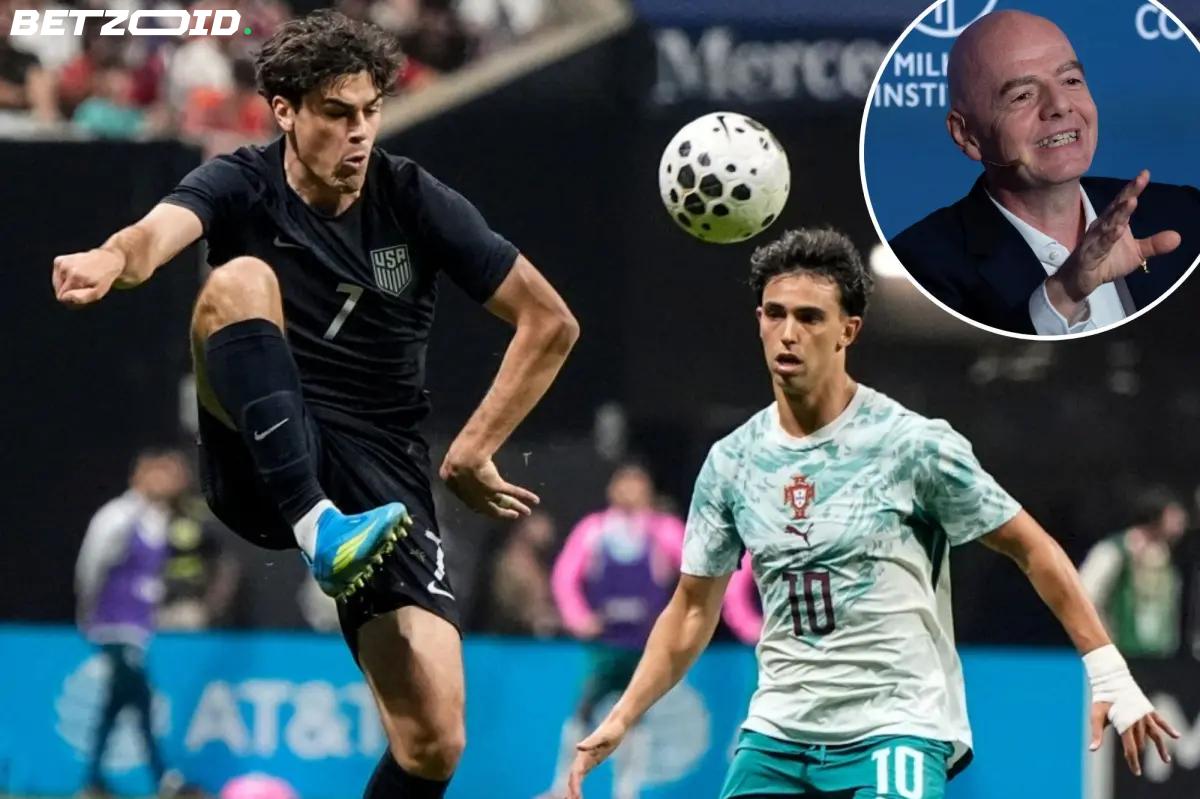
FIFA president Gianni Infantino appeared at the Milken Institute Global Conference in Beverly Hills last Tuesday — which feels appropriate given the pricing — and explained the logic: the American market demands it. Set prices too low and tickets flood the secondary market at even higher prices. He also claimed 25 percent of group stage tickets are available for under $300, arguing you can't see a top U.S. college game for that price.
That last point is demonstrably false. Tickets to the Cotton Bowl dropped below $50 last year after Texas A&M's first-round CFP exit. But the secondary market argument has at least some structural validity — scalping is a genuine problem FIFA doesn't usually face in Europe, where secondary markets are often outright banned and allocation goes through official supporter clubs.
The issue is that FIFA seems to have hiked prices to meet a secondary market ceiling that doesn't actually exist at this tournament. According to TicketData.com, prices across nearly every one of the 91 U.S. and Canada matches have fallen over the past 30 days, with a large majority dropping by double-digit percentages. The American Hotel and Lodging Association released a report last Monday showing hotel bookings in World Cup host cities are tracking below forecasts for 80 percent of respondents.
Sales for the USMNT opener against Paraguay — the match that should be the easiest sell of the entire tournament — have lagged badly. A minimum $1,120 ticket for a U.S. home opener, versus $302 four years ago to see Qatar play Ecuador, will do that.
Meanwhile, Penn Station will be closed to non-ticketholders on New York gamedays, NJ Transit pricing has generated its own wave of local outrage, and the actual football has barely registered in the noise. FIFA's contracts with host cities hand the organization almost all revenue while cities absorb security and infrastructure costs. Infantino estimates FIFA will take at least $11 billion from the tournament against a $3.6 billion budget — from an organisation officially registered as a non-profit under Swiss law.
The organisation says it reinvests that money into developing football globally. Whether that development extends to the country that just handed them the biggest cash grab in sporting history is, at this point, a genuinely open question.