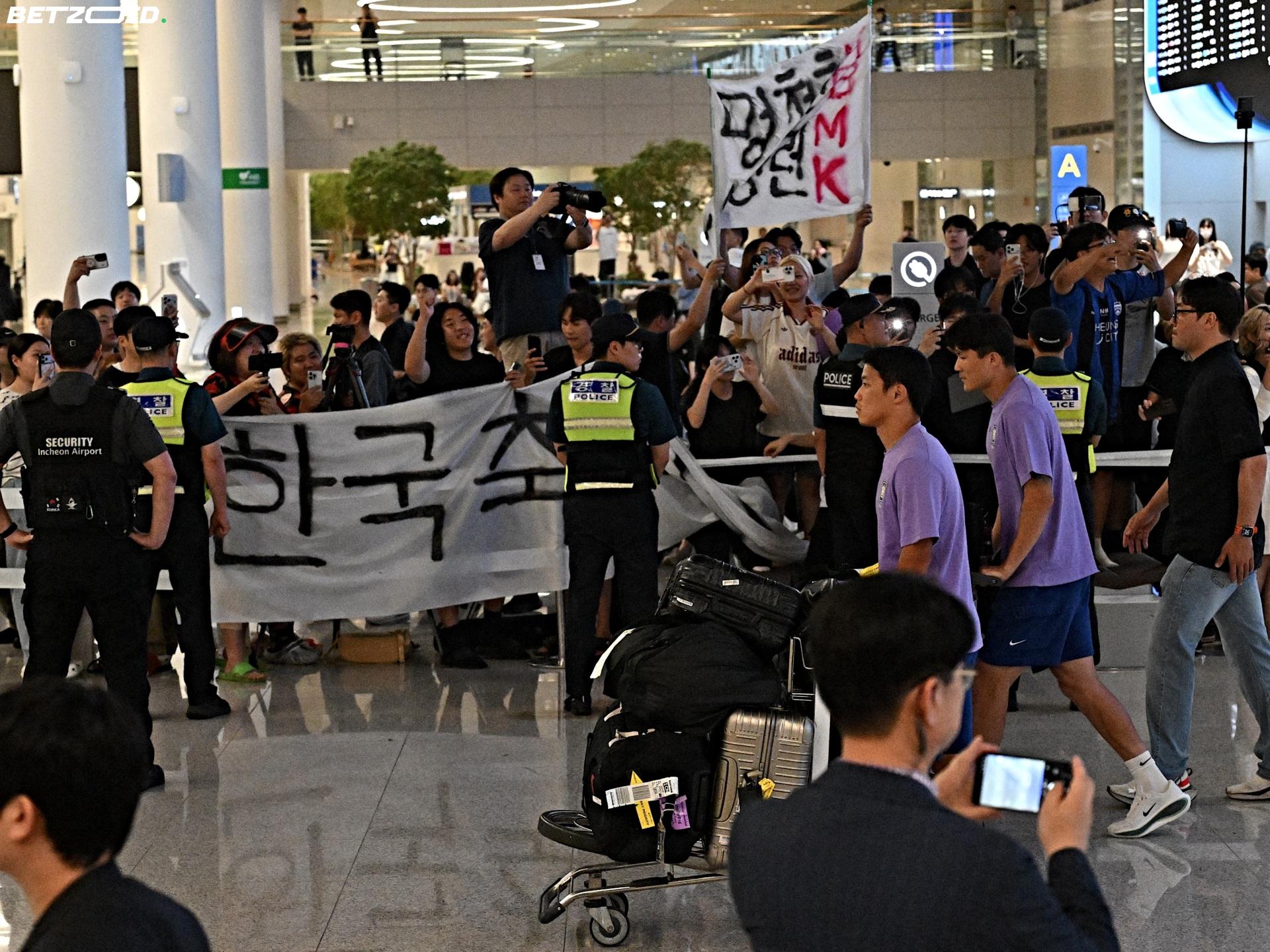
When your team flies home at 4 AM to dodge the crowds and still gets ambushed by dozens of furious fans and a squad of 160 riot police, that's not a rough night — that's a full institutional crisis.
South Korea's World Cup squad, along with coach Hong Myung-bo and Korean Football Association president Chung Mong-gyu, touched down at Incheon International Airport in the early hours of Tuesday morning. The ungodly arrival time was reportedly chosen to reduce the risk of mob violence — Hong had been receiving death threats online. It didn't work. Fifty to a hundred fans were waiting anyway, chanting "Hong Myung-bo, get out of Korea!" and "Hong Myung-bo, you should be ashamed!" Someone threw a dog's dental chew at the KFA president's head. One sign read: "Korean football is dead."
Hard to argue with the sign.
A failure that goes deeper than tactics
South Korea went out in the group stage, beating Czechia but losing to Mexico and South Africa — two sides that have never won a World Cup. Pre-tournament expectations had the Koreans comfortably advancing, given the squad's European experience. They didn't. And for a country that went out in the group stage in 2014 under the same coach, there's a very specific kind of fury attached to that.
Hong Myung-bo is the only manager in South Korean football history to be given a second chance with the national team. His 2024 appointment sparked a parliamentary investigation into whether his hiring was the product of favoritism and corruption inside the KFA rather than footballing merit. The investigation produced no meaningful consequences. Now the football has delivered its own verdict.
Players like Jo Hyeon-woo, Kim Min-jae, Hwang In-beom, Hwang Hee-chan and Lee Kang-in — who plays for PSG — walked through the terminal with heads down, enduring the noise. Lee was reportedly the only one who looked directly at the crowd, and the description of his expression — "staring painfully" — tells you everything about the mood in that group.
The fans who showed up weren't just venting. "The poor results are one thing," one supporter told AFP. "I think the people need an explanation for the poor results. It is regrettable that this responsibility was only addressed with a single resignation." Hong's resignation clears one chair. It doesn't answer any of the structural questions about how South Korean football makes its biggest decisions.
When the president gets involved, it's beyond sport
South Korean President Lee Jae-myung went further than most heads of state would dare. He publicly called Hong "incompetent" on social media, offered the country a personal apology describing "utter bewilderment," and ordered the Ministry of Culture, Sports and Tourism to investigate the hiring process and prevent it happening again.
"When you put an incompetent person in charge by prioritizing personal connections over their abilities, then it's easy to predict how things will play out," Lee wrote. That's not diplomatic language. That's a sitting president openly blaming a sporting body for institutional corruption, and doing it in public.
For anyone watching South Korean football's competitive trajectory — and those tracking Asian football markets more broadly — the question now is what the KFA actually does next. Another insider appointment and this becomes a pattern with consequences that stretch well beyond one tournament exit. The fans demanding Hong return his salary, reported to be worth millions of won, may not get their money back. But the pressure for genuine structural reform just got a direct line to the presidential office.