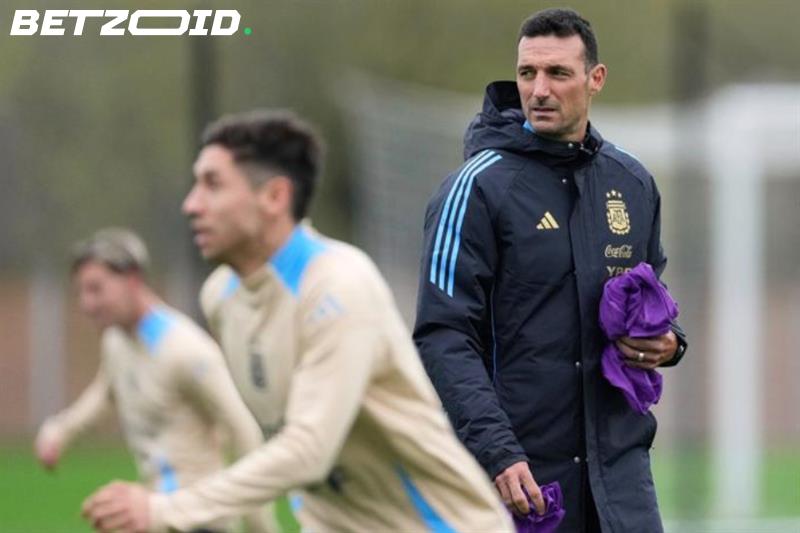
"We are world champions." That's what it took to break Lionel Scaloni. A player whispering those three words into his ear, minutes after Gonzalo Montiel's penalty sealed the 2022 World Cup. Before that, Scaloni had just stood there — still, silent, apparently unmoved by one of the greatest sporting moments in Argentine history.
That composure isn't an act. And as Argentina prepares to defend the title at the 2026 World Cup, it may be the most important quality Scaloni brings to the dugout.
The man who wasn't supposed to be there
When Scaloni took the Argentina job on an interim basis in 2018, Diego Maradona's verdict was blunt: "Scaloni? He can't even direct traffic." The AFA was shopping around for Pochettino or Simeone. Scaloni wasn't the plan — he was a placeholder.
Six years later, he's won two Copa Américas (2021 and 2024), topped South America's World Cup qualifying group, and delivered Argentina its first World Cup since 1986. He was right when he said, shortly after lifting the trophy, that Maradona "wasn't far off" — not as a dig at himself, but as a man who understood exactly how unlikely the whole thing was.
His secret weapon isn't tactics. It's cycling. Scaloni spends two to three hours a day on a bike, either through the mountains of Mallorca where he lives, or back in his hometown of Pujato in Argentina. "On the bike, you can think about your team, your opponent, how to prepare for the match," he's said. "It's a good escape... it helps me lower my expectations, be calmer." The hobby came via a recommendation from his friend Carlos Moyá, the former Spanish tennis player. Whatever the origin, the results speak for themselves.
The 2026 challenge is genuinely difficult
Defending a World Cup is not something anyone does anymore. Brazil are the last side to manage it — in 1962. Sixty-three years ago. The gap tells you everything about how hard this is.
Scaloni is walking into 2026 with Messi at 38 and nearing the end, a fractious relationship with the AFA (who face corruption accusations and internal chaos), and a pre-tournament schedule that included friendlies against Indonesia, Puerto Rico, Angola, Mauritania, and Zambia. The last two warm-up games are against Honduras and Iceland — neither of whom qualified for the tournament. The preparation has been widely questioned, and not without reason.
He's also had to deal with rumoured dressing room friction following a training camp incident before a qualifier loss to Uruguay, and publicly flirted with resignation after the win over Brazil in November 2023 — citing his parents' health, though the timing raised eyebrows. He stayed. The squad largely stayed intact too: 20 of the 26 players from Qatar are in his preliminary 55-man roster for 2026.
Argentina open against Algeria on June 16 in Kansas City, then face Austria (June 22) and Jordan (June 27) in Group J. On paper, a manageable path to the knockouts. But every team will be waiting to land a punch on the champions — just as Saudi Arabia did in Qatar's opening match before Scaloni rebuilt mid-tournament by handing Enzo Fernández, Alexis Mac Allister, and Julián Álvarez their moments.
Jorge Valdano, who won the World Cup with Argentina in 1986, put it well: "Argentina has achieved the best thing a national team can achieve: being a team. Players who haven't lost their hunger." That hunger is real. Whether it's enough against sides who have spent four years studying exactly how Argentina play is the actual question.
"The World Cup is very, very difficult," Scaloni said recently. "To win a World Cup, a lot of things have to come together, not just playing well. It's very difficult, but not impossible."
He becomes only the third coach to take Argentina to back-to-back World Cups, following Menotti and Bilardo — both also champions. He dismisses comparisons to either. That might be the most Scaloni thing about him: the man least interested in his own legend is the one building it.