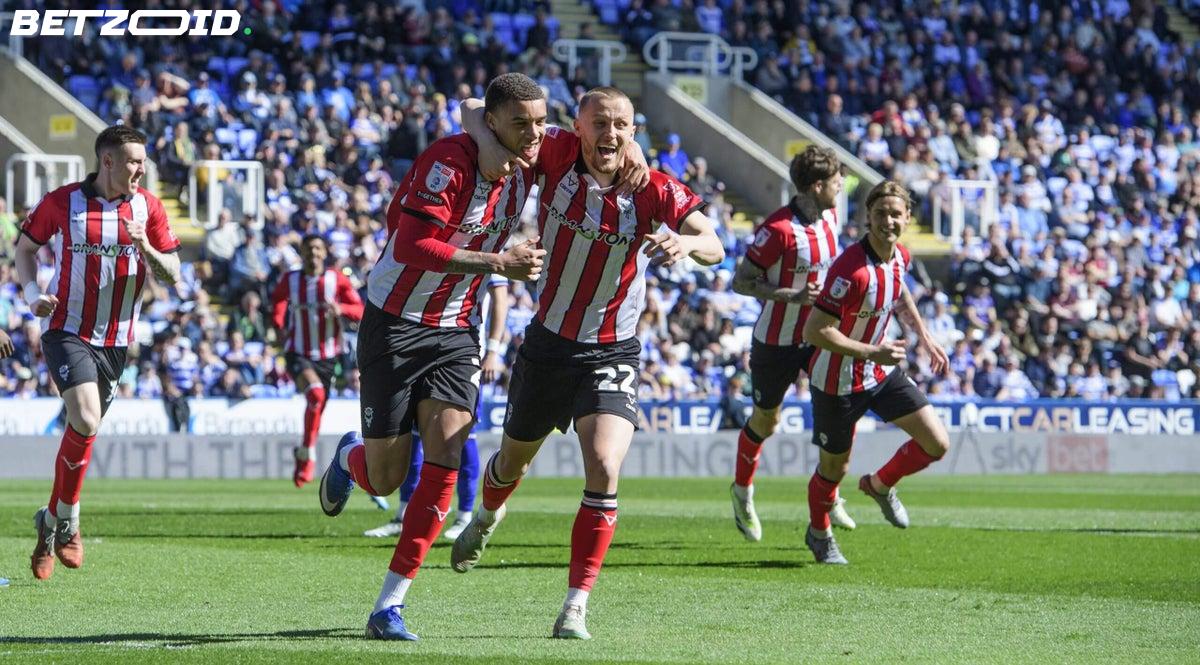
"Arsenal are the Lincoln City of the Premier League!" Landon Donovan said it with a laugh, but he wasn't entirely joking. Lincoln just clinched promotion to the Championship — their first time in the second tier of English football since 1952 — and they did it by out-thinking, out-pressing, and out-set-piecing virtually everyone in League One on a budget of roughly £5 million.
A 2-1 win over Reading on Monday sealed the deal with five games to spare. They sit 19 points clear of third-placed Bradford and lead Championship-bound Cardiff City by 12 in the race for the title. Their unbeaten run now stretches to 23 matches, 18 of which they've won. For context: the top spenders in League One are burning through £14-15 million a season. Lincoln's highest-paid player earns £3,500 a week.
The model is smarter than the money
Sporting director Jez George runs a recruitment operation that reads more like a tech startup than a football club. The club buys data from analysis company Impect, covering eight to ten European leagues. Their in-house data scientists write Python code and build algorithms to identify player profiles for every position. Ukrainian midfielder Ivan Varfolomeev was flagged entirely through that process before Lincoln spent £400,000 — their record fee — to sign him from Czech side Slovan Liberec.
That's not a one-off. Forward Jack Moylan came from the League of Ireland. Striker Ben House arrived from non-League Eastleigh. Goalkeeper George Wickens was a free transfer who had only played professionally on loan in the National League and Scottish Premiership before Lincoln came calling. The profile is consistent: undervalued, data-verified, then scouted in person and assessed for character fit.
The club spent £10,000 on an AI tool from Insight Sport — since acquired by the Friedkin Group, who own Everton and Roma — that analyses millions of set pieces to identify opponent weaknesses and generate fresh patterns. Twenty-six of Lincoln's 77 league goals this season have come from set pieces. Last season, they scored from one in every 16 corners in a league where the average is one in 33. Rangers noticed — they poached set-piece coach Scott Fry in November. Lincoln kept on scoring anyway.
Under manager Michael Skubala, the team operates with the lowest average possession rate in League One. They press high, avoid risk in their own third, and score first in 75-80% of their matches. They've led for 52% of total minutes played — 20% more than the next-best side. They've been behind for just 8% of minutes all season. That's not luck. That's a system working exactly as designed.
Staying up is the real job now
The American investment angle is well-documented at this point — Ron Fowler, formerly of the San Diego Padres, holds the largest stake, with fellow American Harvey Jabara also invested and Donovan serving as investor and strategic advisor. South African hedge fund manager Clive Nates has been there since 2016, when Lincoln were in the fifth tier of non-League football. The ownership group deserves credit for the stability, but they haven't simply outspent the competition. Even with promotion secured, Lincoln lost around £3 million in 2023-24.
The Championship is a different animal. Revenues are larger but so are wage bills, and the gap between a well-run smaller club and the parachute payment giants is significant. Lincoln's wage structure — tight, collective, with a small spread between highest and lowest earners — will face pressure. No individual player has even hit double figures in league goals this season, which tells you everything about how this squad functions. That collective identity will be tested when Championship clubs come knocking for their best players.
- Lincoln have sold over £3 million in playing talent over the past three years, mostly to Championship clubs
- Their training complex was funded by an FA Cup run in 2016-17 that knocked out Burnley (Premier League), Brighton and Ipswich before a quarter-final against Arsenal
- George maintains a database of potential hires for every role and met three prospective coaches in the past month alone
Donovan frames it cleanly: "It's not about going up. It is about staying up." George is just as direct — "We can't have a personality transplant." The principles stay. The budget stays modest. The data operation keeps running.
Lincoln's Championship odds next season will be shaped entirely by whether a club built to punch above its weight can do it one division higher, against opponents with four times the financial muscle. The blueprint is real. The proof of concept is sitting there in the League One table. Whether it scales is the question that starts in August.