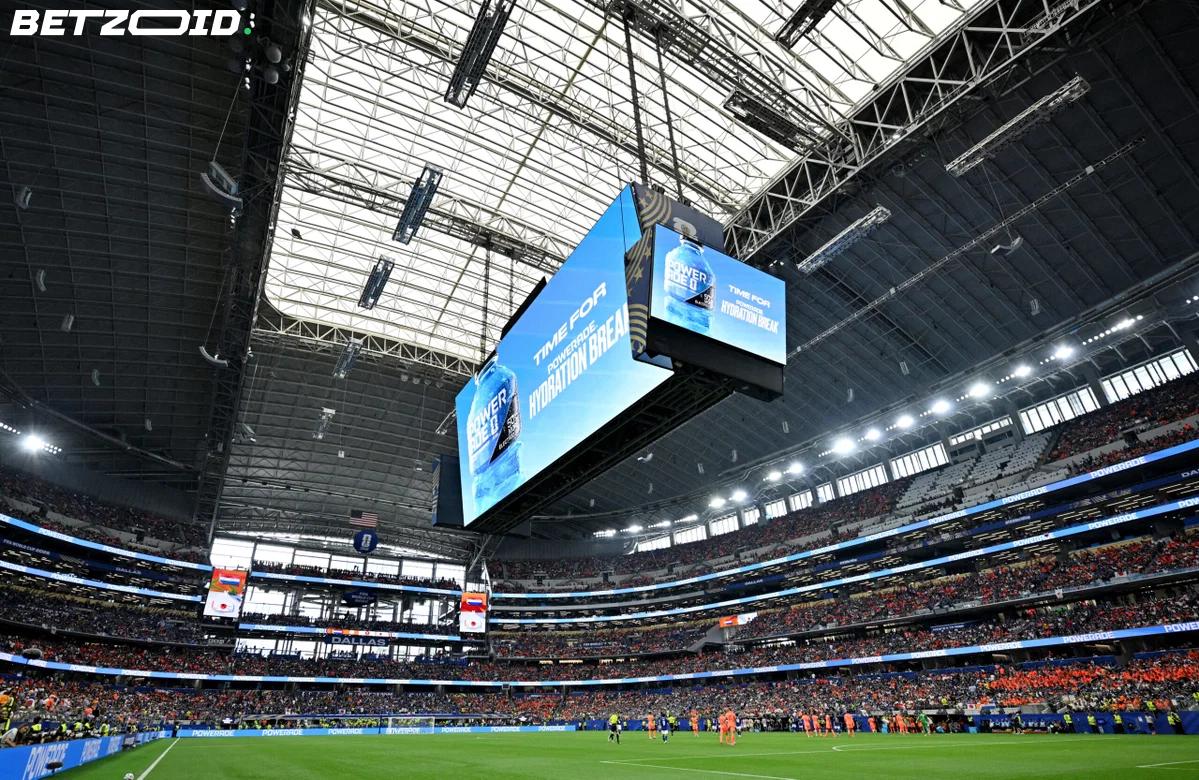
A hydration break during a rainstorm in Philadelphia. Boos raining down inside the stadium while players sat in puddles doing nothing. If there's a single image that captures how badly FIFA has misjudged this, that's it.
The mandatory hydration break — introduced at the 2025 Club World Cup and imposed on every World Cup match regardless of conditions — has become one of the tournament's defining controversies. Not for good reasons.
National Soccer Hall of Famer Marcelo Balboa didn't hold back on CBS Sports' Golazo Network. "There's no need to stop the game at 70°-80° Fahrenheit," he said. "Over the tournament, there are only five games that hit the heat requirement. Now we're stopping the game, we're stopping the rhythm." He went further, pointing to the gesture players were making on the touchline — four fingers, signaling the break like a quarter-change in American football. "It's not our sport," he said. "You're changing our sport, and it's not good."
Mandatory enforcement is the real problem
The case for hydration breaks in genuine heat isn't hard to make. Ninety-degree temperatures, high humidity, players cramping — fine. But FIFA's insistence on applying the rule uniformly across every match, regardless of the thermometer, is where the logic falls apart.
Gianni Infantino framed it as fairness. "If we were to use hydration breaks only in those matches where it was too hot... we would give an advantage or a disadvantage to some of the coaches or some of the teams," he said. That argument would hold water if the breaks weren't already handing coaches a tactical timeout they don't have in any other version of the sport. Infantino acknowledged the tactical benefit himself, then insisted it wasn't the point.
Balboa's co-host Tony Meloa described what he saw during France vs Iraq in Philadelphia: "It was raining, and these guys were taking a hydration break. Everyone was miserable, and the guys coming out of the dugout were miserable — they were just sitting in the rain doing nothing."
The game had already been delayed over two hours at halftime due to torrential rain. Then came the break anyway. In the second half. In the downpour.
UEFA takes its shot
The backlash has handed UEFA a rare PR win. The European governing body confirmed that Euro 2028 will not have mandatory hydration breaks — instead assessing conditions game by game using the standard Wet Bulb Globe Temperature metric. It's how the rest of the football world handles heat. It works.
This puts FIFA and UEFA back at opposite ends of the table, a familiar position on issues from World Cup expansion to player welfare. But here, UEFA's position is the common-sense one, and fans know it.
Infantino, undeterred, said FIFA will use the World Cup experience to consider rolling the hydration break into future events. The break that drew boos inside the world's largest air-conditioned stadium — AT&T Stadium, during England vs Croatia — may not be going anywhere.
"I am not a fan of it," Balboa said plainly. On this, most of the watching world agrees with him.