

Plinko looks like the simplest game on the internet — drop a ball, watch it bounce, collect whatever multiplier it lands in — yet tracking down casinos with Plinko that stock the exact build you want takes more digging than it should. The title rarely sits in the slots lobby; it lives under "instant win", "originals" or "crash games", and at least four different studios publish something called Plinko, each with its own rows, risk levels and paytable. Two sites can both advertise the game and still give you completely different maximum multipliers.
Our editorial team at Betzoid works through Canadian-facing lobbies with a short list of checks: which studio version is actually loaded, whether the game runs in demo before you register, what the minimum bet per ball is in CAD or crypto, and how the bonus terms treat instant-win titles. That last point catches people out constantly — plenty of welcome offers either exclude the category or count it at a fraction of a slot spin. Below the comparison, we go through the practical checks that decide which lobby suits your bankroll.
Top Casinos With Plinko (October 2026)






How Plinko Works at Canadian Online Casinos
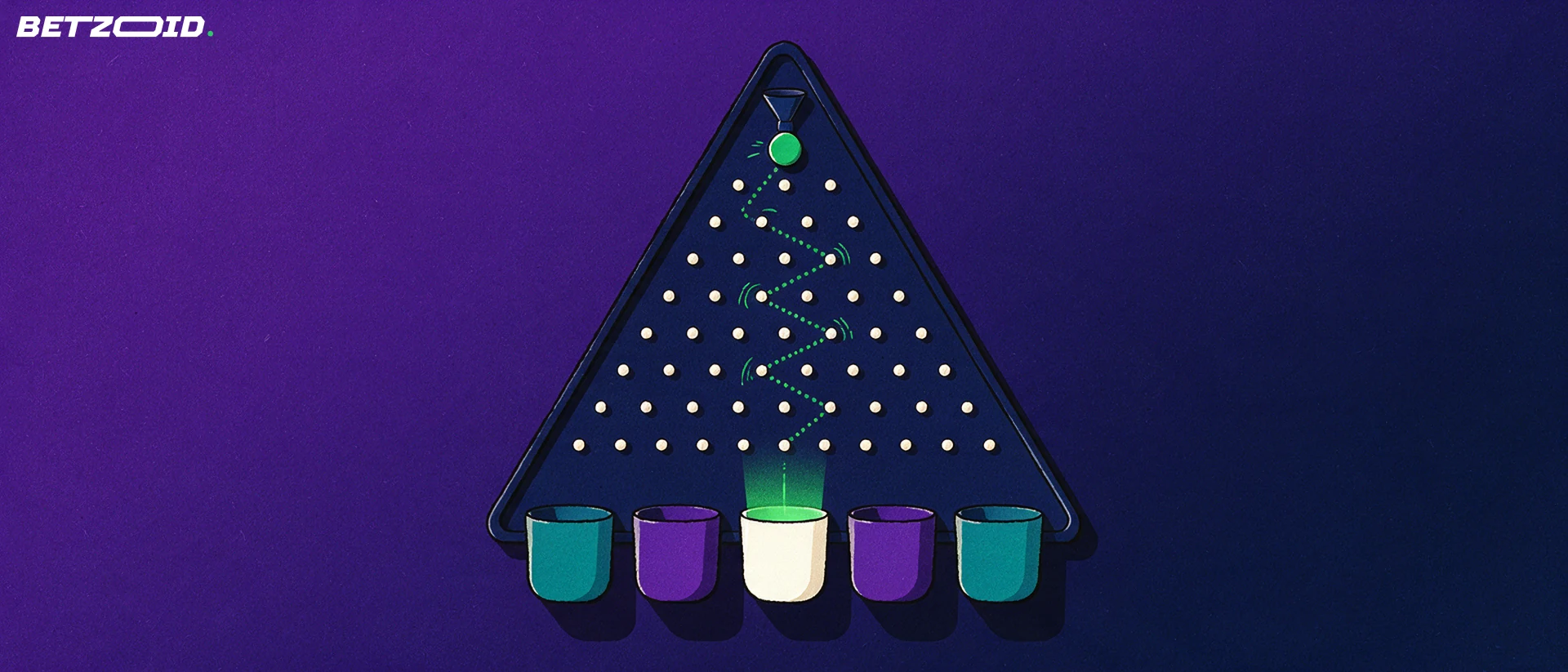
You set a bet per ball, choose how many rows of pegs the board has, pick a risk level, and release. The ball bounces down into one of the numbered buckets along the bottom, and that bucket's multiplier applies to your stake. There is no spin button, no paylines and no bonus round — one click, one result, usually in under two seconds.
The physics you see is presentation. The outcome comes from the random number generator (or, on provably fair builds, from a server seed, client seed and nonce you can verify after the round). Rows typically run from 8 to 16. More rows means a wider spread of outcomes: the centre buckets pay less than your stake, the outer ones pay far more but are hit rarely.
Risk level reshapes the same board. On a 16-row board at low risk, the middle buckets often return around half your stake and the edges pay a modest double-digit multiplier. Switch to high risk and the centre can drop to roughly a fifth of your stake while the outer buckets climb into three- and four-figure territory. Same house edge, radically different volatility.
In practice, a $1 ball at low risk grinds slowly with frequent small returns, while the same $1 at high risk will burn through a bankroll waiting for one big bounce. Decide which of those two experiences you want before you fund an account.
Studio Versions You Will Actually Find
The name is not trademark-protected in the way a slot brand is, so several studios ship their own take. Knowing which one a lobby carries matters, because the max multiplier, bet range and whether the round is provably fair all change with the publisher. Here is what turns up most often in lobbies open to Canadian players.
| Version | Board and risk options | Typical lobby location | What to verify before betting |
|---|---|---|---|
| Plinko by BGaming | 8–16 rows, three risk levels | Instant win / crash games tab | RTP stated in the in-game info panel (BGaming lists 99%) |
| Plinko by Hacksaw Gaming | Fixed grid with a risk toggle | Alongside the studio's slots and scratch titles | Max win and RTP in the paytable, plus minimum bet in CAD |
| Plinko X by SmartSoft Gaming | Multi-ball play with extra board modes | Sportsbook-led and crypto-first sites | How many balls a single click actually stakes |
| In-house "originals" Plinko | 8–16 rows, seed-based provably fair | Own-studio section at crypto casinos | Seed verification tool and bonus eligibility |
| Plinko-style drop games from smaller studios | Varies widely, sometimes no risk selector | Instant-win shelf at newer brands | Provider name on the loading screen |
The column that matters most is the last one. Two lobbies can both list "Plinko" on a category page while one loads a 99% RTP board with full risk control and the other loads a stripped-down clone with a single fixed layout. The provider logo on the loading screen settles it in two seconds, and it is the one check we never skip when assessing sites that offer the game.
Plinko by BGaming vs Crash-Style Clones
BGaming's build is the reference point for a reason: it publishes its RTP openly, offers all three risk levels across 8 to 16 rows, and runs an autoplay module with a configurable number of drops. Lobbies carrying that version are also easy to audit, since the game info panel spells out the return figure rather than hiding it.
Generic crash-style clones borrow the visual and drop the transparency. Some omit the RTP entirely, some lock you into one board, and a few only expose the paytable mid-round. If a version will not show you its multiplier ladder before your first bet, treat that as a reason to play elsewhere rather than a quirk.
Checking a Casino Lobby for the Right Title
Use the lobby search box rather than browsing categories — instant-win games are filed inconsistently and often sit three tabs deep. Type the game name, then filter by provider if the site offers that control. If the search returns several results, hover or tap each thumbnail; most lobbies show the studio name there.
When nothing appears, check whether the site geo-blocks specific studios rather than assuming the game is missing. Loading the demo is the fastest confirmation: if it opens and the info panel lists the provider and RTP, you have found the version you came for.
Demo Mode and Real-Money Play Compared
Free play is genuinely useful here, but only for a narrow purpose. Because the board is a single-decision game, an hour of demo drops teaches you volatility, not strategy — there is nothing to learn that changes your expected return. What it does show you is how fast a bankroll moves at each risk setting, which is exactly the thing people misjudge.
- Access: many operators let you open the demo without an account, while others require you to log in first; a demo that works logged-out is the quickest way to confirm which studio version is loaded.
- Balance behaviour: demo credits usually reset on reload, so a 200-drop session showing a drawdown of 60% of the starting balance gives you a realistic feel for a high-risk 16-row board.
- Autoplay limits: some demos cap the number of automatic drops or disable autoplay entirely, which hides the pace you would actually experience with real stakes.
- Bet sizing: demo balances are often inflated to several thousand credits, making a 10-credit ball feel trivial — recalculate at your real stake before you switch over.
- Bonus interaction: demo play never contributes to wagering, and some sites simply block fun mode while a bonus is active.
The sensible sequence is demo first at the exact risk level and row count you intend to use, then real money at a stake you can repeat a hundred times. If you want to play for real money in Canada without guessing, the operators that expose a working demo are usually the ones being straightforward about the rest of their terms too.
From Sign-Up to Your First Ball Drop
Registration for an instant-win title is no different from any other casino sign-up, but a few steps in the middle decide whether your first session goes smoothly or stalls at a verification screen.
- Confirm the game exists in the lobby before registering — search the title, check the provider name, and run the demo if one is available.
- Create the account with details that match your ID exactly; a mismatched middle name or an old address is the most common cause of a held first withdrawal.
- Read the welcome offer terms before opting in, since claiming a bonus you did not want can lock instant-win games out of your balance entirely.
- Deposit in CAD or your chosen crypto, checking the minimum against your planned stake — a $20 minimum against a $0.10 ball is fine, against a $5 ball it is two drops.
- Complete identity verification early rather than at cash-out; uploading documents while your balance is zero costs you nothing in waiting time.
- Open the game, set rows and risk, and place a single manual bet at your intended stake before touching autoplay.
Step three is where most friction appears. If you intend to play instant-win games only, declining the welcome package often leaves you better off than accepting it — though it is worth checking what the available first deposit bonus offers actually permit before you decide, because a minority do allow the category at full contribution.
CAD Banking and Crypto Casinos With Plinko
Funding options split the market fairly cleanly. Operators built around Canadian dollars typically run Interac e-Transfer, Instadebit, credit and debit cards, and prepaid vouchers, with minimum deposits commonly in the $10 to $20 range. That suits a game where a $0.20 ball is perfectly playable — a $20 deposit gives you a hundred drops at that stake before you need to reload.
Crypto sites lean the other way. Deposits are denominated in BTC, ETH, LTC or a stablecoin, minimums are often tiny in fiat terms, and the in-house provably fair version of the game is usually the one on offer rather than a licensed studio build. The trade-off is currency volatility: a balance that holds its value in CAD does not necessarily hold it in BTC over a week.
Weigh withdrawal speed separately from deposit convenience, because Interac and crypto behave differently on the way out than on the way in. If cashing out quickly matters to you, compare the operators known for quick payouts alongside game availability rather than treating the two as one decision. Whichever rail you pick, verify your account before you have a win to withdraw.
Where Bonuses Fall Short on Plinko
This is the section that changes most people's shortlist. Instant-win games sit in an awkward category for bonus departments: the RTP is high, the game is fast, and the outcome distribution is easy to model, so operators protect themselves with exclusions. A generous-looking match bonus can end up close to useless for the game you actually want to play.
Three patterns recur. Some terms exclude instant-win and crash titles from wagering entirely, so drops made with bonus funds contribute nothing toward the playthrough. Others allow the category but at reduced contribution. A third group permits full contribution while capping the maximum stake per round, which caps your realistic upside at the same time.
Free-spin packages are the clearest mismatch, since spins are tied to specific slots and cannot be used on a board game at all. That does not make them worthless — they simply belong to a different session. Among newer brands running no-deposit offers, small cash credits are more useful for instant-win play than spin bundles, because cash can at least be staked on the board if the terms permit it.
Read the excluded-games list before opting in, not after. It takes two minutes and it is the difference between a bonus that works with your play style and one that freezes your balance for a week.
Wagering Contribution and Max Bet Caps
The arithmetic is worth doing explicitly. A $100 bonus at 35x wagering needs $3,500 turned over. At full contribution that is 3,500 drops of $1. At 20% contribution the same bonus needs $17,500 in stakes to clear — 17,500 drops, a different proposition entirely on a game that resolves in under two seconds.
Max bet caps compound it. A $5 per-round limit while wagering is active stops you accelerating through the requirement with larger balls, and exceeding the cap even once can void the bonus. Check the cap and the contribution percentage together; either one alone tells you half the story.
Risk Settings, Rows and Bankroll Control
The two sliders in the game do more for your session length than any deposit decision. Rows control how many outcomes exist; risk controls how the multipliers are distributed across them. Get the combination wrong for your bankroll and the session ends in minutes regardless of which operator you chose.
Work backwards from the number of drops you want. If you deposit $50 and want roughly 250 drops, your ball size is $0.20. At low risk on a 12-row board, most of those drops return something close to your stake and the balance drifts slowly — you will likely still be playing after 250 clicks. Move the same $0.20 to 16 rows at high risk and the majority of results return a fraction of the stake while you wait for an outer bucket, so a run of 40 or 50 losing drops is entirely ordinary. Your effective session length halves or worse.
Autoplay deserves a hard limit. Setting 500 automatic drops at $1 commits $500 in a couple of minutes, faster than most people intend. Use the loss-limit and single-win stop settings if the version offers them, and if it does not, run manual drops in blocks of 20 and check the balance between blocks. On mobile, where the tap target sits right under your thumb, that discipline matters even more than on desktop.
One more practical note: the house edge does not change when you switch risk levels, so chasing a losing run by moving from low to high risk only increases variance. It does not improve your position.
Choosing between these sites really comes down to three things: which studio version the lobby loads, whether the banking rail matches how you want to move money, and how the bonus terms treat instant-win games. Confirm the provider on the loading screen, run the demo at the exact rows and risk level you plan to use, and read the excluded-games list before opting into any offer. If you are browsing recently launched operators, apply the same three checks rather than assuming a fresh lobby carries the full-featured build.
Set a deposit limit and a session budget before your first drop — the game resolves fast enough that a plan made in advance is worth more than one made mid-session.