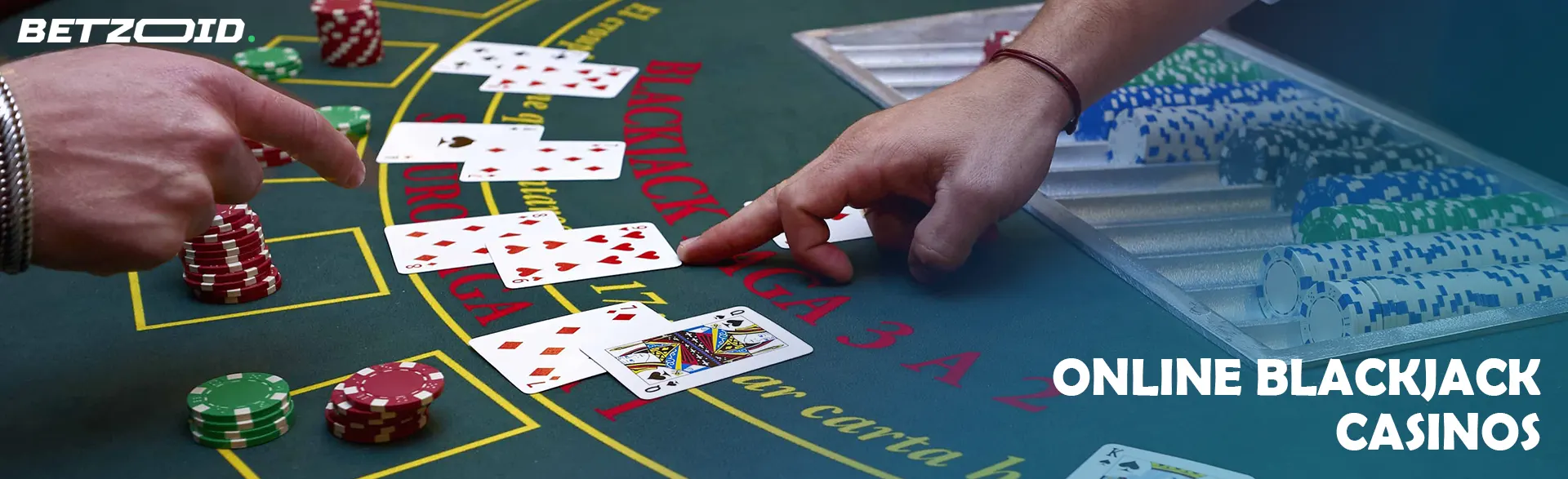

Most rankings of online blackjack casinos compare bonus sizes and homepage polish, when the number that actually decides your results is printed on the table itself: whether a natural pays 3:2 or 6:5. Get that wrong and a $500 welcome offer will not rescue your bankroll. For players in Canada, the shortlist narrows fast once you apply the practical filters — a native CAD balance, Interac e-Transfer in the cashier, clearly published table rules, and limits that start low enough to practise strategy without burning through a deposit.
The Betzoid editorial team works through published rule screens, cashier pages and bonus terms rather than marketing copy, because those documents hold the real differences: payout rules, contribution rates, withdrawal conditions and identity checks. Below you will find our current comparison, followed by the reasoning behind it — how to read a table's rules, what payment methods realistically mean for payout timing, and which bonus structures are worth claiming at a blackjack table at all.
Recommended Online Blackjack Casinos (October 2026)






Why Blackjack Rules Matter More Than Site Rankings
A 6:5 payout on a natural is the most expensive rule in the game, and it shows up on tables hosted by sites that otherwise look perfectly respectable. Classic blackjack with 3:2 payouts runs around a 0.43% house edge with correct strategy; drop the payout to 6:5 and you are playing closer to 1.8%. At $10 a hand and roughly 100 hands an hour on an RNG table, you cycle about $1,000 through the game per hour. At 0.43% that hour costs you around $4.30 in expected losses. On the 6:5 version it costs closer to $18. Two sessions a week for a month, and the payout rule alone accounts for a swing of well over $100 — more than most welcome offers return in real value.
Smaller rule variables stack on top. A dealer who hits soft 17 adds roughly 0.2%, restricting doubling after a split adds about 0.14%, and moving from a single deck to eight decks costs around half a percent. Variant names give you a rough guide — Classic near 0.43%, Atlantic City rules closer to 0.35%, European no-peek around 0.62% — but only the rules panel inside the individual table confirms what you are actually playing. Read it before you look at anything else on the site.
What Separates Strong Online Blackjack Casinos?
Four checkable things separate a solid platform from a frustrating one: a verifiable licence, table rules published before you sit down, a cashier that handles Canadian dollars natively, and withdrawal terms written in plain language. Everything else — theme, loyalty tiers, the number of variants advertised — is secondary. When we compare operators, we look for these signals in the footer, the rules screens and the banking page.
| What to check | Strong sign | Weak sign |
|---|---|---|
| Licence | Named regulator and licence number you can look up on the regulator's own register | Vague "licensed and regulated" text with no number or jurisdiction |
| Table rules | Payout, deck count, soft 17 and surrender rules visible before the first hand | Rules hidden behind gameplay or missing entirely |
| Currency | CAD account option at registration, no conversion on deposit or payout | USD or EUR only, with conversion applied both ways |
| Bet range | RNG tables from around $0.50–$1, live tables from $5 | Lowest table starts at $10 or more across the whole lobby |
| Withdrawal terms | Stated pending period, method-by-method timing, no monthly cap surprises | "Up to 5 business days" with no pending-period detail |
The trade-off the table cannot show you is depth versus quality. A lobby advertising 30 variants is worse value than one with six tables if most of those 30 pay 6:5, and a low $0.50 minimum means little if the only 3:2 tables in the building start at $25. Check the rules on the cheapest tables you would actually play, not on the flagship one in the promo banner.
Live Dealer Tables vs RNG Blackjack
These are different products with different costs per hour. RNG tables deal roughly 100–200 hands an hour and start at $0.50–$1, so you can grind basic strategy cheaply. Live studio tables deal about 50–60 hands an hour with minimums usually from $5, but you see the shoe, the shuffle and the dealer's hands on video. Fewer hands at a higher minimum often means similar hourly exposure, so the choice is about what you want from the session. If streamed tables are your priority, our breakdown of casinos with live blackjack studios goes deeper into table counts and side-bet rules.
Mobile Play on Phones and Tablets
Blackjack survives the small screen better than most casino games, because you need four buttons and two card areas. Browser play covers almost everything now, so an app download is rarely necessary. The practical limits are screen size and connection: a tablet gives you near-desktop visibility, a phone is fine for one table but cramped if you try to run two, and live dealer streams punish patchy connections in a way RNG tables do not. Check that the rules panel is still reachable on mobile — on some lobbies it is buried.
How Do Real Money Blackjack Sites Pay You Out?
Your payout speed depends less on the operator's marketing and more on the rail you chose at deposit, since most sites return withdrawals to the same method. The common Canadian options behave roughly like this:
- Interac e-Transfer: the default for Canadian players. Deposits usually land within minutes, and payouts are among the quicker bank-linked options because no card network sits in the middle and no currency conversion applies to a CAD balance.
- Visa and Mastercard: deposits are normally instant, but refunds back to a card depend on your issuer and are typically the slowest route, often several business days. Some Canadian banks also decline gambling transactions outright.
- E-wallets such as Skrill and Neteller: fast in both directions and useful when your bank blocks casino payments, though small transaction fees and wallet-specific bonus exclusions are common in the terms.
- Bank transfer: reliable for larger sums and high withdrawal ceilings, slow for everyday cashouts, and occasionally subject to a minimum payout amount well above a typical blackjack win.
- Cryptocurrency: quick once the operator approves the request, with no banking intermediary, but you take on exchange-rate movement between payout and cash-out.
For a $50 win you want tonight, the method matters more than the brand. Where a site markets fast withdrawals, read the pending period rather than the headline number — that is where the delay usually lives.
Interac e-Transfer and CAD Balances
Playing in Canadian dollars removes a cost most players never see on their statement. Conversion spreads on cards and banks commonly run in the 2.5–3.5% range, applied on the way in and again on the way out, so a $300 deposit and a $400 payout can quietly cost you the equivalent of several hands. Sites that accept Interac e-Transfer almost always offer a CAD balance too, which is why the pairing is worth treating as one requirement rather than two. Check the currency selector at registration, because many platforms lock your account currency permanently once it is set.
Verification and Withdrawal Timing
Identity checks are the most common reason a first payout feels slow. Expect to supply photo ID, a proof of address and sometimes a screenshot of the payment method you used; document review commonly takes a day or two, though automated systems can clear it faster. Submit everything right after registration instead of waiting for a win, and match the name on your account to your banking details exactly. A mismatch, not the payment rail, is usually what turns a same-day withdrawal into a week-long email exchange.
What Do Welcome Bonuses Really Pay in Blackjack?
In blackjack, most welcome offers are worth far less than the headline figure, and some are worth less than nothing. The reason is game contribution. Slots usually count 100% toward wagering; blackjack commonly counts 10%, and some terms exclude it entirely. Take a $200 match with a 30x requirement. That is $6,000 in qualifying wagers if the game counted fully — but at 10% contribution you need $60,000 of blackjack bets to release it. Cycling $60,000 through a good 0.5%-edge table costs roughly $300 in expected losses to unlock a $200 bonus. The math is not close.
Two other clauses do the quiet damage. Maximum bet limits while a bonus is active are often $5 per hand, which makes a $60,000 turnover target impractical before the 7- or 30-day expiry. And "prohibited strategy" wording in some terms lets an operator void winnings from low-risk play, which is exactly how correct blackjack strategy looks to a risk desk. If you want to use a deposit match offer, check the contribution rate and the max-bet clause before the percentage.
Other promotion types suit a card player better. Cashback on net losses, reload credits with low turnover, and live-casino-specific offers that count table games at full rate all beat a slots-oriented match. Bonuses with no turnover attached are the cleanest fit, since you keep what you win — our guide to casinos with no wagering requirements covers how those offers are structured and where the caps sit instead. Otherwise, declining the bonus and playing your deposit at a 3:2 table is often the higher-value decision, and it keeps your withdrawal free of conditions.
What Could Go Wrong Before You Cash Out?
Most payout disputes trace back to a term the player accepted without reading. These are the failure points worth checking before your first hand, not after your first win.
- An unverifiable licence. If the footer names no regulator and no licence number, you have no complaints channel when a withdrawal stalls. Look the number up on the regulator's register rather than trusting the seal image.
- Bonus terms that trap the balance. A high multiplier combined with 10% blackjack contribution can make a bonus mathematically unclearable within its expiry window. If you want a claimable offer, compare structures with lower turnover requirements rather than bigger headline amounts.
- Max bet breaches. Doubling from $4 to $8 on a $5 bonus bet cap can void the whole balance under standard terms — a rule that catches strategy players especially, since doubling is part of correct play.
- Disconnection handling. Ask what happens to an in-progress hand if your connection drops. Better platforms resolve the hand by house rules and credit the result; weaker ones leave the stake in limbo until support intervenes.
- Withdrawal caps and reversals. Weekly or monthly payout ceilings can turn one good session into months of instalments, and a "reverse withdrawal" button that returns pending funds to your balance is designed to be clicked at the worst moment.
None of these are reasons to avoid real money play. They are reasons to spend ten minutes in the terms page, where every one of them is disclosed in writing.
How to Vet a Blackjack Casino Before Depositing
Work through this in order and you will disqualify most weak options before any money moves. Your provincial context matters too: Ontario runs its own regulated iGaming market, which opened in April 2022, while players in Nova Scotia and the rest of Atlantic Canada generally play at internationally licensed operators, so the licence you are checking may differ depending on where you live.
- Confirm the licence at the source. Take the licence number from the footer and search the regulator's own register — Ontario's iGaming authority, the Kahnawake Gaming Commission, the Malta Gaming Authority or Gibraltar. If the name on the register does not match the site, stop there.
- Open a table in demo mode and read the rules panel. You are looking for 3:2 naturals, deck count, whether the dealer stands on soft 17, double-after-split and surrender. Note the minimum on those specific tables, not the lobby's lowest.
- Check the cashier before registering, if it is public. Confirm a CAD account option, Interac e-Transfer availability, the minimum withdrawal amount and any per-transaction fee. Currency is usually locked for the life of the account.
- Read the two clauses that decide your payout. The pending period and the identity checks tell you more about real withdrawal speed than any advertised timeframe. Upload documents immediately after signing up.
- Price the bonus before accepting it. Multiply the bonus by the wagering multiplier, then divide by the blackjack contribution rate to get your true turnover target. Compare that against the max bet cap and the expiry date; if it does not fit, decline the offer.
The sequence matters because each step is cheaper than the one after it. A licence check costs you a minute, a rules check costs nothing in demo mode, and both happen before you hand over documents or funds. We re-check these same points when we revisit the operators in our comparison, since rule sets and cashier terms change more often than site design does.
Rules first, payment rail second, bonus last — that order reflects where the money actually goes. A 3:2 table at a licensed site with a CAD balance and Interac support will outperform a bigger welcome package on 6:5 tables every month of the year, and verification submitted early is what turns an advertised fast payout into a real one. Use the comparison above to shortlist two or three candidates, then spend ten minutes in their rules panels and terms pages before you deposit.
Set a deposit limit and a session budget in your account settings while you are still in the cashier, before the first hand rather than after a losing one — the tools are there, and they work best when you never need them.
FAQ