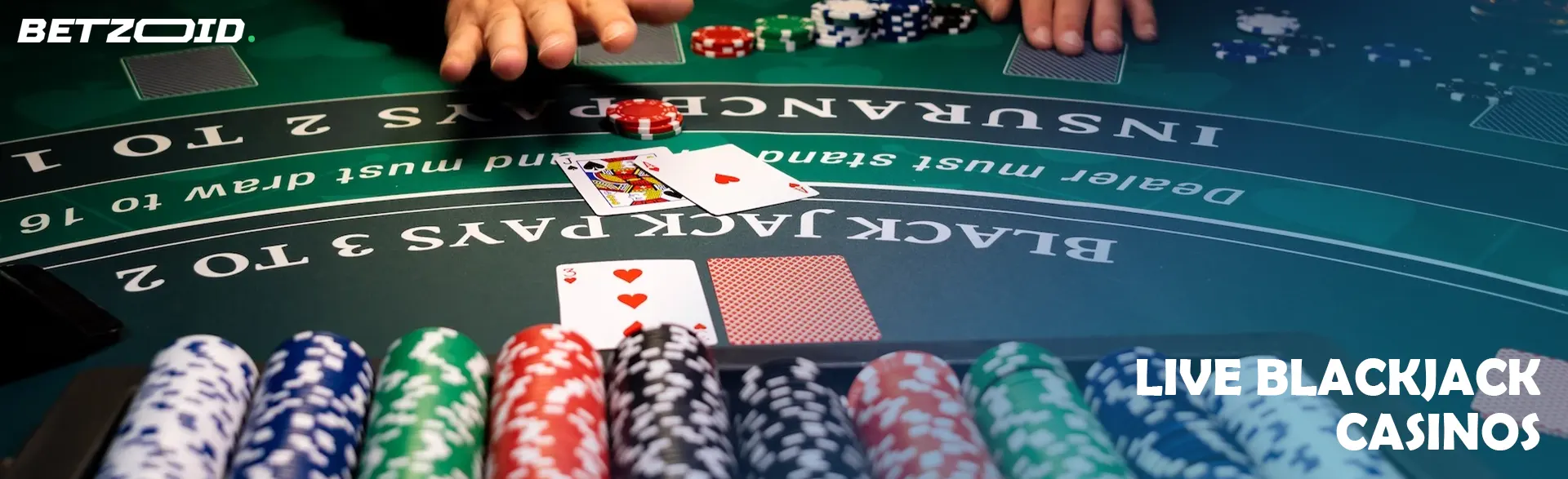

In the United States, access to live blackjack casinos is decided less by which site has the slickest lobby than by which state you're sitting in: seven states license real-money online casino play, and everywhere else you're choosing among offshore operators with far weaker recourse. That single fact shapes the rest of your decision — minimum bets, payout speed, which studio deals your cards, and whether a welcome bonus is even usable at a blackjack table.
The Betzoid editorial team reads the details a screenshot never shows: whether the dealer hits or stands on soft 17, whether blackjack pays 3:2 or 6:5, how little live blackjack contributes toward wagering requirements, and how wide a table's limit spread really is once you're seated. We also weigh what changes on a phone, where compressed video and a cramped bet layout quietly cost you decisions. The comparison below ranks the current options; the sections that follow explain how to read them so the one you pick still suits you in month three.
Top Live Blackjack Casinos in the US (October 2026)








Legal Access to Live Blackjack by State
Seven states license real-money online casino gaming: New Jersey, Pennsylvania, Michigan, West Virginia, Connecticut, Delaware and Rhode Island. Inside those borders you can play on a state-licensed app that geolocates you every few minutes and answers to a local regulator. Outside them, live blackjack means an offshore site licensed abroad — widely used by American players, but with no state authority to escalate a frozen withdrawal to.
A license doesn't automatically mean a deep live lineup. Larger regulated markets support dedicated studios and a dozen or more blackjack streams; smaller ones often run a handful of seats and lean on RNG tables to fill the gap. Availability shifts as operators add and retire tables, so treat the column below as what to verify in the lobby rather than a permanent guarantee.
| State or market | Regulated online casino | Typical live blackjack depth | Check before depositing |
|---|---|---|---|
| New Jersey | Yes | Deepest lineup, in-state studios | Limit spread per table |
| Pennsylvania | Yes | Broad, multiple operators | Side bet menu and payouts |
| Michigan | Yes | Broad, multiple operators | Seat availability at peak |
| West Virginia | Yes | Narrower, fewer tables | Whether live tables run 24/7 |
| Connecticut | Yes, tribal-linked operators | Moderate | Blackjack payout rule |
| Delaware / Rhode Island | Yes, single statewide platform | Limited, varies by launch phase | Current live dealer catalog |
| All other states | No | Offshore sites only | License, payout terms, complaint history |
The trade-off runs in both directions. Regulated apps give you a regulator, mandatory responsible-gaming tools and banking that works with U.S. cards, but they lock you to state lines and a shorter table list. Offshore platforms advertise more tables and higher ceilings while handling disputes entirely in-house. If your state's live seats are thin after midnight Eastern, the RNG side of the lobby — covered in our rundown of online blackjack sites — usually still has low-stakes tables open.
What Separates Strong Tables from Weak Ones
Rules and layout decide more of your result than stream resolution does. Two tables at the same operator can differ by a full percentage point of house edge, and the giveaway is always in the info panel, not the video feed.
- Blackjack pays 3:2, not 6:5. A 6:5 payout on a natural adds roughly 1.4% to the house edge — more than every basic-strategy mistake a careful player makes in an hour combined.
- Dealer stands on soft 17. Tables where the dealer hits soft 17 cost you about 0.2%. It's smaller than the payout rule, but it's free to avoid by switching seats.
- Useful doubling and splitting. Double on any two cards, double after split and re-splitting aces all matter; tables restricting doubles to 9-11 quietly remove value from your best hands.
- A wide limit spread on one table. A $5-$500 range lets you scale within a session; $25-$100 tables force you to leave and rejoin a queue when your stake changes.
- Optional side bets, clearly priced. Perfect Pairs and 21+3 carry edges several times higher than the main game. Good tables make them skippable; weak interfaces bury them under your main bet box.
Rules first, then presentation. A 3:2 table with a plain interface beats a 6:5 table with 1080p video every session, and the operators worth shortlisting let you read the full rule set before you sit rather than after your first hand.
Stream Latency and Dealer Response Times
Live tables give you a fixed decision window — commonly 12 to 15 seconds — and that clock runs on the server, not on your screen. If your connection adds a second or two of lag, you lose part of the window, and a missed click means an auto-stand on a hand you meant to double. The practical check takes one shoe: sit at a minimum table, make a few deliberate late decisions, and watch whether the confirmation appears before the timer expires. If the buttons feel like they're catching up with the dealer, switch tables or move from cellular to Wi-Fi before you raise your stake.
Evolution Studios and Other Providers
Evolution supplies most of the live blackjack American players see, including Infinite Blackjack, Free Bet and Lightning variants, and it operates studios inside regulated states so the feed doesn't travel far. Playtech and Ezugi also appear in regulated and offshore lobbies, while Visionary iGaming and Fresh Deck Studios show up mainly on offshore sites. Provider matters because it sets the rule template, the timer length and the interface you'll use for hours — if you've learned one, it transfers across operators. Our wider look at live dealer casino platforms breaks down how those studios differ beyond blackjack.
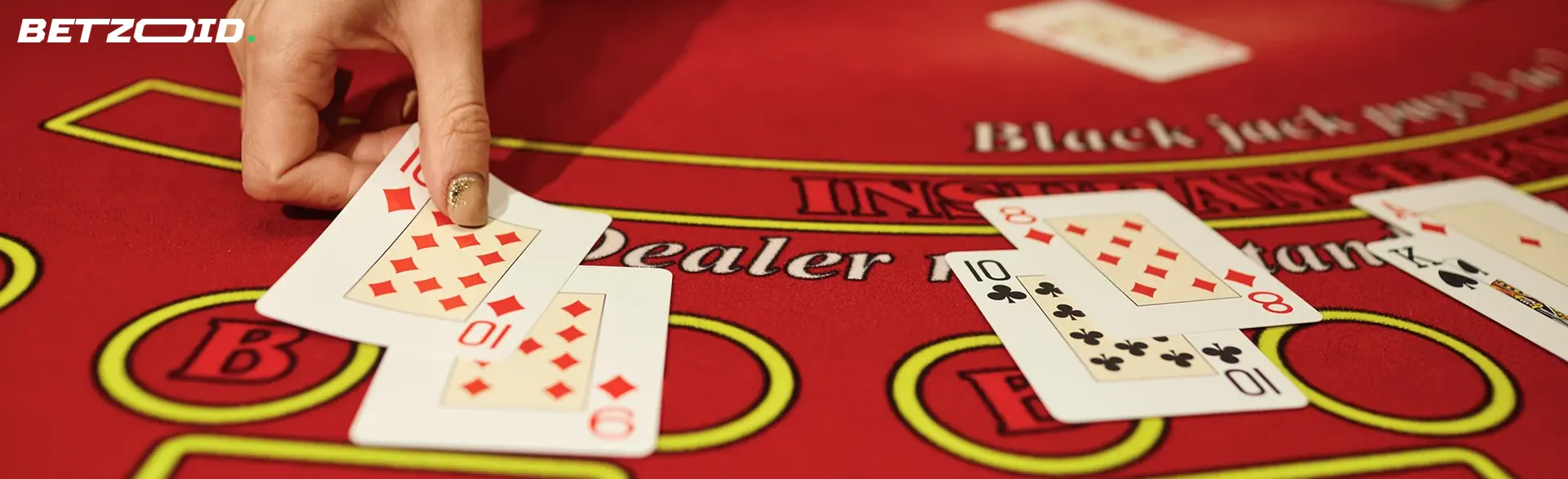
Table Limits That Match Your Bankroll
Match the table to your bankroll first, then judge the rules. The working number most experienced players use is 40 to 50 betting units for a session: $400-$500 to play $10 hands, $1,000-plus to play $25 hands. That isn't superstition — it's variance. Losing eight of ten hands happens regularly, and a bankroll of 15 units simply doesn't survive it long enough for the game's thin house edge to mean anything.
Limit spread deserves as much attention as the minimum. A table advertised at $5 may cap at $100, which is fine until you want to press a good run; a $5-$500 table lets you move between $5 and $50 hands without leaving your seat. That matters more than it sounds, because popular tables fill and rejoining can mean waiting several minutes or dropping into an unfamiliar rule set.
Also read the max, not just the min, before you deposit. Sites that publish a $1-$25,000 range across their whole catalog rarely offer both ends on the same feed, so check the individual table rather than the marketing page.
Low Minimum Tables Starting Near $5
Most regulated lobbies open their live blackjack at $5, and Infinite Blackjack-style tables — where unlimited seats share one dealing hand — often start lower, around $1. Those are the right places to test an operator: you can sit through a full shoe, read the rule panel and judge the timer for the cost of a couple of hands. The catch with low table limits is availability, since $5 seats fill first in the evening. A lobby that keeps several running past 10 p.m. Eastern is doing something right.
High Limit Play for High Rollers
At the top end you're looking for VIP or salon-style tables with ceilings from $5,000 into five figures, plus a cashier that can actually move those sums. Two things separate genuine high limit live blackjack from a marketing badge: published withdrawal caps that don't force you to split a win across weeks, and hosts who can lift a daily limit the same day. Players chasing the widest ceilings often end up comparing casinos without strict betting caps, where payout terms deserve even closer reading than table rules.
Live Blackjack Bonuses and Wagering Rules
Assume live blackjack is the worst game on the site for clearing a bonus, then check whether the terms prove you wrong. Contribution is typically 10% to 20%, and some operators exclude live tables from wagering altogether. Work the arithmetic before you opt in: a $200 bonus at 30x carries $6,000 of wagering. At 20% contribution that's $30,000 in blackjack bets; at 10%, $60,000. Nobody clears that on $10 hands in a weekend.
The second trap is the max-bet rule. Many bonus terms cap individual wagers at $5 or $10 while a balance is in play, which rules out the mid-limit tables you actually wanted and can void winnings retroactively if you exceed it once. That restriction is why plenty of blackjack players simply decline the welcome offer, keep their deposit as cash and play the tables they like at the stakes they chose.
If you do want a bonus working alongside live blackjack, the terms to look for are a low playthrough multiple, a contribution rate at the upper end of the range, and a max bet that covers your normal unit. Offers built around lower wagering requirements are far more realistic for table players than headline percentages, since a smaller match at 10x can be worth more than a large one at 40x. Cashback or rakeback on live tables, where offered, avoids the contribution problem entirely because it pays in withdrawable funds.
Mobile Live Blackjack: What Changes on Phone
The game is identical; the interface and your connection are not. Portrait mode shrinks the dealer feed to a strip and stacks the action buttons, which is fine for hit or stand but tight when you need to split and then double the second hand inside the same timer. Landscape gives you the full table but eats more of the screen with chat overlays.
Three practical differences matter on a phone. Streaming video for an hour uses real data, so cellular-only sessions get expensive and unstable. Geolocation in regulated states relies on your device's location services, and a denied permission drops you mid-shoe. And a dropped connection doesn't pause the hand — the table auto-plays a stand, which is exactly how a promising 11 becomes a loss.
Operators that handle mobile well keep the rule panel one tap away, remember your last bet size, and reconnect to the same seat rather than dumping you in the lobby. Worth checking on a $5 table before you trust a phone session with meaningful stakes.

Your First Live Blackjack Session, Step by Step
A first session at a new operator goes wrong in predictable places — usually verification or a bonus you didn't mean to accept. This order avoids both.
- Confirm how you'll be playing. In a regulated state, expect location services and a geolocation check at login; outside one, vet the offshore license and published payout terms before anything else.
- Verify your identity up front. Upload ID and proof of address at signup rather than at cashout, where document review is the single most common cause of a delayed first withdrawal.
- Deposit with a method you can also withdraw to. Card deposits often can't receive payouts, which pushes you toward a bank transfer or e-wallet you should set up now, not later.
- Decline or accept the bonus deliberately. Run the contribution and max-bet math from the section above; if the numbers don't work for table play, take the cash balance instead.
- Open the table rules, not just the table. Check the blackjack payout, soft 17, doubling and re-split rules, and the limit spread before you place a chip.
- Play one shoe at the minimum. Use $5 hands to judge timer length, button response and how the interface handles a split before you scale up.
Two of those steps do most of the work: verifying early and reading the rule panel. Everything else is preference, but a 6:5 table or an unverified account will cost you regardless of how well you play the hands.
Deposit Caps and Session Reminders
Set your limits in account settings before the first hand, while the decision is still abstract. Regulated operators must offer deposit, loss and session caps; reductions usually apply immediately, while increases are held for a cooling-off period of 24 hours or longer, so the cap you set tonight is the one that actually binds. Session reminders matter more at live blackjack than at slots because a full table deals roughly 60 hands an hour and an hour disappears quickly. Self-exclusion and time-out tools sit in the same menu, and 1-800-GAMBLER connects you to free confidential support in every U.S. state.
Three things decide this choice: whether your state licenses online casino play, whether the table you sit at pays 3:2 with a limit spread that fits your bankroll, and whether the bonus terms let live blackjack count for anything at all. Get those right and the difference between operators narrows to interface polish and payout speed.
Use the comparison above to shortlist what's available where you are, then spend one low-stakes shoe reading the rule panel and testing the timer before you raise your stake. Set a deposit cap while you're in the account settings — it takes a minute, and it's the one limit that still holds when a session runs long.