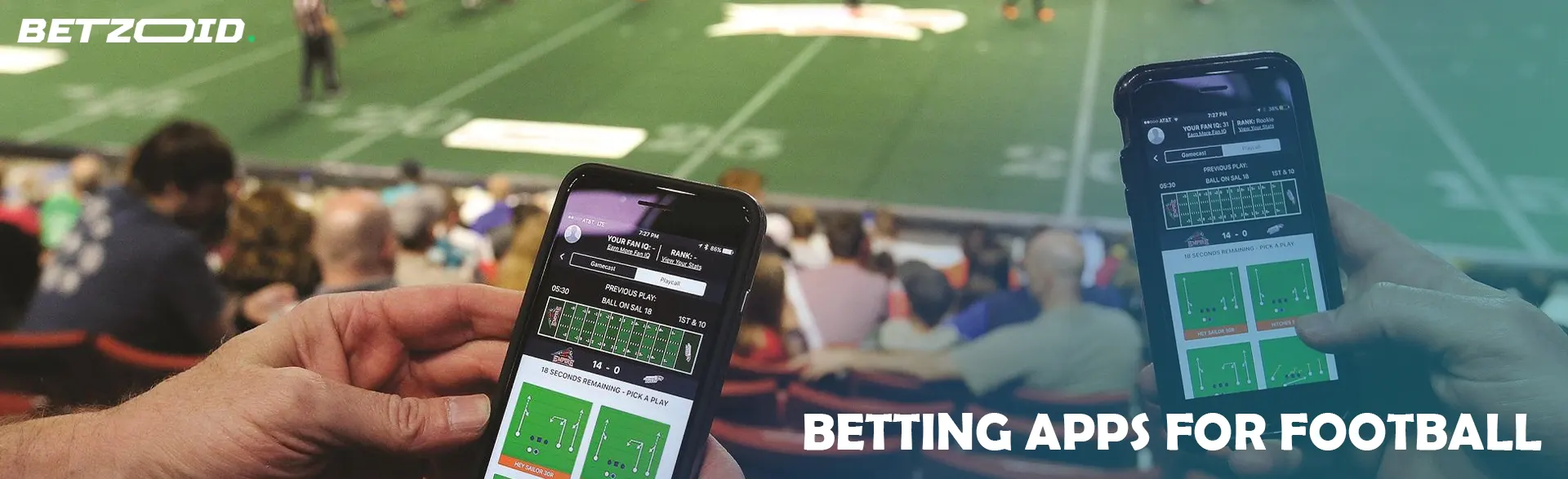

Football betting apps look interchangeable in the store listings — same stadium artwork, same welcome-offer banner — and the real differences only show up when you need them most: whether the operator holds a license for your state, what it charges in juice on an NFL spread, and how long your money sits between the withdraw button and your bank account. Those three things shape your season far more than the interface does.
The Betzoid editorial team compares what operators and state regulators actually publish: licensing by state, standard pricing on core football markets, cash-out and same game parlay support, payout methods including PayPal, and the wagering terms tucked under each sign-up offer. Availability and promotions across the United States shift during the season, so confirm any offer inside the app before you deposit a dollar. The comparison below is the starting point; the sections after it explain how to read it.
Top Football Betting Apps by State (October 2026)








Why Your State Decides Which Apps You Get
Your location sets the shortlist before any feature comparison begins. Every legal US sportsbook app runs on a state license, and geolocation confirms you are physically inside that state at the moment you tap place bet — your home address is irrelevant. That is why an app can advertise freely in the store, then refuse your registration, and why a Sunday drive across a state line can freeze an open bet slip mid-quarter.
State rules also reach into the markets themselves. Several states allow college game lines but restrict player props on college athletes, and some narrow that restriction to in-state schools only. Market size matters too: states that issue a long list of licenses leave room to shop for a better number, while limited markets mean you take the price that is posted. Before trusting any published list of legal apps by state, check the current licensee register on your own regulator's site, because those lists change between seasons.
| State rule you may hit | How it shows up in the app | Practical move |
|---|---|---|
| No licensed online sportsbook | App installs, but registration or bet placement is blocked by geolocation | Wager only while inside a legal state; avoid unlicensed offshore workarounds |
| Limited number of licenses | Short operator list, fewer weekly boosts, little room to compare lines | Judge apps on price for the two or three markets you bet most |
| College player props restricted | CFB spreads and totals load, but individual-player markets are missing or team-specific | Build Saturdays around sides, totals and team props |
| App distribution limits | iPhone installs come from the App Store, Android sometimes from the operator's own site | Install and log in midweek, not ten minutes before kickoff |
| Strict border enforcement | Bet slip locks the moment your location reading drifts out of state | Grant precise location access and add any required location helper |
The distribution row trips up more new bettors than the legal ones. Android users in particular can end up downloading from a website rather than Google Play, and that flow needs a permission change you do not want to discover during a two-minute drill. The same state restrictions apply in a browser, so if you split time between phone and laptop, our roundup of football betting sites covers the desktop side of the same licensed operators.
What Real Money Football Apps Actually Offer
Real money football apps sell themselves on bonuses, but the feature set you touch every weekend is narrower and easier to compare. Five things carry the experience, and an app that is weak in one of them will annoy you by Week 4 regardless of how good the welcome offer looked.
- Market depth on NFL games: sides, totals, moneylines, alternate spreads, halves and quarters, plus player props. Deep books post hundreds of markets on a primetime game; thinner ones offer a few dozen and reopen slowly.
- Same game parlay builders: a touchdown scorer, a passing-yards over and the spread on one ticket. The useful versions reprice visibly as you add each correlated leg instead of silently rejecting the combination.
- Live markets with cash out: in-game spreads, next-drive and next-score wagers, plus full or partial cash out. Some apps restrict cash out to straight bets, which is worth knowing before you build a parlay you may want to close early.
- Odds boosts and profit boosts: weekly NFL boosts on props and parlays, plus percentage tokens you apply to a bet of your choice, usually with a capped stake.
- Payment range: debit card, online banking, PayPal, Venmo and cash-at-retail options. Deposit lists are almost always longer than withdrawal lists, and the withdrawal list is the one that matters.
Depth and cash-out flexibility decide how an app feels in the fourth quarter; payments decide how it feels on Monday morning. If you keep one balance for football and other sports, the broader picture in our comparison of US betting apps shows where the same operators are stronger or weaker outside the NFL calendar.
NFL Sundays vs College Football Saturdays
These are two different navigation problems. An NFL weekend gives you roughly a dozen games with enormous prop depth, so you want search, prop filters and a clean bet slip. Saturdays bring dozens of kickoffs across several conferences, which makes speed, conference filters and favorites lists more valuable than prop volume. College football apps also live with tighter market rules — restricted player props in some states and lower limits on small-conference games. If Saturdays are your priority, test how quickly an app lets you jump between a noon Big Ten game and a late West Coast kickoff without scrolling through the NFL slate first.
How Odds, Limits and Payouts Compare
Price is the one comparison that pays you every week, and it hides in plain sight. Standard football spreads are priced at -110 on both sides, which is roughly a 4.5% theoretical hold for the book on a balanced market. A book posting -105 on the same side cuts that to around 2.4%. Nothing about the app changes; your return on identical opinions does. Limits and payout routes belong in the same conversation, because a great number is worthless if the app cuts your stake or holds the money for five days.
| Comparison point | Common setup | Sharper version | What the gap means |
|---|---|---|---|
| NFL spread price | -110 both sides | -105 to -108 on selected sides | A $110 stake wins about $104.76 at -105 instead of $100 — close to $48 across ten winners |
| Player prop price | -115 to -125 on popular overs | -110 on core passing, rushing and receiving props | Props are where Sunday volume goes, so a wider price costs you most here |
| Same game parlay pricing | Correlated legs repriced or blocked with no explanation | Leg-by-leg repricing shown before you confirm | You can see what a fourth leg actually costs instead of guessing |
| Maximum stake | Scaled by market, rarely published up front | Limits visible in the bet slip as you type | A four-figure bet on a thin college market can be cut without warning |
| Withdrawal route | ACH or card, typically 1-5 business days | PayPal or Venmo with a stated processing target | Method choice moves payout speed more than the operator's branding does |
The trade-off the table cannot show is that reduced-juice pricing often comes with lower ceilings, while the biggest-limit books tend to hold the standard -110. If you stake $50 a game, chase the price. If you fire $2,000 on an NFL side, the limit and the reliability of getting that bet accepted are worth more than a couple of cents of juice.
PayPal Withdrawals and Verification Timing
Apps that pay out through PayPal are usually the fastest route to cash because the account is already identity-checked on PayPal's side, and many operators require you to deposit with PayPal before you can withdraw to it. What actually delays a first payout is not the wallet — it is know-your-customer review. Expect to supply a photo ID, the last four digits of your Social Security number and an address match. Clear that in the preseason with a small deposit and a small withdrawal, not when playoff winnings are sitting in the balance. Single-operator write-ups such as our Betboss review go through account checks and banking terms in more detail.

Are Sign-Up Bonuses Worth the Rollover?
Sometimes — and the answer depends entirely on which of the two common structures you are accepting. A bet-and-get offer returns bonus bets after a qualifying wager, so your exposure is the qualifying bet itself. A deposit match with playthrough is different arithmetic: a $1,000 match attached to 10x rollover means $10,000 of turnover, and at standard -110 pricing the house edge on that volume is roughly $450. You are being paid $1,000 to give back about half of it in expected juice, and only if you complete the full cycle.
That is why low-playthrough offers matter more than headline size. A 1x requirement on a $100 bonus asks for $100 of turnover; a 10x requirement on a $500 bonus asks for $5,000. Read three lines before you opt in: the playthrough multiple, whether it applies to bonus only or deposit plus bonus, and the minimum odds allowed. Bonus offers also rotate, and codes expire, so verify the current terms in-app rather than trusting a screenshot. Our page on betting sites with promo codes explains how code-gated offers differ from ones that apply automatically at deposit.
Reading Odds Boosts and Bonus Bet Terms
Boosts are real value when the underlying bet is one you wanted anyway. A $25 stake at +350 returns $87.50 in profit; boosted to +450 it returns $112.50 — $25 extra for the same risk, capped by a maximum stake that is often $25 to $50. Bonus bets need one more check: most pay profit only, so a $50 bonus bet at +150 credits $75 rather than $125. Add typical minimum-odds floors around -200, expiry windows of about 7 days, and the common rule that bonus bets cannot be cashed out, and you can see why an unused bonus bet is worth nothing at all.
What Goes Wrong Mid-Game, and Why
The failures that cost money are boringly consistent, and most of them have a technical explanation you can plan around. Geolocation is the leading one: stadium and large-venue networks route traffic oddly, so the app cannot confirm you are in-state and refuses the bet even though you are sitting in the stands. Enabling precise location and installing any required location component before you leave home fixes most cases.
Second is odds movement at submission. You tap at -110, the app checks the price against the trading feed, and the bet returns at -115 because the line moved while you were confirming. Apps let you allow or reject odds changes; leaving that switch on means you accept whatever the new number is. Third is bonus bet handling — some bet slips default to the bonus balance, so a $50 bonus bet can vanish on a $10 wager. Check the currency on the slip, every time.
Then there are suspensions. Markets lock during scoring plays, reviews and injury stoppages, which is normal risk management rather than a malfunction. What is not normal is a market staying frozen for several minutes after play resumes, or a withdrawal sitting in pending because verification was never completed. The first is a trading-platform weakness worth noting; the second is entirely within your control.
Live Betting Delays and Same Game Parlays
Live betting runs on a data feed, and your television or stream sits behind that feed by anywhere from a few seconds to half a minute. You are never betting on what you just watched, which is exactly why live prices move against you as you type. Treat the delay as a cost of doing business and avoid reflex bets on plays you have only just seen. Same game parlays add a second layer: legs that correlate — a quarterback's passing yards with his team's total, for example — get repriced or rejected. Build the ticket leg by leg so you know which combination triggered the block before you commit a stake.
How Do You Set Up Your First App?
Allow about fifteen minutes and have your ID nearby. The order matters, because the steps people skip are the ones that cause problems at payout rather than at signup.
- Confirm the operator is licensed where you are. Check your state regulator's licensee list, then look for the license number in the app's footer or settings. No number, no deposit.
- Download from the right source. iPhone apps come through the App Store; on Android you may be directed to the operator's own site, which needs an install permission change. Never use an APK from a third-party mirror.
- Register with details that match your ID exactly. Nicknames and old addresses are the most common reason verification stalls later.
- Complete identity verification before depositing. Upload the ID, add the last four digits of your SSN, confirm your address. Doing this first means your first withdrawal is a payment, not an investigation.
- Set deposit and loss limits during signup. Most apps prompt you, and most impose a cooling-off period before an increase takes effect — so pick numbers you would still accept in Week 12.
- Run a small test cycle. Deposit a modest amount, place one bet, then request a withdrawal to the method you plan to use. You learn the real timeline while the stakes are trivial.
That last step is the one worth insisting on. Discovering a payment-processor problem with a $20 withdrawal request in August is a minor annoyance; discovering it in January with a five-figure balance is not.
Three checks separate an app you will keep from one you delete in October: it must be licensed for your state, it must price the markets you actually bet without padding the juice, and it must pay out through a method that suits your timeline, with verification already cleared. Bonuses are the tiebreaker, not the reason to choose — a low-playthrough offer beats a big headline number nearly every time. Compare the pricing and payout trade-offs in the tables above against how you bet, then set your deposit limit during signup while it is still an easy decision rather than a corrective one.