

Andar Bahar casinos in India are easy to find and genuinely hard to compare. Almost every site aimed at Indian players lists the game somewhere in its live lobby, yet the details that decide your experience — whether the balance stays in rupees, whether UPI deposits actually go through, whether the table comes from a studio supplier like Ezugi or Evolution or is a basic RNG clone — sit buried in banking pages and terms nobody reads.
So that is where the Betzoid editorial team starts. Instead of repeating marketing lines, we read the published payment pages, licence footers, bonus conditions and game lobbies, then translate them into the things you can check in five minutes: minimum deposit (commonly ₹200–₹500, occasionally ₹100), typical payout windows, wagering multipliers, and which side bets quietly carry a worse edge than the main Andar/Bahar wager. The comparison below groups the sites worth a closer look, and the sections after it explain which conditions to confirm on the operator's own pages before you fund an account.
Recommended Andar Bahar Casinos (October 2026)






How Andar Bahar Works at Online Casinos
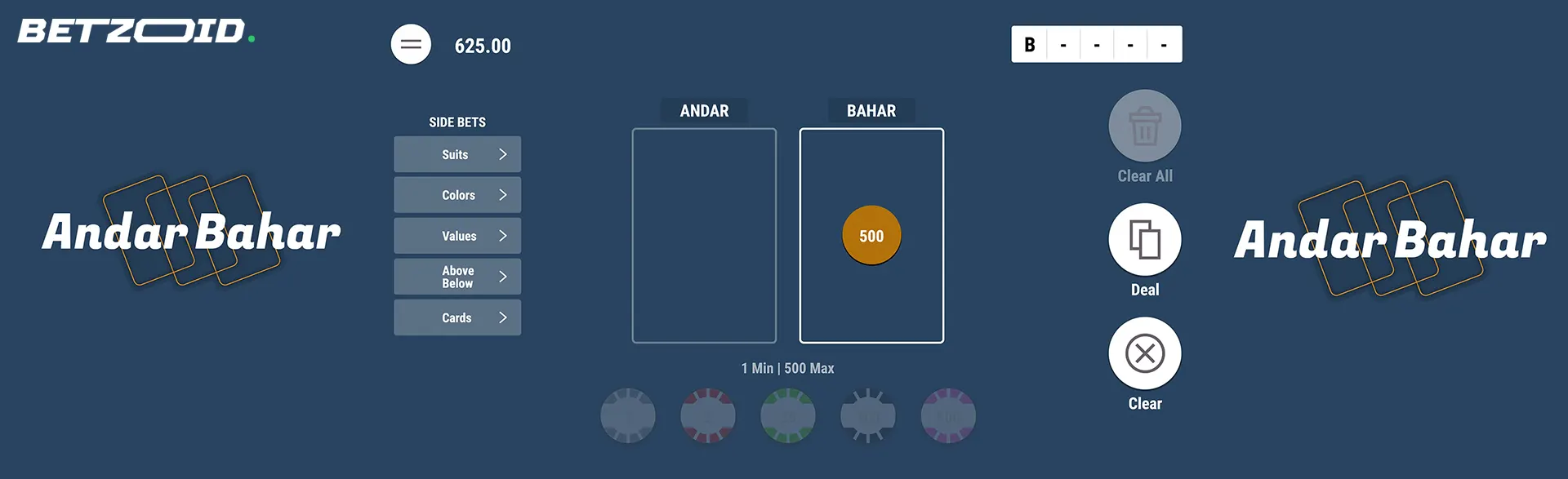
One deck, one exposed card, two sides — that is the whole game. The dealer turns up a joker (also called the game card or house card), then deals cards alternately to the Andar (inside) and Bahar (outside) piles until one of them matches the joker's rank. You bet on which pile will produce that match, and the round is over in well under a minute.
The payouts are where online versions differ from the kitchen-table game. Because Andar usually receives the first card, it hits slightly more often, so most tables pay Andar around 0.9:1 and Bahar 1:1. That puts the house edge close to 2.15% on the main bet — a tighter margin than typical online slots, which is a large part of the game's appeal to regular players.
Digital tables add layers the physical version cannot: a stake range that often runs from about ₹10 to ₹50,000 per hand, saved bet history, statistics panels, repeat-bet buttons, and side wagers on the joker's suit, the number of cards dealt or whether the first card is a face card. Those side bets carry noticeably higher margins than the main market.
Open the table's information panel before your first real-money round. Two lobbies can carry the same game name and the same familiar layout with very different paytables, and the commission applied to the favoured side is the single number that changes your long-run cost most.
Live Dealer Tables vs RNG Versions
Live tables stream a real dealer shuffling physical cards, usually from suppliers such as Ezugi, Evolution or Super Spade, and some run with Hindi-speaking hosts during IST evening hours. You get chat, tipping and a visible shoe — plus slower rounds and higher table minimums.
RNG versions deal instantly, accept smaller stakes, load on patchy mobile data and never make you wait for other players to finish betting. If you play on the train or on a 4G connection that drops, the RNG table is the reliable option; if the atmosphere is half the reason you play, the live studio is worth the extra bandwidth.
Why Indian Players Pick This Card Game
Familiarity plus a low house edge is an unusual combination in an online casino lobby. Most Indian players already know the rules from festival nights and family gatherings, so there is no strategy chart to learn and no unfamiliar terminology — the learning curve that keeps people away from baccarat or craps simply does not exist here. That is also why the game turns up in the live section of nearly every real-money casino serving Indian players: it needs no tutorial and fills a table quickly.
- Roughly 2.15% house edge on the main bet — considerably kinder than the 5–10% margin common on slot titles, which means a fixed bankroll survives more rounds on average.
- Rounds that finish in under a minute — you can play ten hands in a lunch break, and RNG tables let you set your own pace instead of waiting for a full table.
- Stakes that suit both ends of the scale — tables commonly open around ₹10–₹50 and stretch to ₹50,000 per hand, so the same game works for a ₹500 evening or a high-limit session.
- Rupee balances and local payment rails — sites built for this market quote limits in INR and accept UPI, which removes conversion spreads from every deposit and payout.
Bonuses need one caveat. Contribution rates for card and live-dealer games vary widely, and some operators count Andar Bahar at a reduced percentage or exclude it from wagering entirely. Check the game-weighting table in the bonus terms before you assume your favourite table clears a welcome offer, because that single line decides whether a bonus is usable or decorative.
Checking an Andar Bahar Casino Before You Deposit
Before money moves, five checks tell you most of what you need to know — and you can verify each one on the operator's own site in a few minutes. Our editorial framework treats them as pass/fail rather than scored, because a site with a great bonus and no rupee account still costs you on every transaction.
| Check | Where to look | What a good answer looks like |
|---|---|---|
| Licence | Site footer, terms, regulator register | Named licensee and licence number that match an entry on the regulator's own list |
| Currency handling | Registration form and cashier | INR selectable at sign-up, limits quoted in rupees, no forced conversion at payout |
| Payment rails | Banking or deposit page | UPI plus at least one backup such as IMPS, Paytm or an e-wallet, with fees stated |
| Table suppliers | Live casino lobby, provider filter | Recognised studios and more than one Andar Bahar table with visible limits |
| Support cover | Live chat window, help centre | Chat staffed through IST evenings, when most Indian sessions actually happen |
The table shows what to confirm; the trade-offs are what it cannot. A site may pass every row and still cap daily withdrawals at a level that makes a ₹40,000 win a three-day exercise, so read the payout limits alongside the checks. The other common gap sits between currency and cashier: an operator can offer a rupee account while routing withdrawals through a wallet that converts back, which quietly reintroduces the spread you avoided on deposit. Our overview of casinos running native rupee accounts covers how INR support is usually implemented.
Licence Details Worth Verifying Yourself
A logo in the footer proves nothing on its own. Copy the licence number and the registered company name, then search them on the issuing authority's public register — Curaçao's gaming authority, the Malta Gaming Authority or Gibraltar are the credentials most commonly held by operators serving India. The licensee name should match the company named in the terms and conditions.
Two details worth a glance while you are there: whether the seal links through to the regulator rather than sitting there as a static image, and whether the site offers two-factor authentication on your account. Neither guarantees a smooth payout, but both are cheap signals of an operator that expects scrutiny.
Funding Your Account in Rupees via UPI
UPI is the default for a reason: the app is already on your phone, the transfer is domestic, and there is no card number to hand over. At most India-facing casinos you select UPI in the cashier, receive a VPA or QR code, approve the request in PhonePe, Google Pay or your bank app, and the balance updates within a few minutes. Minimums usually sit between ₹200 and ₹500, with some newer sites accepting ₹100 for a first deposit.
Operators generally absorb processing costs on incoming UPI payments, so the amount you send is the amount you play with; your own bank's standard UPI terms still apply. Daily withdrawal ceilings are the number people overlook — commonly somewhere in the ₹10,000 to ₹1,00,000 range, with higher tiers unlocked by account history or VIP status.
The usual failure point is a pending deposit. Third-party processors often supply the VPAs and rotate them, so pay only to the address shown in your open cashier session, never a saved one, and keep the UPI reference number. If funds leave your account without appearing in your balance, that reference is what support needs; sites listed among the better UPI-friendly casino options typically resolve it the same day, and the ones that ask you to email screenshots to a generic inbox rarely do.
Paytm, IMPS and E-Wallet Alternatives
Paytm appears at a good share of India-facing casinos and behaves much like UPI — instant, rupee-denominated, no card details. IMPS and NEFT bank transfers are the near-universal fallback, useful during UPI maintenance windows, though they inherit banking hours and add a day at weekends.
Skrill and Neteller often clear faster than domestic rails on the casino's side, but you then move money from the wallet to your Indian bank account, which adds a step and possibly a conversion. Pick one primary method and one backup, and register both before you need them — switching methods mid-withdrawal usually restarts verification.

Withdrawal Speed: The Realistic Picture
Your first payout is always the slowest, and that is a KYC issue rather than a payment one. Expect to upload PAN or Aadhaar documents plus proof of your payment account, and expect a manual review queue on top of the transfer itself. Once the account is verified, the method you chose does most of the work.
| Method | Typical first withdrawal | Typical later withdrawals |
|---|---|---|
| UPI | 24–48 hours | 2–6 hours |
| IMPS bank transfer | 48–72 hours | 12–24 hours |
| Paytm wallet | 24–48 hours | 4–8 hours |
| Skrill / Neteller | around 24 hours | 1–4 hours |
These are the windows operators publish for verified accounts, and the ranking rarely changes: wallets beat bank rails, and UPI sits close behind them for repeat payouts. What the table cannot show is the wording trap. "Instant withdrawals" in marketing copy almost always means instant approval; the money still travels on IMPS or NEFT timing afterwards, so a Friday-evening request approved in seconds can still land Monday. Requesting mid-week and keeping single withdrawals under the site's automated-approval threshold avoids most manual queues, and comparing published payout terms across operators known for stronger payout handling is a faster filter than reading individual reviews.
Where Welcome Bonuses Help and Where They Trap
A deposit match helps when the wagering multiplier is low and your game counts in full. It traps you when either condition fails. Take a ₹1,000 bonus at 40x: that is ₹40,000 of turnover before a withdrawal is possible. At 20x the same bonus needs ₹20,000 — the same money, half the exposure, and a realistic target for a card-game session.
Two clauses matter more than the headline percentage. The first is game weighting: if Andar Bahar contributes 10% rather than 100%, that ₹40,000 requirement effectively becomes ₹4,00,000 in bets, which no sensible bankroll clears. The second is the maximum bet allowed while a bonus is active, often a few hundred rupees per round; exceed it once and many operators void the bonus and its winnings outright.
If you mainly want the card tables rather than slots, weigh offers on turnover terms instead of size, or skip the bonus and play the cash balance — a comparison of promotions with lower wagering requirements is usually more useful than chasing the biggest advertised match.
Pointers for Smarter Andar Bahar Sessions
None of this beats the house edge, but each habit below removes a specific, avoidable cost from your play.
- Fix the session bankroll before you open the app. Rounds settle in under a minute, so ₹500 or ₹5,000 disappears faster here than in almost any other live game if you have no stop point.
- Stay on the main bet. Side wagers on suits, face cards or card counts pay attractively and carry a much larger margin than the roughly 2.15% edge on Andar or Bahar.
- Ignore the statistics panel. Every round uses a fresh shoe position and an independent joker; a run of six Bahar results tells you nothing about the seventh.
- Match the table to your connection. Live studios on weak mobile data cause missed betting windows; the RNG version keeps the same odds without the buffering.
- Complete KYC on day one. Uploading PAN or Aadhaar while your balance is small turns the slow first payout into a routine one.
- Read the paytable and the commission. A table paying 0.9:1 on the favoured side is standard; anything worse quietly raises your cost per round.
Applied together, these habits mostly buy you time — more rounds from the same deposit and fewer surprises at the cashier. That is the honest ceiling of good play in a game of pure chance, and it is worth more than any pattern-spotting system you will see advertised.
Three things separate a site worth your deposit from one that merely lists the game: a licence you can find on a regulator's register, a rupee account with UPI in and UPI out, and bonus terms whose turnover you could actually clear on a card table. The comparison above is the shortlist; the checks in this guide are how you confirm any of them on the operator's own pages before funding an account.
Pick one payment method plus a backup, verify your identity early, and set a deposit or session limit in account settings while you are still in the cashier — it takes a minute and it is the one decision that keeps fast rounds from turning into a fast bankroll.