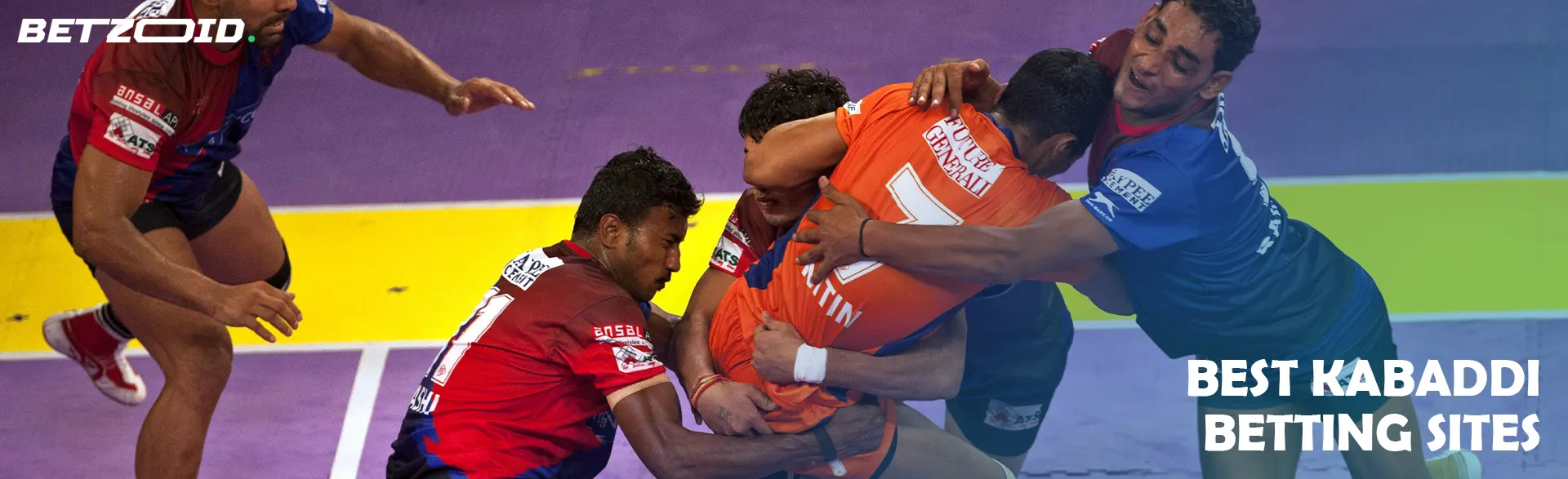

The gap between kabaddi betting sites worth an account and the ones that merely list fixtures shows up in two places: how many markets they open on a single Pro Kabaddi League match, and how fast rupees move in and out. A platform with nothing but match winner and total points is fine for a casual Sunday punt, but it leaves you stranded when a lead raider sits out the second half and the real value appears mid-game.
The Betzoid team built this comparison around what changes a decision for bettors in India: market depth per PKL fixture, native INR accounts with UPI and IMPS, the stated withdrawal windows for each payment method, whether an app exists for Android and iOS, and the wagering conditions buried in the welcome offer. Odds quality matters, but a strong price is worthless if the payout sits in review for days. The ranked operators appear below, and the sections that follow explain how to read each of those criteria for yourself.
Top Kabaddi Betting Sites in India (October 2026)







Which PKL Markets a Kabaddi Site Should Cover
A kabaddi sportsbook is only as useful as its second and third market. Match winner alone means you can back a result and nothing else — no reaction to a benched raider, no way to trade a defensive first half. The coverage below is what we treat as a reasonable baseline for a PKL fixture, and it also shows where the sharper prices tend to sit.
| Market | What it settles on | Why you would use it |
|---|---|---|
| Match winner | Result after the full 40 minutes | Baseline market with the tightest bookmaker margin |
| Points handicap | Result after a points head start is applied | Makes a mismatched fixture playable at a fairer price |
| Total points over/under | Combined points scored by both sides | Style-driven: defence-heavy sides suppress totals |
| Half-time lines | Leader or points at the 20-minute break | Short exposure and quick settlement |
| Raid and tackle points, player props | Individual raider or defender output | Where lineup knowledge pays, at wider margins |
Breadth on its own is not the whole test. Player markets usually open later than the team lines and are the first to be pulled when a lineup is unconfirmed, and they normally carry lower maximum stakes than match winner. So check two things on any site before the season starts: whether the props go live at least a couple of hours before the toss, and what the stake ceiling is on them. A site with fifteen markets you can only back for a few hundred rupees is less useful than one with eight you can bet properly.
Reading Decimal Odds on Raid Points
Decimal odds are the default on international platforms, and the arithmetic is one multiplication. Say a raider is priced at 2.50 to record 10 or more raid points: a ₹100 stake returns ₹250 in total, so ₹150 profit. Divide 1 by 2.50 and you get the implied probability, 40%. Your only job is to decide whether that raider clears the line more often than four times in ten against this particular defence. Also confirm how the site treats do-or-die raids and Super Raid points in its settlement rules, because that wording decides borderline bets.
Rupee Deposits and UPI on Kabaddi Betting Sites
Native INR accounts are the thing to insist on. When a site holds your balance in rupees, ₹2,000 in is ₹2,000 on screen, and no conversion spread quietly shaves a percentage off every deposit and every withdrawal. Platforms that take rupee deposits normally set minimums somewhere in the ₹100 to ₹500 range, though the floor often differs by method, so read the cashier page rather than the landing page.
- UPI — the default for most bettors: instant in practice, no fee at the bank's end, and the collect request appears in your usual app. Make sure the UPI ID belongs to the same name as your betting account.
- Paytm, PhonePe and Google Pay wallets — handy when a site's UPI handle is temporarily unavailable, which does happen; keep a second method registered so a deposit outage doesn't cost you a pre-match price.
- IMPS and NEFT bank transfer — slower to credit but reliable for larger amounts, and the bank statement entry is clean. NEFT can wait for banking hours, IMPS generally does not.
- Cards — accepted in places, but Indian issuers decline gambling merchants fairly often, and a declined card is the most common reason a first deposit fails.
- Crypto — available on several sportsbooks for bettors who prefer it; you take on the exchange step and price movement in return for fewer banking intermediaries.
UPI wins on speed and convenience, bank transfer wins on paperwork for bigger sums. One practical check before you fund anything: some welcome offers exclude specific methods from bonus eligibility, so confirm your chosen method qualifies. To see how an INR cashier and banking page are typically laid out before signing up anywhere, our 10Cric review walks through that part of the account in detail.
Withdrawal Times by Payment Method
Advertised payout speeds describe processing, not your first payout. The realistic order is crypto quickest, UPI and wallets usually within hours, bank transfer typically the next working day or two. What delays almost everyone is verification: the first withdrawal request triggers KYC, and if your Aadhaar or PAN upload is blurry or the name doesn't match the payment account, you wait for a second round of review. Do the KYC step right after registering, not on the night you want the money. Manual approvals on some sites still follow office hours, which is why a Friday evening request can sit until Monday.
Live Kabaddi Odds and In-Play Betting
Kabaddi suits in-play betting better than almost any other sport on an Indian sportsbook. Two 20-minute halves, a 30-second raid clock and an all-out swing of several points mean the market is never stable for long. A side trailing at the break can look completely different once a rested raider returns, and that is exactly the moment a pre-match price becomes obsolete.
Two features decide whether in-play kabaddi odds are usable at all. The first is suspension behaviour: a well-run market freezes during an active raid and reopens between raids, which is annoying but honest. The alternative — odds that stay open several seconds behind the action — usually ends in rejected bets or a price change on confirmation. The second is your stream. If you are watching broadcast television and betting on a site with its own feed, the two are rarely in sync, so treat your screen as the clock, not the TV.
Cash out, where offered, is priced with a margin built in, so it is a risk tool rather than a value play. If in-play is your main interest, compare sportsbooks on general live betting quality too, since a platform that handles a cricket over well usually handles a raid sequence well.
Android APKs vs iOS Kabaddi Betting Apps
Google Play restricts real-money betting apps in India, so Android users generally download an APK straight from the operator's own site and then allow installation from that source. Updates are manual — check the download page occasionally, because an outdated build is a common cause of live-odds lag. On iOS it splits: some operators list in the App Store, others hand you a web app you save to the home screen, which behaves almost identically. Only ever install from the operator's official domain; third-party APK mirrors are where fake builds live. Reading a full operator write-up first, such as our IndiBet review, tells you what to expect from the mobile side.
Where Kabaddi Betting Stands Legally in India
Online kabaddi betting sits in a grey zone rather than a clearly permitted or clearly criminal one. The central Public Gambling Act of 1867 predates the internet by well over a century and says nothing about placing a wager from a phone, and gambling is largely a state subject, which is why the answer changes depending on where you live.
Sikkim and Meghalaya have built their own licensing frameworks. Telangana and Andhra Pradesh prohibit online gambling outright, and other states have introduced or debated their own restrictions since, so the safest assumption is that your state law may have moved recently and needs checking rather than remembering. For most bettors the practical position is that offshore operators hold licences elsewhere and accept Indian customers; they are not regulated in India, which also means an Indian authority is not the place to take a dispute. That is the main reason licensing and complaint history matter more here than in markets with domestic regulators.
Two habits protect you regardless of state. Keep your own record of deposits and withdrawals, because that statement is your only evidence if an account is frozen. And treat winnings as taxable income and declare them — the tax position does not depend on where the operator is based. If you are still deciding where to bet on kabaddi in India, verify the licence number on the regulator's own register rather than trusting the logo in the site footer.
Setting Deposit and Session Limits
Every serious sportsbook keeps these tools in account settings, usually under "responsible gambling" or "limits", and the useful time to set them is before your first deposit clears. A weekly deposit cap — ₹5,000 is a common figure — is the simplest brake, because it works whether you win or lose. Loss limits and session reminders matter more for live betting, where a 40-minute match can turn into three hours of raid markets without you noticing. Cooling-off options typically run from 24 hours to permanent closure. Increases to a limit usually take effect only after a delay, which is the point.
Welcome Bonus Terms Worth a Second Look
A headline percentage tells you almost nothing. Two sites can both advertise a 100% match and produce completely different outcomes once the rollover rules apply, so read these five lines before you opt in anywhere.
- What the wagering multiplies — a rollover applied to bonus only is far easier to clear than the same number applied to deposit plus bonus, which silently doubles the turnover required.
- Minimum odds per qualifying bet — short favourites below the stated threshold usually contribute nothing, which rules out much of the safest side of a match-winner market.
- Whether kabaddi counts — some sportsbook offers are written around cricket or football and either exclude other sports or count them at a reduced rate; check that PKL markets qualify at full weight.
- Expiry window — a 7-day clock outside PKL season is nearly impossible to clear, while 30 days spanning a run of fixtures is workable.
- Maximum bet and max conversion — a stake cap while wagering limits how quickly you can turn over the balance, and a conversion ceiling caps what you can withdraw at the end.
Balance the size of the offer against those terms. A smaller match with bonus-only wagering and minimum odds of around 1.50 is frequently worth more in practice than a bigger one tied to deposit plus bonus. If clearing a rollover during a busy PKL week doesn't appeal, declining the bonus and keeping a withdrawable balance is a perfectly rational choice.
Placing Your First Bet on a PKL Match
The sequence below avoids the two classic first-timer problems: a blocked withdrawal caused by mismatched details, and a bonus accidentally attached to money you wanted to keep free.
- Pick a licensed operator and check the register. Copy the licence number from the footer into the regulator's own search. If a full breakdown helps you decide, our Crickex review covers the sportsbook side in depth.
- Register with details that match your bank. Same name, same spelling, same mobile number linked to UPI. Mismatches are the single most common reason a first payout stalls.
- Complete KYC immediately. Upload a clear Aadhaar or PAN image while you have nothing riding on it, rather than on the evening you want to cash out.
- Decide on the bonus before depositing. Opt in or opt out consciously, and confirm your deposit method is eligible if you want the offer.
- Fund the account with a small amount. ₹500 to ₹1,000 via UPI is enough to test the cashier, the odds feed and the app without meaningful risk.
- Open the kabaddi section and compare prices. It usually sits under Sports, or searching "kabaddi" gets there faster during PKL season when fixtures rotate daily.
- Start with match winner or a half-time line. Both settle cleanly and need no interpretation of raid-point rules while you are still learning the settlement wording.
- Check the return figure before confirming. The bet slip shows total return, not profit — ₹200 at 1.90 returns ₹380, so ₹180 profit.
- Request a small withdrawal early. Taking out ₹500 once verified tells you what the payout process feels like on that site.
That last step is the one most people skip, and it is the most informative. A sportsbook's deposit flow is designed to be frictionless; its withdrawal flow is where you learn whether the operator deserves a bigger balance later in the season.
Choosing between Pro Kabaddi League betting sites comes down to three things you can verify yourself: does the site open enough markets per fixture to let you react to a lineup change, does it hold your balance in rupees with UPI in and out, and do the bonus terms leave a realistic path to a withdrawable balance.
Use the ranking above as a shortlist, then confirm the licence number and the payout wording for your own payment method before you deposit. Set your deposit and session limits in account settings on day one — it takes a minute, and it is far easier while the PKL season is still ahead of you.